中文
|
English
Toggle navigation
Home
期刊主页
电子期刊
出版伦理
MENU
关于期刊
期刊介绍
编委会
开放获取政策
期刊荣誉
数据收录
影响因子
广告服务
联系我们
投稿指南
征稿简则
参考文献格式
综述要求
数据汇交
科学名称的规范用法
作者贡献角色分类
下载中心
版权协议
论文模板
在线期刊
最新录用
当期目录
过刊浏览
阅读排行
下载排行
引用排行
读者服务
期刊订阅
E-mail Alert
更多选择
期刊
DOI
请选择
菌物学报
起始年
结束年
请选择
1982
1983
1984
1985
1986
1987
1988
1989
1990
1991
1992
1993
1994
1995
1996
1997
1998
1999
2000
2001
2002
2003
2004
2005
2006
2007
2008
2009
2010
2011
2012
2013
2014
2015
2016
2017
2018
2019
2020
2021
2022
2023
2024
2025
2026
请选择
2026
2025
2024
2023
2022
2021
2020
2019
2018
2017
2016
2015
2014
2013
2012
2011
2010
2009
2008
2007
2006
2005
2004
2003
2002
2001
2000
1999
1998
1997
1996
1995
1994
1993
1992
1991
1990
1989
1988
1987
1986
1985
1984
1983
1982
卷
期
作者
作者单位
检索结果
期刊
Loading ...
出版年
Loading ...
表3 齐云山自然保护区2019年调查与本次调查相似性
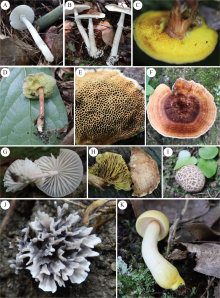
图4
齐云山自然保护区大型真菌中国特有种
A:裂皮鹅膏;B:袁氏鹅膏;C:重孔金牛肝菌;D:纤细金牛肝菌;E:菌索拟蜡孔菌;F:厚集毛孔菌;G:云南小奥德蘑;H:褐盖褶孔菌;I:双孢罗叶腹菌;J:干巴糙孢革菌;K:黄盖臧氏牛肝菌
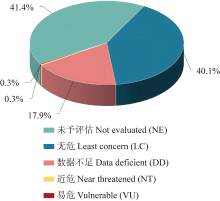
图3
齐云山自然保护区大型真菌物种濒危状况
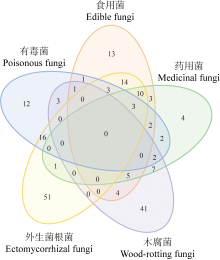
图2
齐云山自然保护区大型真菌资源评价维恩图
表2 齐云山自然保护区大型真菌属级分布类型统计
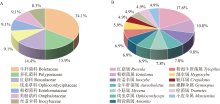
图1
齐云山自然保护区大型真菌优势科属饼状图
A:优势科;B:优势属
表1 齐云山自然保护区大型真菌物种组成
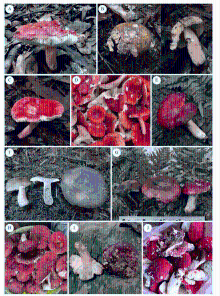
Fig. 5
Species similar in appearance to ‘dahongjun'. A: Russula griseocarnosa clade Ⅷ (HKAS 76051); B: R. griseocarnosa clade Ⅲ (HKAS 104808); C: R. dhakuriana (HKAS 104867); D: R. aff. lepida (HKAS 104840); E: R. cf. lepida (HKAS 104869); F: R. purpureozonata (HKAS 118314); G: Russula sp1 (HKAS 110297); H: R. quercina (HKAS 149469); I: Russula sp.2 (HKAS 104855); J: R. yanheensis (HKAS 104879).
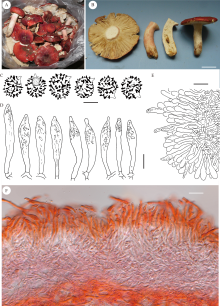
Fig. 4
Russula occulta (holotype). A: Basidiocarps sold in market, B: Basidiocarps, C: Spores, D: Pleurocystidia, E: Lamellar edge, F: Pileipellis. Bars: B=1 cm, C=5 µm, D=20 µm, E, F=25 µm.
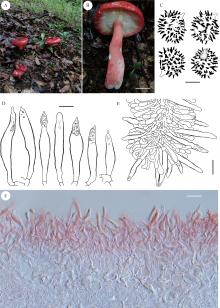
Fig. 3
Russula griseocarnosa var. ailaoshanensis (holotype). A: Basidiocarps in the habitat, B: Basidiocarp, C: Spores, D: Pleurocystidia, E: Lamellar edge, F: Pileipellis. Scale bars: B=2 cm, C=5 µm, D=20 µm, E, F= 25 µm.
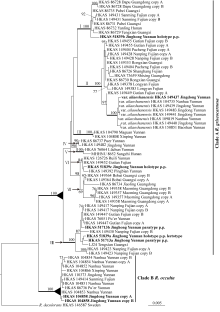
Fig. 2
Maximum likelihood phylogram generated from combined ITS-nrLSU-RPB1-RPB2-TEF1-α dataset of Russula griseocarnosa complex. The thick branches indicate independent evolutionary lineages and the triangles at the nodes two species recognized by genealogical concordance phylogenetic species recognition. Note that clades Ⅵ and Ⅶ are not evolutionary lineages. Sample names are given in the order of herbarium number, county name and province (autonomous region) name. Copy A and B refer to the different copies of ITS or other loci when ITS has only one copy. Samples in bold are types. The tree was rooted with R. decolorans.
Table 2 Maximum likelihood bootstrap value from the single-locus genealogies and five-locus combined phylogeny for each terminal clade of Russula griseocarnosa complex
Table 1 Samples sequenced in this study and used for investigating the species diversity of ‘dahongjun' and phylogenetic species recognition of the Russula griseocarnosa complex
Fig. 1
Maximum likelihood phylogram generated from combined ITS-nrLSU-RPB1-RPB2-TEF1-α dataset of Russula subgen. Russula. Red-highlighted samples are those under the local name ‘dahongjun'. Names of these samples are given in the order of herbarium number, county name and province (autonomous region) name. The tree was rooted with two species of R. subgen. Archaeae.
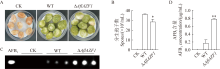
图8
AflAZF1影响黄曲霉侵染花生的能力
A:WT和ΔAflAZF1菌株在花生上的生长情况;B:WT和ΔAflAZF1在花生上产生分生孢子数量的定量分析;C:WT和ΔAflAZF1产生AFB
1
的薄层层析分析;D:WT和ΔAflAZF1产生AFB
1
含量的定量分析
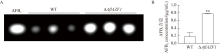
图7
AflAZF1负调控黄曲霉毒素AFB
1
的合成
A:WT和ΔAflAFZ1在YES培养基上产生黄曲霉毒素AFB
1
的薄层层析分析,AFB
1
为黄曲霉毒素标准品;B:WT和ΔAflAFZ1在YES培养基培养时AFB
1
含量的定量分析,将AFB
1
标品的浓度调整为1 μg/mL,利用GeneTools软件对毒素进行相对定量;下同
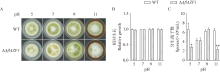
图6
AflAZF1调控黄曲霉适应酸碱环境的能力
A:WT和ΔAflAZF1在不同pH培养基上的生长情况;B:WT和ΔAflAFZ1菌落直径的统计分析;C:WT和ΔAflAZF1分生孢子数量的统计分析
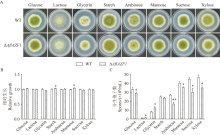
图5
AflAZF1调控黄曲霉的碳源利用过程
A:WT和ΔAflAZF1在不同碳源培养基上的生长情况;B:WT和ΔAflAZF1在不同的碳源培养基上第5天时菌落直径的统计分析;C:WT和ΔAflAZF1分生孢子数量的统计分析
图4
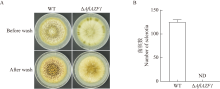
AflAZF1基因的缺失导致黄曲霉不能形成菌核
A:WT和ΔAflAZF1在YEPS培养基上菌核形成的情况;B:WT和ΔAflAZF1在第7天时菌核数量的统计分析. ND表示检测不到菌核
图3
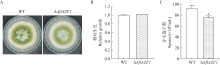
黄曲霉中AflAZF1对营养生长和分生孢子形成的影响
A:WT和ΔAflAZF1菌株的生长和产孢;B:WT和ΔAflAFZ1菌落直径的统计分析;相对生长=菌落直径/野生型菌落直径;C:WT和ΔAflAZF1产生的分生孢子统计分析;误差棒是表示5次重复的标准差,*表示P<0.05差异显著,**表示P<0.01差异极显著;下同
跳至
页
第1页
共146页
共2916条记录
首页
上一页
下一页
尾页