叶丽云, 林强, 刘梅, 吴小平
福建农林大学菌物研究中心 福建 福州 350002
YE Li-Yun, LIN Qiang, LIU Mei, WU Xiao-Ping
通讯作者:
收稿日期: 2016-01-22
接受日期: 2016-05-17
网络出版日期: 2017-02-22
版权声明: 2017 中国科学院微生物研究所《菌物学报》编辑部 版权所有
基金资助:
展开
摘要
灵芝多糖和三萜是灵芝主要的药理活性物质。如何提高液体发酵中灵芝多糖和三萜的含量是目前研究的热点。本研究以J-7/AL-2菌株为例,在灵芝的液体发酵中加入10mmol/L钙离子诱导,多糖含量比对照提高34%,三萜含量提高64%。在发酵液中加入150µmol/L水杨酸(SA)诱导,多糖含量提高57.54%,三萜含量提高37.19%。在灵芝的液体发酵第12天加入10mmol/L钙离子和150µmol/L水杨酸,三萜含量提高46.9%。在不同诱导条件下,三萜的高效液相图谱(HPLC)显示钙离子与对照的差异性比较大。灵芝三萜关键酶基因的表达也有所不同。水杨酸提高法尼基焦磷酸合酶(FPS)、鲨烯合酶(SQS)和羊毛兹醇合酶(LS)基因的表达量,而钙离子和钙离子与水杨酸共同处理提高3-羟基-3-甲基戊二酰辅酶A合酶(HMGS)、3-羟基-3-甲基戊二酰辅酶A转录水平还原酶(HMGR)、焦磷酸甲羟戊酸脱羧酶(MVD)、法尼基焦磷酸合酶(FPS)、鲨烯合酶(SQS)和羊毛兹醇合酶(LS)6个三萜关键酶基因的表达量。在3种处理下,都是SQS的基因表达量提高最多,推测SQS基因是灵芝三萜合成过程中重要的基因。
关键词:
Abstract
The pharmacologically active substances of Ganoderma lingzhi are mainly triterpenoids and polysaccharides. This study aims at improving the content of triterpenoids and polysaccharides in liquid fermentation by using G. lingzhi strain J-7/AL-2 as test material. The result showed that after inducement with 10mmol/L CaCl2 in G. lingzhi liquid fermentation, the content of polysaccharides and triterpenoids increased by 34% and 64% respectively as compared with that of the control. The content of polysaccharides and triterpenoids increased by 57.54% and 37.19% respectively after adding 150µmol/L salicylic acid (SA) to the fermentation broth. When SA (150µmol/L) and CaCl2 (10mmol/L) were simultaneously added to the liquid fermentation of Ganoderma lingzhi at twelfth day, the triterpenoid content by increased 46.9%. Detection with high performance liquid chromatography (HPLC) showed that under CaCl2 treatment the triterpenoid content was significantly different from that of the control. Under different induced conditions, the expression of key enzyme gene of triterpenoids was different. SA inducement could just enhance gene expression of three triterpenoid enmyzes including farnesyl pyrophosphate synthase (FPS), squalene synthetase (SQS) and lanosterol synthase (LS). CaCl2 and the combination of CaCl2 and SA could enhance gene expression of six triterpenoid enmyzes including 3-hydroxy-3-methylglutaryl-coenzyme A (HMGS), 3-hydroxy-3-methylglutaryl coenzyme A reductase (HMGR), mevalonate pyrophosphate decarboxylase (MVD), FPS, SQS and LS. The SQS gene expression was improved most significantly by three kinds of treatment. It was inferred that SQS might be an important gene in triterpenoid synthesis.
Keywords:
灵芝Ganoderma lingzhi Sheng H. Wu, Y. Cao & Y.C. Dai古称为瑞草,又名为赤芝、万年蕈、红芝、灵芝草等,在真菌的分类地位上属于担子菌门Basidiomycota,伞菌纲Agaricomycetes,多孔菌目Polyporales,灵芝科Ganodermataceae,灵芝属Ganoderma(Cao et al. 2012;戴玉成等 2013)。随着灵芝研究的不断深入进展,人们已经意识到灵芝的营养价值和药理作用,特别是对灵芝多糖和三萜类物质的开发。
灵芝中的三萜化合物是灵芝中一类主要的次生代谢产物之一,具有关键药理活性。余素萍等(2004)研究发现灵芝菌丝体三萜类成分在发酵后期才大量产生。赤芝中提取的三萜类化合物可以抑制肝癌细胞的生长,灵芝酸T具有诱导肺癌细胞凋亡的作用,灵芝酸β可以抑制HIV-1病毒活性(Toth et al. 1983;Tang et al. 2006;Min et al. 1998)。赤芝中提取的灵芝酸A对小鼠的肝脏有较好的保护作用,灵芝酸F可以通过抑制血管紧张素转化酶来达到降低血压的作用(王明宇等 2000;Morigiwa et al. 1986)。
灵芝是通过甲羟戊酸途径来合成灵芝酸的(Shiao 1992;Hirotani et al. 1990)。整个三萜合成过程涉及的关键催化酶包括3-羟基-3-甲基戊二酰辅酶A合酶(HMGS)、3-羟基-3-甲基戊二酰辅酶A转录水平还原酶(HMGR)、焦磷酸甲羟戊酸脱羧酶(MVD)、法尼基焦磷酸合酶(FPS)、鲨烯合酶(SQS)和羊毛兹醇合酶(LS)等(陈慧等 2015)。灵芝通过甲羟戊酸途径来合成三萜类化合物的过程中,受到许多酶的调控作用。而合适的诱导物可以提高三萜关键酶基因的表达,从而改变酶活性来达到提高三萜含量的目的。任昂等(2013)研究发现茉莉酸甲酯不但能显著提高灵芝酸的合成还能促进编码HMGR、FPS、LS等基因的表达量的提高。赵艳等(2011)对不同植物药的提取物诱导灵芝的作用进行研究,在她的结果中显示银杏的水提取对灵芝酸的合成有着明显的抑制作用。
灵芝多糖类化合物是灵芝中分离得到的另一类具有重要药用价值的化学成分。灵芝多糖种类多样,然而从灵芝多糖的组成来看,大多数灵芝多糖属于杂多糖(李荣芷和何云庆 1987)。灵芝多糖的主链是由许多葡萄糖单糖聚合而成的葡聚糖,大部分类型为β(1,3)-葡聚糖,少数类型为α(1,6)-葡聚糖。多糖链的立体结构为螺旋状,类似于DNA、RNA的构型,螺旋层之间以氢键相连来维持稳定(刘佳和王勇 2012)。大部分多糖可溶于水,且不溶于有机溶剂。
灵芝多糖的生物活性主要与分子质量、主链长度和分支程度有着密切的关系,研究表明,分子量越大,主链越长,分支越多的灵芝多糖的生物活性会比较高(殷勤燕 1996)。灵芝多糖具有十分广泛的药理活性。灵芝子实体中提取的多糖可以抑制Lewis肺癌和结肠癌,提高机体的免疫力(Miyazaki & Nishijima 1981);对细胞氧化损伤具有保护作用,具有一定的抗氧化活性(杨丽娟 2010);灵芝多糖可以显著地降低血压(黄智璇和欧阳蒲月 2009)。同时灵芝多糖还具有抗衰老、消除炎症和抗神经衰弱等其他作用。
目前市场上灵芝类产品层出不穷,主要包括灵芝子实体切片、灵芝孢子粉和灵芝提取物。市场对灵芝产品的需求不断扩大,这就需要我们对灵芝产品有进一步的开发。而如何提高灵芝的产量以及如何提高灵芝中有效成分的含量成为当前的热点。本研究应用高效液相色谱、荧光定量分析等方法来研究钙离子、水杨酸对灵芝三萜和多糖的诱导作用,比较三萜6个关键酶基因的表达量差异,以期为灵芝有效成分的进一步开发和利用奠定基础。
灵芝菌株J-7/AL-2由福建农林科技大学菌物研究中心提供,能正常出菇。
通过预实验得到最适钙离子浓度为10mmol/L。将平皿中的菌丝用9mm的打孔器取8块接入100mL液体PDA培养基中,称取0.111g CaCl2溶于1mL无菌水中,通过滤膜除菌分别在接种后的1-6d加入基础培养基中。28℃静置培养一周后收集菌丝进行检测。
通过预实验得到最适水杨酸浓度为150µmol/L。将平皿中的菌丝用9mm的打孔器取8块接入100mL液体PDA培养基中,28℃、150r/min摇床培养一周后,分别称取0.0207g溶于1mL乙醇,通过滤膜除菌加入含有9mL无菌水的离心管中,再将离心管中的溶液加入培养基中,使得培养基中水杨酸终浓度为150µmol/L。以加入1mL乙醇、9mL无菌水的培养基为对照。在诱导1-7d进行收集菌丝检测。确定最佳诱导时间a天。
将平皿中的菌丝用9mm的打孔器取8块接入100mL液体PDA培养基中,28℃、150r/min摇床培养一周后转静置培养,检测不同培养时间时菌丝三萜含量。确定三萜含量最高时的培养时间b天。
灵芝菌丝28℃、110r/min摇床培养一周后,转静置培养(b-7-a)天,用10mmol/L钙离子、150µmol/L水杨酸、10mmol/L钙离子和150µmol/L水杨酸进行诱导处理a天,收集菌丝,一部分用于三萜的检测,一部分保存于液氮中用于检测三萜关键酶基因的表达。
1.3.1 多糖的提取与检测:灵芝多糖的提取主要是用热水浸提法,参照田光辉等(2000)的方法并进行了改良。准确称取0.1g的灵芝菌丝粉末,置于10mL的离心管中加入蒸馏水进行90℃热水浸提4h。离心收集上清液,再重复提取一次,合并2次的提取液约4mL。将菌丝提取液和发酵液加入三倍的无水乙醇,进行醇沉过夜。然后5 000r/min离心10min,弃去上清液,所得沉淀用2mL蒸馏水溶解,最后用sevag法去除蛋白,吸取上层清液用蒸馏水定容至25mL。
多糖的检测采用苯酚硫酸法。取1mL样品溶液加入1mL的5%苯酚溶液,摇匀后快速加入5mL浓硫酸,摇匀后室温静置10min,再30℃水浴20min,最后冷却至室温,490nm检测OD值。
1.3.2 三萜的提取与检测:三萜的提取参考张志军等(2009)的方法。准确称取0.2g灵芝菌丝体粉末于小三角瓶中,并加入30mL的85%乙醇常温浸提2h,然后进行超声提取0.5h,功率为150W。将滤液用旋转蒸发仪60℃减压蒸馏去除乙醇,最后用甲醇定容至25mL,每组3个重复。
三萜的检测采用通过条件优化香草醛-冰醋酸法(刘海良 2008)。取0.2mL的样品溶液于具塞试管中,在60℃水浴锅中蒸干,加入0.4mL的5%香草醛-冰醋酸(现配现用)和1mL的高氯酸,摇匀后60℃水浴15min。冷却至室温后再加入5mL的冰醋酸,摇匀后室温静置0.5h,546nm检测OD值。
高效液相检测法。将提取液通过0.45µm的有机微孔过滤膜备用,以乙腈(A)-0.1%乙酸水(B)的梯度洗脱系统,检测波长为254nm,柱温40℃,流速为0.8mL/min,进样量为10µL。
1.3.3 三萜关键酶基因的检测:三萜关键酶基因的检测采用荧光定量PCR法中的Livak法。将诱导培养后收集的菌丝用Omega植物RNA提取试剂盒的方法提取RNA,核酸微量测定仪对提取的RNA进行浓度检测后,使用TransScript All-in-One First-Strand cDNA Synthesis SuperMix for qPCR试剂盒进行反转,荧光定量PCR检测使用伯乐试剂盒,以GADPH基因为内参基因,在BIO-RAD CFX96 PCR仪上运行。
数据分析采用Excel和SPSS软件;每个试验处理设计3个重复,结果以平均值±标准偏差表示。
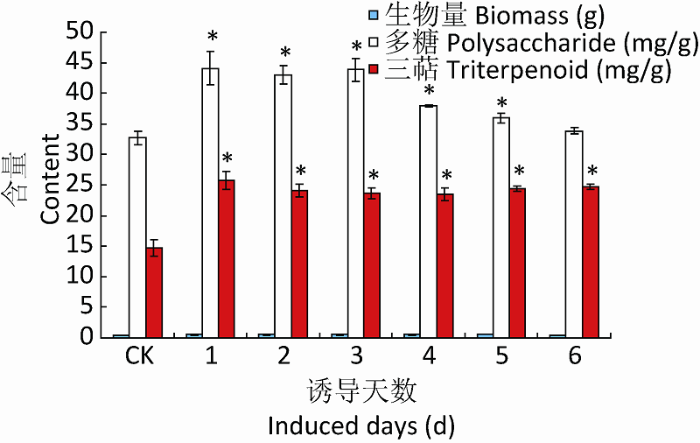
通过预实验发现10mmol/L的钙离子浓度比较适合灵芝液体发酵。本研究选用10mmol/L作为合适的浓度来研究钙离子不同添加时间对灵芝液体发酵的影响。结果显示不同时间添加钙离子灵芝生物量差异不显著,均为0.52mg左右。说明合适浓度钙离子诱导时,生物量不受钙离子添加时间的影响(图1)。但不同时间添加10mmol/L钙离子对灵芝多糖有影响。在前5天加入钙离子能显著提高灵芝菌丝的多糖含量,前3天加入钙离子效果更佳,灵芝菌丝多糖含量为(43.55±0.55)mg/g,比未添加的对照大概提高(33.15±1.65)%。而在第4天之后添加,灵芝多糖的含量有所降低。不同添加时间对灵芝三萜的影响结果显示:从第1天到第6天添加都能提高灵芝三萜含量,灵芝三萜的含量大约为(24.36±0.72)mg/g,比对照高出(67.62±7.89)%。而钙离子不同添加时间之间不存在显著性差异,说明无论第几天添加钙离子都能提高灵芝三萜含量(图1)。
图1 钙离子(浓度10mmol/L)不同添加时间对灵芝多糖和三萜的影响*表示与对照有显著差异,P<0.05
Fig. 1 The effects of different adding time of 10mmol/L calcium ion on polysaccharide and triterpenoids of Ganoderma lingzhi.* Indicates the significant difference between the experiment and the control with the P<0.05.
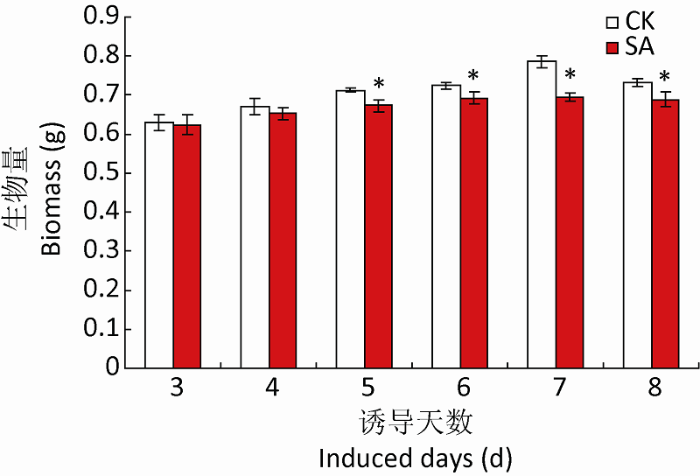
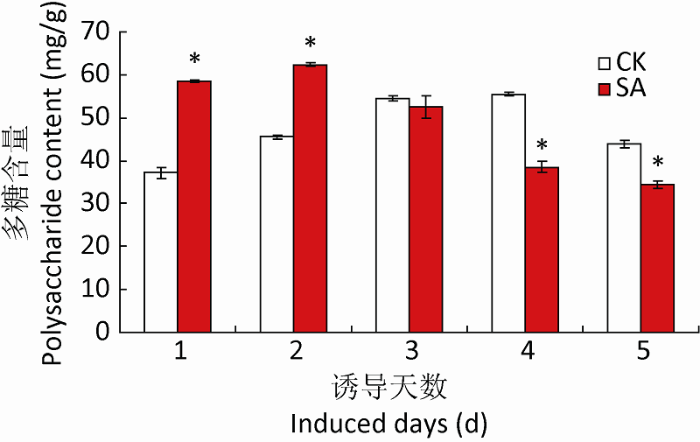
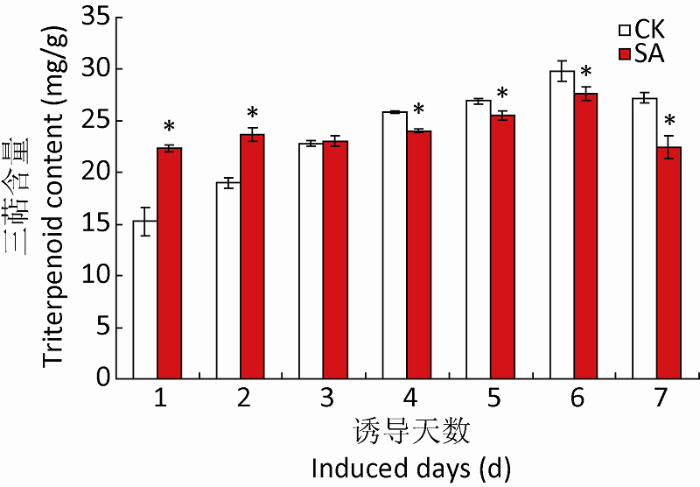
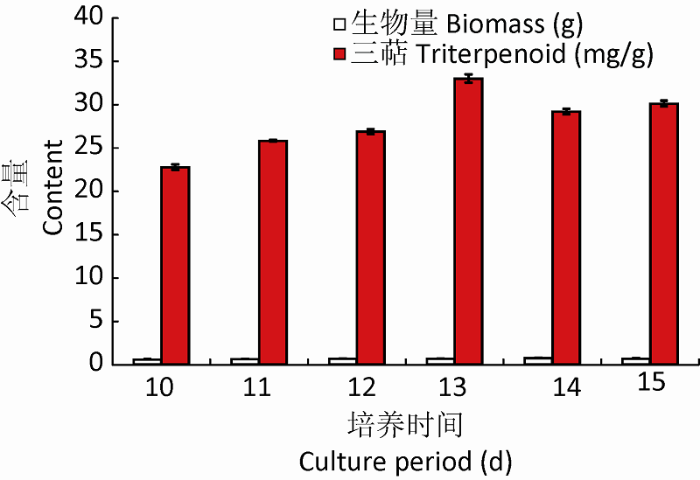
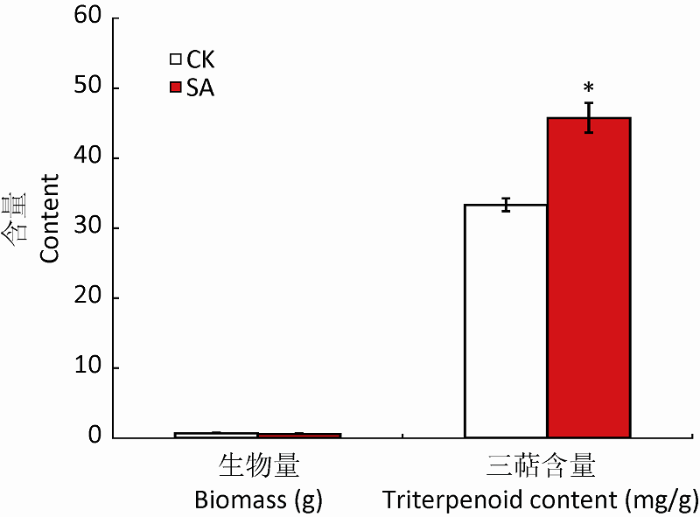
在灵芝摇床培养一周后,用150µmol/L水杨酸诱导菌丝,探究不同诱导天数对灵芝生物量的影响。结果显示,水杨酸诱导前4d对菌丝量没有显著影响,而从第5天开始对灵芝的菌丝量有一定的抑制,说明长期用水杨酸进行诱导会抑制菌丝生物量(图2)。对于灵芝多糖,水杨酸诱导处理后的前两天灵芝多糖的含量比对照分别提高57.54%、36.87%,然而随着诱导天数的增加却抑制灵芝多糖的合成(图3)。同样,在诱导后的前2天灵芝三萜的含量得到显著的提高,分别比对照高出46.1%和24.8%,但在诱导的后期,灵芝三萜的含量有所下降(图4)。同时,我们也探究不添加诱导物的情况下,灵芝菌丝摇床培养一周后转静置培养的时间对三萜含量的影响,发现在培养的第13天,即摇床培养7d,静置培养6d时,三萜含量达到最高值33.03mg/g(图5)。在第12天时添加水杨酸诱导处理,三萜含量为45.74mg/g,比对照组高37.19%(图6)。
图2 水杨酸(浓度150µmol/L)不同诱导时间对生物量的影响*表示与对照有显著差异,P<0.05
Fig. 2 The effects of different induction period of 150µmol/L salicylic acid on the biomass of Ganoderma lingzhi.* Indicates the significant difference between the experiment and the control with the P<0.05.
图3 水杨酸(浓度150µmol/L)不同诱导时间对灵芝多糖的影响*表示与对照有显著差异,P<0.05
Fig. 3 The effects of 150µmol/L salicylic acid different induction period on intracellular polysaccharide of Ganoderma lingzhi.* Indicates the significant difference between the experiment and the control with the P<0.05.
图4 水杨酸(浓度150µmol/L)不同诱导时间对灵芝三萜的影响*表示与对照有显著差异,P<0.05
Fig. 4 The effects of 150µmol/L salicylic acid different induction period on triterpenoids of Ganoderma lingzhi.* Indicates the significant difference between the experiment and the control with the P<0.05.
图5 不同培养时间对灵芝三萜的影响
Fig. 5 The effects of different culture period on triterpenoid content in Ganoderma lingzhi fermentation broth.
图6 菌丝培养第12天时水杨酸(浓度150µmol/L)诱导处理的影响*表示与对照有显著差异,P<0.05
Fig 6 The effects of 150µmol/L salicylic acid inducement at day 12 of culture on biomass and triterpenoid content of Ganoderma lingzhi.* Indicates the significant difference between the experiment and the control with the P<0.05.
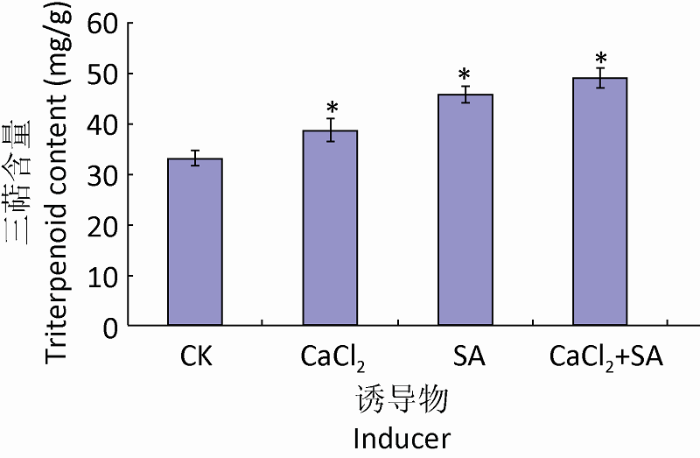
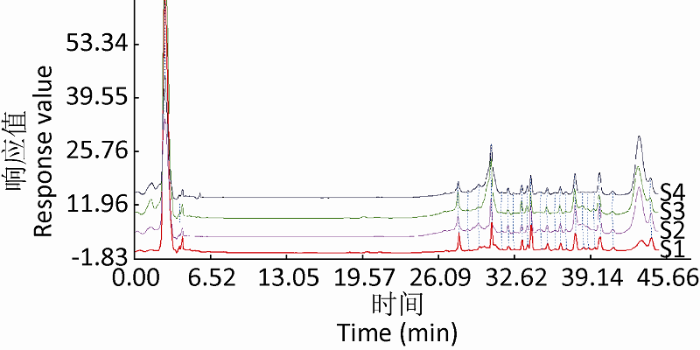
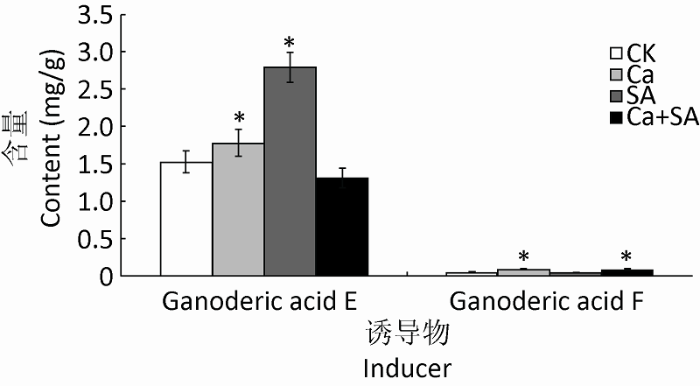
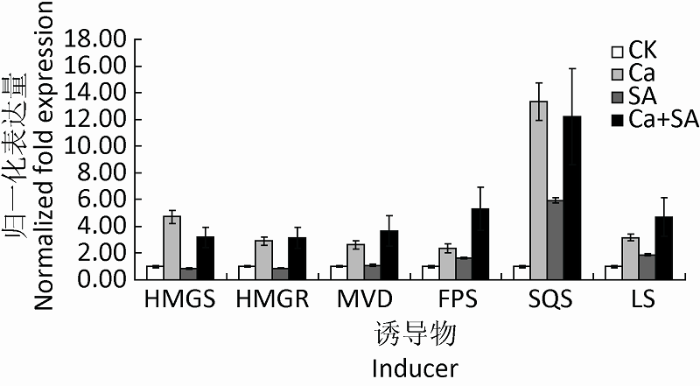
单独添加钙离子与水杨酸均能提高灵芝总三萜的含量,且钙离子的最适诱导浓度为10mmol/L,水杨酸的最适诱导浓度为150µmol/L。在此研究基础上,我们研究钙离子与水杨酸共同处理对灵芝三萜含量的影响。在用诱导物处理后的灵芝菌丝三萜含量比空白有显著的提高。钙离子与水杨酸共同处理的促进效果最佳,比空白对照提高46.9%,并且比单独添加钙离子的处理也提高26.78%左右,这说明钙离子与水杨酸共同处理能够进一步提高 灵芝三萜的含量(图7)。不同诱导物诱导灵芝三萜合成HPLC图谱可以看出添加诱导物的三萜图谱与空白对照既有相似性又存在着差异。其中在43min左右添加诱导物的3个图谱的峰值显著比对照的要大。CaCl2单独处理与对照差异显著(图8,表1)。同时,不同诱导物对灵芝酸单体(灵芝酸E和灵芝酸F)也有影响。CaCl2和SA单独诱导处理均能提高灵芝酸E的含量,且诱导效果显著。但CaCl2+SA处理却不利于灵芝酸E的合成,这可能是因为诱导子组合处理后某些诱导信号分子之间产生拮抗作用,导致诱导信号减弱,反而影响灵芝酸E的合成。而CaCl2单独处理和CaCl2+SA处理均提高灵芝酸F的含量,但是SA单独处理却对灵芝酸F的合成促进效果不显著。虽然SA提高灵芝总三萜的含量,但不是对每个灵芝酸单体都有促进作用(图9)。本研究还进一步用荧光定量检测不同诱导物处理下的灵芝三萜关键酶基因的表达量的变化(图10)。结果发现CaCl2单独处理和CaCl2+SA处理均提高6个三萜关键酶基因的表达量,而SA单独处理提高FPS、SQS和LS的表达量,对HMGS、HMGR和MVD的影响不大。其中3个诱导物对SQS基因表达量的提高最明显,说明SQS可能是在这诱导过程中起关键作用的三萜酶。
图7 不同诱导物对灵芝三萜的影响钙离子浓度为10mmol/L,水杨酸的浓度为150µmol/L.*表示与对照有显著差异,P<0.05
Fig 7 The effects of different inducer on triterpenoid content of Ganoderma lingzhi.Calcium ion concentration: 10mmol/L; Salicylic acid concentration: 150µmol/L.* Indicates that there is a significant difference between the experiment and the control with the P<0.05.
图8 不同诱导物诱导三萜HPLC图谱S1:未添加任何诱导物的对照;S2:添加10mmol/L钙离子诱导;S3:添加150µmol/L水杨酸诱导;S4:添加10mmol/L钙离子与150µmol/L水杨酸诱导
Fig. 8 HPLC fingerprint detection of triterpeniods under inducement of different inducer.S1: A control without any inducer; S2: Induced by 10mmol/L calcium ion; S3: Added with 150µmol/L salicylic acid; S4: Induced by 10mmol/L calcium ion combined with 150µmol/L salicylic acid.
表1 不同诱导物诱导三萜图谱相似度
Table 1 The similarity of triterpeniod fingerprints under inducement of different inducer
| 相似度比较 Similarity comparison | S1 | S2 | S3 | S4 |
|---|---|---|---|---|
| S1 | 1 | 0.562 | 0.942 | 0.782 |
| S1 | 1 | 0.725 | 0.813 | |
| S1 | 1 | 0.942 | ||
| S1 | 1 |
图9 不同诱导物对灵芝酸E、F含量(mg/g)的影响钙离子浓度为10mmol/L,水杨酸的浓度为150µmol/L. *表示与对照有显著差异,P<0.05
Fig. 9 The effects of different inducer on the content of ganoderic acid E and ganoderic acid F (mg/g).alcium ion concentration: 10mmol/L; Salicylic acid concentration: 150µmol/L. * Indicates the significant difference between the experiment and the control with the P<0.05.
图10 不同诱导物诱导下三萜关键酶基因的表达量钙离子浓度为10mmol/L,水杨酸的浓度为150µmol/L
Fig. 10 The expression levels of six key enzyme genes in triterpenoid biosynthesis under different inducer.Calcium ion concentration: 10mmol/L; Salicylic acid concentration: 150µmol/L.
灵芝是我国重要的药用真菌,其药理作用与灵芝次级代谢产物多糖和三萜等活性成分密切相关。随着研究的不断深入,工业上采取液体发酵生产次级代谢产物已取得很大的突破。在这个基础上,可以通过添加合适的外源诱导物来提高次级代谢产物。Fe和Zn两种元素均可提高灵芝中多糖和三萜的产量(陈志玲等 2009),Mg、K元素可以提高块菌多糖含量(Tang et al. 2008)。Yue & Zhong(2005)也发现Ca元素可以提高人参发酵培养基中人参皂苷含量。茉莉酸甲酯能提高灵芝三萜的含量(任昂等 2013),水杨酸的衍生物Aspirin可以诱导灵芝三萜的含量(You et al. 2013)。
本研究通过钙离子、水杨酸诱导作用,研究其对灵芝多糖和三萜含量的影响。结果显示不同时间添加钙离子对灵芝的生物量和三萜含量没有影响,但对灵芝多糖影响显著,且接种后前3天添加钙离子对多糖的诱导效果更显著。而150µmol/L浓度水杨酸不同诱导时间对灵芝多糖和三萜均有显著影响,在诱导的前期能促进灵芝多糖和三萜的合成,随着时间的增加作用减弱,甚至产生抑制作用。CaCl2、SA和CaCl2+SA 3种处理方式均能提高灵芝总三萜的含量,钙离子与水杨酸共同诱导处理的促进效果最佳,比空白对照提高46.9%。不同诱导物诱导灵芝三萜合成HPLC图谱既有相似性又存在着差异。
比较CaCl2、SA和CaCl2+SA 3种处理方式对灵芝酸E、F的影响,CaCl2和SA单独诱导处理均能提高灵芝酸E的含量,且诱导效果显著,而CaCl2单独处理和CaCl2+SA处理均提高灵芝酸F的含量。灵芝三萜在合成过程中受到很多相关酶的调控作用,检测其中6个关键酶基因的表达量,发现CaCl2单独处理和CaCl2+SA组合处理均提高6个关键酶基因的表达量,而SA单独处理提高FPS、SQS和LS的表达量。我们可以通过提高相关酶基因的表达量,从而促进灵芝三萜的高效合成。
| [1] |
Species clarification of the prize medicinal Ganoderma mushroom “Lingzhi”. |
| [2] |
Biosynthesis and fermentation control of triterpenoids from Ganoderma lingzhi.
|
| [3] |
Effect of some trace elements and vitamins on contents of polysaccharide and acid of Ganoderma lucidum .
|
| [4] |
Notes on the nomenclature of the most widely cultivated Ganoderma species in China.
|
| [5] |
Investigation of the biosynthesis of 3α-hydroxy triterpenoids, ganoderic acids T and S, by application of a feeding experiment using [1,2-13C2]acetate . |
| [6] |
Study on blood-sugar-lowering effect of Ganoderma lucidum polysaccharide.
|
| [7] |
Discussion on the thoughts and ways of the research on the active components of traditional Chinese medicine by the discovery of Ganoderma polysaccharides from Ganoderma lucidum .
|
| [8] |
Extraction and determination of ganoderic acid from submerged cultures of Ganoderma M-01.
|
| [9] |
Research progress on Ganoderma lucidum polysaccharide.
|
| [10] |
Triterpenes from the spores of Ganoderma lucidum and their inhibitory activity against HIV-1 protease. |
| [11] |
Studies on fungal polysaccharides. XXVII. Structural examination of a water-soluble, antitumor polysaccharide of Ganoderma lucidum. |
| [12] |
Angiotensin converting enzyme-inhibitory triterpenes from Ganoderma lucidum . |
| [13] |
The effect of methyl jasmonate on the biosynthesis of Ganoderma triterpenoids and the differential expression of the Ganoderma lucidum response gene.
|
| [14] |
Triterpenoid natural products in the fungus Ganoderma lucidum. |
| [15] |
Ganoderic acid T from Ganoderma lucidum mycelia induces mitochondria mediated apoptosis in lung cancer cells. |
| [16] |
Quantitative response of cell growth and Tuber polysaccharides biosynthesis by medicinal mushroom Chinese truffle Tuber sinense to metal ion in culture medium. |
| [17] |
Improvement on the extractive technique of polysaccharide of Ganoderma lucidium.
|
| [18] |
Les acides ganoderiques tàz: triterpenes cytotoxiques de Ganoderma lucidum (Polyporacée). |
| [19] |
Effects of triterpenoids from Ganoderma lucidum (Leyss. ex Fr.) Karst on three different experimental liver injury models in mice.
|
| [20] |
Protective effect of Ganoderma lucidum polysaccharides peptide on injury human umbilical vein endothelial cells induced by reactive oxygen species .
|
| [21] |
The status of anti-tumor effect of Ganoderma lucidum .
|
| [22] |
A novel approach to enhancing ganoderic acid production by Ganoderma lucidum using apoptosis induction.
|
| [23] |
Correlation between intracellular triterpenes from mycelia of Ganoderma lucidum in different growth stage and inhibition effect on tumor cells.
|
| [24] |
Impact of external calcium and calcium sensors on ginsenoside Rb1 biosynthesis by Panax notoginseng cells.
|
| [25] |
Optimized preparation method of triterpenoids from Ganoderma lucidum .
|
| [26] |
Effects of extracts from different phytomedicines on cell growth and intracellular triterpenoids formation of Ganoderma lucidum in submerged fermentation.
|
| [27] |
灵芝三萜的生物合成和发酵调控 . |
| [28] |
几种微量元素和维生素对灵芝多糖及灵芝酸含量的影响 . |
| [29] |
中国灵芝学名之管见 . |
| [30] |
灵芝多糖降血糖作用的研究 . |
| [31] |
从灵芝扶正固本有效成分灵芝多糖的发现讨论中药活性成分研究的思路和途径 . |
| [32] |
树舌灵芝发酵液中灵芝酸的提取及测定 . |
| [33] |
灵芝多糖的研究进展 . |
| [34] |
茉莉酸甲酯对灵芝三萜生物合成的影响及其灵芝应答基因的差异表达 . |
| [35] |
灵芝多糖提取工艺的优化 . |
| [36] |
灵芝三萜类化合物对3种小鼠肝损伤模型的影响 . |
| [37] |
灵芝多糖肽对人脐静脉内皮细胞氧化损伤的保护作用 . |
| [38] |
灵芝抗肿瘤作用的研究现状 . |
| [39] |
不同发酵阶段的灵芝菌丝三萜类成分与抗肿瘤作用的相关性研究 .
|
| [40] |
灵芝中三萜化合物提取工艺 .
|
| [41] |
不同植物药提取物对灵芝细胞生长和胞内三萜产物形成的影响 .
|



/
| 〈 |
|
〉 |