



植物内生真菌是指在生活史的一定阶段寄生在植物内部但不表现明显病害症状的一类真菌(Wilson 1995)。Carroll(1988)将内生真菌分为麦角菌类内生真菌(clavicipitaceous endophytes,C-endophytes)和非麦角菌类内生真菌(nonclavicipitaceous endophytes,NC- endophytes)两大类。
禾本科Poaceae是单子叶植物中仅次于兰科的第二大科,是种子植物中最有经济价值的大科,人类主要的粮食作物,如水稻Oryza sativa、小麦Triticum aestivum、玉米Zea mays、高粱Sorghum bicolor都是禾本科植物。目前全球有777属11 461种禾本科植物(
我国幅员辽阔,气候类型多样。纳板河流域国家级自然保护区位于云南西双版纳,所在区域属于热带雨林;百山祖国家级自然保护区地处浙江南部,所在区域属于中亚热带季风气候;锡林郭勒位于内蒙古中部,所在区域属于中温带半干旱大陆性气候。本研究选取纳板河流域国家级自然保护区、百山祖国家级自然保护区和锡林郭勒草原的30属禾本科植物,对根和地上部组织的内生真菌进行分离并鉴定,分析了内生真菌多样性和种群结构特征,为探究内生真菌与禾本科植物的互作关系奠定基础。
1 材料与方法
1.1 禾本科植物样品采集
从2015年到2019年的8-10月,在云南省西双版纳纳板河流域国家级自然保护区(N 22°04′-22°17′,E 100°32′-100°44′)采集20属主要禾本科植物,包括荩草属Arthraxon、地毯草属Axonopus、细柄草属Capillipedium、薏苡属Coix、香茅属Cymbopogon、马唐属Digitaria、穇属Eleusine、肠须草属Enteropogon、苞茅属Hyparrhenia、求米草属Oplismenus、稻属Oryza、黍属Panicum、金发草属Pogonatherum、钩毛草属Pseudechinolaena、甘蔗属Saccharum、囊颖草属Sacciolepis、狗尾草属Setaria、鼠尾粟属Sporobolus、粽叶芦属Thysanolaena和鼠茅属Vulpia,在浙江省百山祖国家级自然保护区(N 27°46′-27°58′,E 119°06′-119°15′)采集6属主要禾本科植物,包括Arthraxon、淡竹叶属Lophatherum、芒属Miscanthus、雀稗属Paspalum、狼尾草属Pennisetum和显子草属Phaenosperma,在内蒙古锡林郭勒(N 43°02′-44°52′,E 115°18′- 117°06′)采集5属主要禾本科植物,包括芨芨草属Achnatherum、冰草属Agropyron、隐子草属Cleistogenes、赖草属Leymus和针茅属Stipa。同种植物在同一地点采集3-5丛。
1.2 内生真菌分离
选取健康无病害症状的根、茎和叶,同种植物相同部位的组织均匀混合,将组织切成片段,每段长约10cm;依次用75%酒精和1%(有效氯)次氯酸钠表面消毒3min和10min,无菌水冲洗3次;用无菌手术刀将其切成约0.5cm长的小块组织,将小组织块置于含50mg/L氨苄青霉素和硫酸链霉素的MEA平板上,每平皿10个小组织块,每样品5个平皿,25℃黑暗培养,将组织块边缘长出的菌丝转接至PDA平板上培养,纯化并保存。
1.3 ITS1-5.8S-ITS2 rDNA序列测定及系统发育树构建
参照Chi et al.(2009)的方法,用研磨仪(上海净信实业发展有限公司,JXFSTPRP-24)快速提取真菌基因组DNA,研磨参数为60Hz和120s。核糖体内转录间隔区(internal transcribed spaces and 5.8S rDNA,ITS)采用引物对ITS-1/ITS-4(White et al. 1990)扩增,PCR扩增产物由浙江尚亚生物技术有限公司用ABI-3730XL测序仪进行测序。采用BLAST(Altschul et al. 1990)和MAFFT(Katoh & Standley 2013)对ITS序列进行基本序列比对和多重序列比对,用IQTREE(Trifinopoulos et al. 2016)以最大似然法(maximum likelihood,ML)建立系统发育树。
1.4 相对频率和多样性分析
内生真菌的组成结构采用相对频率(relative frequency,RF)进行定量描述。相对频率是某一分类水平的菌株数占总菌株数的百分比(Huang et al. 2008)。多样性采用ACE丰富度指数、Chao 1丰富度指数、Fisher’s Alpha多样性指数、Shannon多样性指数、Simpson Inv多样性指数和累加曲线进行描述,用Estimates v. 9.1.0(
2 结果与分析
2.1 内生真菌鉴定与种类组成
从云南西双版纳、浙江百山祖和内蒙古锡林郭勒的禾本科植物分离获得1 821株内生真菌,对本研究分离的内生真菌与已知的代表性真菌的ITS序列进行多重序列比对,对不同类群进行系统发育分析,构建ML树,并根据各类群系统发育分析结果和ITS预测真菌属的阈值——相似性得分94.3%(Vu et al. 2019),将1 821株内生真菌鉴定为3门10纲34目216属,其中1 751株内生真菌属于子囊菌门Ascomycota的5纲26目192属,57株内生真菌属于担子菌门Basidiomycota的3纲6目21属,13株内生真菌属于毛霉菌门Mucoromycota的2纲2目3属。
从不同分类水平比较禾本科植物内生真菌的种类组成,从门水平来看,在1 821株内生真菌中,属于子囊菌门的内生真菌占96.2%,其他2个门的内生真菌不到4%,可见子囊菌占绝大多数,担子菌和毛霉菌仅占少数。从纲水平来看,子囊菌门的粪壳菌纲Sordariomycetes和座囊菌纲Dothideomycetes是禾本科植物内生真菌的优势类群,分别占54.81%和30.86%,另外子囊菌门的散囊菌纲Eurotiomycetes的内生真菌也较多,占7.08%,其他7个纲的内生真菌不到8%。从目水平来看,座囊菌纲的格孢腔菌目Pleosporales和粪壳菌纲的肉座菌目Hypocreales、巨座壳目Magnaporthales、小丛壳目Glomerellales和炭角菌目Xylariales分离获得的相对频率较高,分别占26.7%、12.6%、12.1%、11.3%和9.9%,是禾本科植物内生真菌的优势类群。从属水平来看,在鉴定的216个属级分类单元中,分离频率大于2%以上的属有8个,包括7个已知属:Colletotrichum、Alternaria、Fusarium、Diaporthe、Penicillium、Arthrinium、Trichoderma和1个分类地位未定的属Pleosporales incertae sedis type 12(图1)。
图1
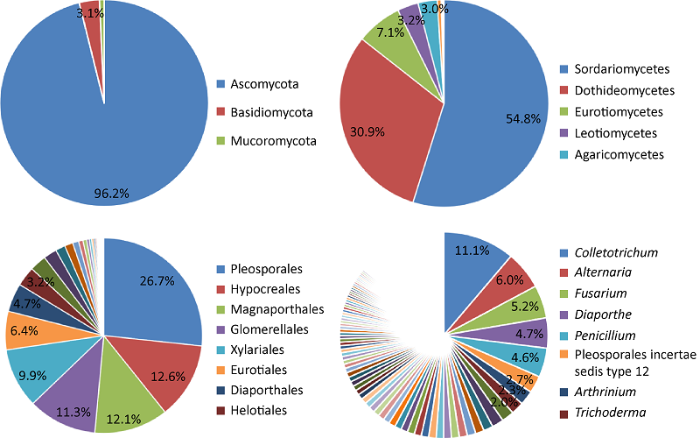
图1
禾本科植物内生真菌种类组成 小于3%的门、纲和目及小于2%的属未显示
Fig. 1
The composition of endophytic fungi from gramineous plants. Phyla, classes and orders less than 3% and genera less than 2% are not shown.
2.2 云南、浙江、内蒙古禾本科植物内生真菌比较与多样性分析
从门、纲和目水平对云南、浙江、内蒙古禾本科植物内生真菌进行比较。从门水平来看,云南、浙江、内蒙古禾本科植物分离获得的属于子囊菌门、担子菌门、毛霉菌门的内生真菌的相对丰度没有明显差异。从纲水平来看,云南、浙江、内蒙古禾本科植物内生真菌不同纲的相对丰度有明显差异。以占优势的子囊菌门内生真菌为例,粪壳菌纲、座囊菌纲、散囊菌纲的内生真菌从云南、浙江、内蒙古均可以分离到,而锤舌菌纲和盘菌纲仅从云南和浙江分离获得;2个优势纲在三地的相对丰度也有明显差异,云南和浙江的粪壳菌纲相对丰度明显高于内蒙古,而内蒙古的座囊菌纲相对丰度明显高于云南和浙江。从目水平来看,云南、浙江、内蒙古禾本科植物内生真菌不同目的相对丰度有明显差异,在6个优势目中,内蒙古的格孢腔菌目相对丰度明显高于云南和浙江,云南和浙江的巨座壳目、炭角菌目相对丰度明显高于内蒙古,云南的小丛壳目相对丰度明显高于浙江和内蒙古,内蒙古和浙江的散囊菌目的相对丰度明显高于云南,而肉座菌目在三地的相对丰度差异较小(图2)。
图2
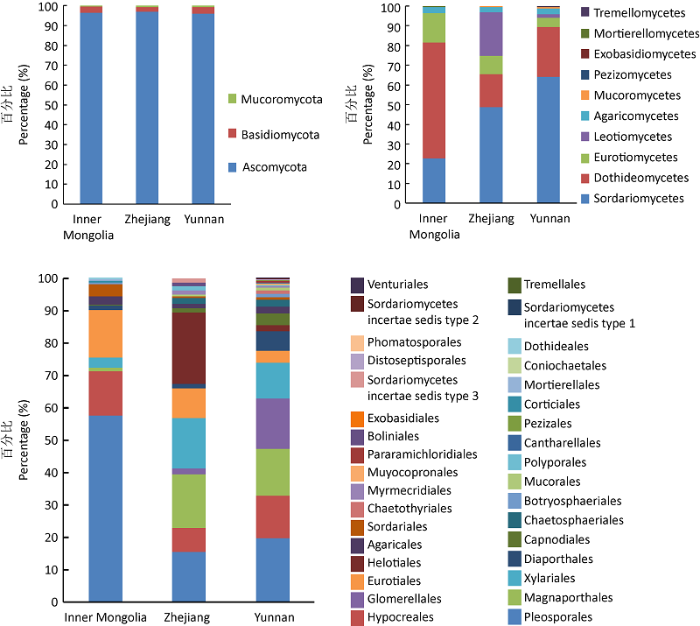
图2
云南、浙江、内蒙古禾本科植物内生真菌门、纲和目水平的相对丰度
Fig. 2
The relative abundance of endophytic fungi from gramineous plants in Yunnan, Zhejiang and Inner Mongolia at the phylum, class and order level.
从内生真菌属级多样性网络关系图可见,从云南、浙江、内蒙古禾本科植物分离获得的菌株属级差异大,在216个内生真菌属级分类单元中,三地共有的属仅7个,云南和浙江共有的属36个,云南和内蒙古共有的属15个(图3)。
图3
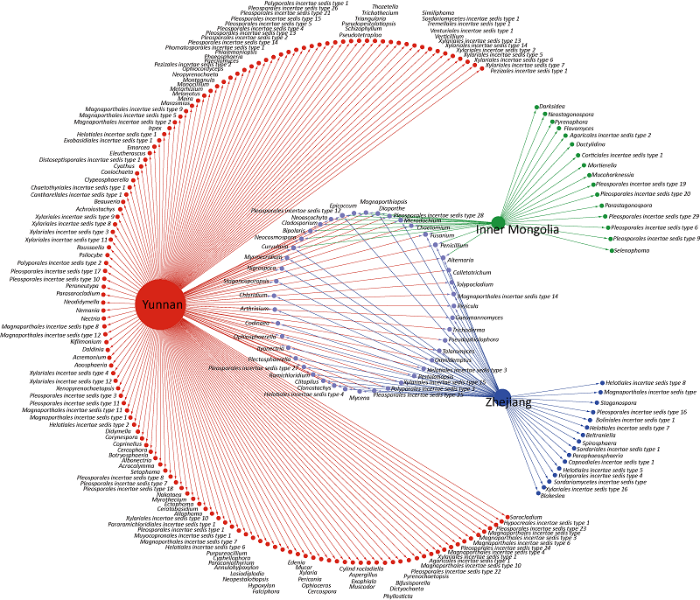
图3
云南、浙江、内蒙古禾本科植物内生真菌属级多样性网络关系图
Fig. 3
Network of endophytic fungal generic diversity from gramineous plants in Yunnan, Zhejiang and Inner Mongolia.
云南、浙江、内蒙古禾本科植物内生真菌属级多样性指数表明,样本的ACE丰富度指数、Chao 1丰富度指数、Fisher’s Alpha多样性指数、Shannon多样性指数、Simpson Inv多样性指数均表现为:云南>浙江>内蒙古,表明云南禾本科植物的内生真菌多样性程度高,内蒙古禾本科植物的内生真菌多样性程度低(表1)。
表1 云南、浙江、内蒙古禾本科植物内生真菌多样性指数
Table 1
| 采样地 Sampling site | ACE丰富度指数 Abundance coverage-based estimator of richness | Chao 1 丰富度指数 Chao 1 richness estimator | Fisher’s Alpha 多样性指数 Fisher′s Alpha diversity index | Shannon 多样性指数 Shannon diversity index | Simpson Inv 多样性指数 Simpson (inverse) diversity index |
|---|---|---|---|---|---|
| Yunnan | 277.77 | 277.77 | 58.37 | 4.23 | 26.87 |
| Zhejiang | 79.43 | 79.43 | 26.51 | 3.50 | 22.24 |
| Inner Mongolia | 34.99 | 34.99 | 8.19 | 2.50 | 7.19 |
Estimate S预测的云南、浙江、内蒙古禾本科植物内生真菌属级累加曲线表明,随着分离菌株数的增加,获得的内生真菌属的数量也增加。云南、浙江、内蒙古禾本科植物内生真菌属数为云南>浙江>内蒙古。从曲线趋势预测,如果增加分离菌株数,可增加获得的内生真菌属数云南>浙江>内蒙古,但增加幅度都不大,特别是内蒙古的累加曲线已经很平缓,表明可增加获得的内生真菌属数很少(图4)。
图4
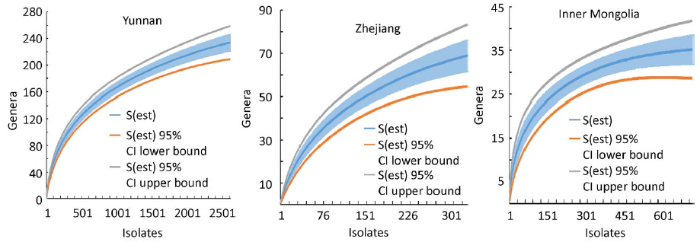
图4 云南、浙江、内蒙古禾本科植物内生真菌属累加曲线预测
Fig. 4 Accumulation curves of endophytic fungi from gramineous plants in Yunnan, Zhejiang and Inner Mongolia.
2.3 禾本科植物根部和地上部内生真菌比较与多样性分析
从根部和地上部内生真菌属级多样性网络关系图可见,禾本科植物根部和地上部分离获得的内生真菌属级差异大,在216个内生真菌属级分类单元中,根部有100个属,地上部有169个属,仅从根部分离的有47个属,仅从地上部分离的有116个属,根部和地上部共有的属仅53个(图5)。
图5
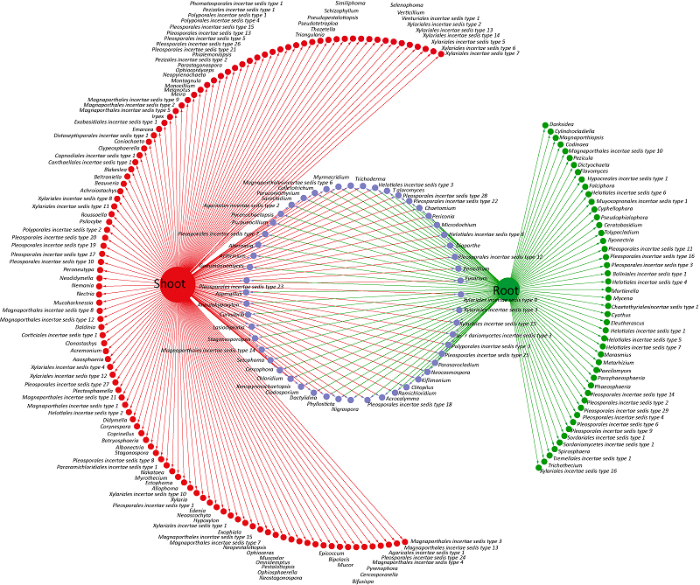
图5
禾本科植物根部和地上部内生真菌属级多样性网络关系图
Fig. 5
Network of endophytic fungal generic diversity from shoots and roots of gramineous plants.
表2 禾本科植物根和地上部组织内生真菌属级多样性指数
Table 2
| 取样部位 Sampling location | ACE丰富度指数 Abundance coverage-based estimator of richness | Chao 1 丰富度指数 Chao 1 richness estimator | Fisher’s Alpha 多样性指数 Fisher′s Alpha diversity index | Shannon 多样性指数 Shannon diversity index | Simpson Inv 多样性指数 Simpson (inverse) diversity index |
|---|---|---|---|---|---|
| Root | 140.99 | 140.99 | 33.87 | 3.77 | 24.02 |
| Shoot | 248.38 | 248.38 | 53.50 | 4.05 | 22.10 |
图6
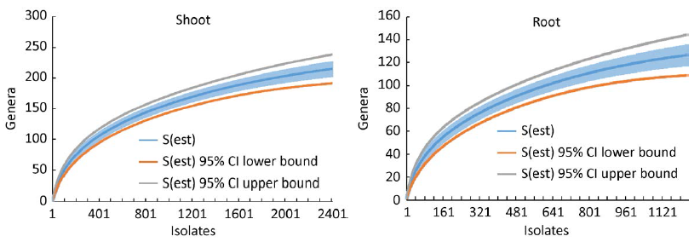
图6 禾本科植物根和地上部内生真菌属累加曲线预测
Fig. 6 Accumulation curves of endophytic fungi from roots and shoots of gramineous plant.
3 讨论
内生真菌的组成结构与地理区域有着密切联系。已有研究指出,低纬度地区植物内生真菌丰富度比高纬度内生真菌高;低纬度地区内生真菌以粪壳菌纲为主,高纬度地区以座囊菌纲为主(Arnold & Lutzoni 2007)。本研究对禾本科植物内生真菌的研究也发现多样性随着纬度的降低而增加,云南禾本科植物内生真菌多样性程度最高,浙江次之,内蒙古最低。不同纬度地区的内生真菌分布有明显差异,如粪壳菌纲总体上在云南和浙江的相对丰度明显高于高纬度的内蒙古,但从目级水平来看,不同目的分布有明显差异,巨座壳目、炭角菌目在云南和浙江的相对丰度明显高于内蒙古,小丛壳目在云南的相对丰度明显高于浙江,而内蒙古则没有,但肉座菌目在三地的相对丰度差异较小。从属级水平来看,禾本科植物的主要内生真菌,如Colletotrichum、Alternaria、Fusarium、Diaporthe、Penicillium、Arthrinium和Trichoderma,都是一些广泛分布的真菌,反映了这类内生真菌分布的广泛性,而这个分类地位未定的属Pleosporales incertae sedis type 12可能与宿主有着密切联系,因此有必要对其进行深入的研究。另外,个体数仅1个或2个(Singletons或Doubletons)等稀有内生真菌也占有比较高的比例(表3),且与内生真菌多样性程度一致,云南最多,浙江次之,内蒙古最少,如Mucoharknessia已知仅2个种少数几个菌株,其中M. anthoxanthi从意大利禾本科植物黄花茅 Anthoxanthum odoratum(Li et al. 2016)、鸭茅Dactylis glomerata分离得到(Li et al. 2020),M. cortaderiae从阿根廷禾本科植物蒲苇Cortaderia selloana分离得到(Crous et al. 2015)。本研究从内蒙古禾本科植物冰草A. cristatum分离到属于Mucoharknessia的2个菌株,可见至少部分分离个体数较少的内生真菌可能具有较高的宿主或地理的专一性。因此调查不同分布区域的禾本科植物内生真菌将丰富我们对禾本科植物内生真菌多样性的认识。
表3 云南、浙江、内蒙古禾本科植物的稀有内生真菌
Table 3
| 采样地 Sampling site | 单个 Singletons | 双个 Doubletons |
|---|---|---|
| Yunnan | 69 | 24 |
| Zhejiang | 24 | 9 |
| Inner Mongolia | 8 | 6 |
宿主植物不同组织的内生真菌组成结构也有明显差别。本研究发现Darksidea、Cylindrocladiella、Magnaporthiopsis、Codinaea、Pezicula、Dictyochaeta、Flavomyces和分类地位未定的Magnaporthales incertae sedis type 10等47个属仅从根部分离得到,其中有些属是禾本科植物根部发现的暗色有隔内生真菌,如Darksidea、Flavomyces从匈牙利半干旱草原(N46°52′,E19°25′)的主要植物:小花针茅Stipa borysthenica、细柄羊茅Festuca vaginata和旱雀麦Bromus tectorum根部分离(Knapp et al. 2015);Falciphora从我国云南西双版纳疣粒稻Oryza granulata根部分离(Yuan et al. 2010);有些属是禾本科植物根部发现的病原真菌,如Magnaporthiopsis是从西伯利亚剪股颖Agrostis stolonifera、Zea mays、硬羊茅Festuca brevipila、草地早熟禾Poa pratensis、Panicum和Triticum等禾本科植物根部分离的病原菌(Luo & Zhang 2013),如Magnaporthiopsis meyeri-festucae引起草地早熟禾夏季斑枯病(Luo et al. 2017)。Cercospora、Neostagonospora、Bifusisporella、Pyrenophora、Pestalotiopsis、Omnidemptus、Mucor、Muscodor和分类地位未定的Magnaporthales incertae sedis type 13、Magnaporthales incertae sedis type 3、Pleosporales incertae sedis type 24、Agaricales incertae sedis type 1、Magnaporthales incertae sedis type 4、Magnaporthales incertae sedis type 15等116个属仅在地上部发现,Cercospora、Pestalotiopsis的大多数种在植物地上部侵染引起植物病害,已知的Omnidemptus种是从禾本科、番杏科植物叶片分离的病原真菌(Cannon & Alcorn 1994;Hernández-Restrepo et al. 2019),Bifusisporella是从巴西高粱叶片分离的内生真菌(Silva et al. 2019),已报道的Muscodor种是植物地上部的内生真菌(Chen et al. 2019),Neostagonospora是莎草科植物Carex acutiformis、帚灯草科植物Elegia cuspidata叶片上的病原真菌(Quaedvlieg et al. 2013)。可见根和地上部两个不同的生态位对内生真菌种群产生了明显的影响。
参考文献
Basic local alignment search tool
Diversity and host range of foliar fungal endophytes: are tropical leaves biodiversity hotspots?
Omnidemptus affinis gen. et. sp. nov., teleomorph of Mycoleptodiscus affinis sp. nov
Fungal endophytes in stems and leaves from latent pathogen to mutualistic symbiont
Confirming the phylogenetic position of the genus Muscodor and the description of a new Muscodor species
Poaceae (Gramineae)
A quick and safe method for fungal DNA extraction
Resolving Tiarosporella spp. allied to Botryosphaeriaceae and Phacidiaceae
Re-evaluation of Mycoleptodiscus species and morphologically similar fungi
Biodivesity of endophytic fungi associated with 29 traditional Chinese medicinal plants
MAFFT multiple sequence alignment software version 7: improvements in performance and usability
Dark septate endophytic pleosporalean genera from semiarid areas
Fungal diversity notes 253-366: taxonomic and phylogenetic contributions to fungal taxa
Taxonomy and phylogeny of hyaline-spored coelomycetes
Magnaporthiopsis meyeri-festucae, sp. nov., associated with a summer patch-like disease of fine fescue turfgrasses
Magnaporthiopsis, a new genus in Magnaporthaceae (Ascomycota)
Sizing up Septoria
Bifusisporella sorghi gen. et sp. nov. (Magnaporthaceae) to accommodate an endophytic fungus from Brazil
W-IQ-TREE: a fast online phylogenetic tool for maximum likelihood analysis
Large-scale generation and analysis of filamentous fungal DNA barcodes boosts coverage for kingdom fungi and reveals thresholds for fungal species and higher taxon delimitation
Endophytic fungi resources and species diversity in grass family
Amplification and direct sequencing of fungal genes for phylogenetics
In: Innis MA, Gelfand DH, Sninsky JJ, White TJ (eds.)
A new species of Harpophora (Magnaporthaceae) recovered from healthy wild rice (Oryza granulata) roots, representing a novel member of beneficial dark septate endophyte
Identity, diversity and molecular phylogeny of the endophytic mycobiota in rare wild rice roots (Oryza granulata) from a nature reserve in Yunnan, China