


线粒体是细胞中重要的能量代谢场所,为生物体正常生命活动提供必要的能量和中间代谢产物。线粒体电子传递链不仅能产生能量物质三磷酸腺苷(adenosine triphosphate,ATP),还是细胞内活性氧(reactive oxygen species,ROS)的重要来源(刘树森 2008)。逆境胁迫会引起呼吸代谢的紊乱(Vanhoudt et al. 2011 ;Tulah & Birch-Machin 2013),造成活性氧的积累。在生命科学及分子医学领域已经发现线粒体ATP的合成和活性氧生成两者的动态平衡和调控对生物的生存、发育、衰老、疾病和死亡有关键意义(Wallace 2005;Navarro & Boveris 2007)。活性氧积累引起氧化应激,导致DNA、蛋白质、脂质等细胞大分子的损伤(Gill &Tuteja 2010;Miller et al. 2010 )。为缓解活性氧造成的伤害,一系列抗氧化酶如过氧化物酶(POD)、超氧化物歧化酶(SOD)、过氧化氢酶(CAT)等发生应激变化以清除过氧化物、超氧阴离子自由基的伤害(Rodriguez & Redman 2005)。
高温是限制生物体生长发育的主要非生物胁迫因子之一。高温胁迫下抗氧化与活性氧的相关性和作用机理方面的研究多集中在动植物及一些低等丝状真菌上。近年来在食用菌方面的研究也逐渐受到关注,Wang et al.(2017a) 、闫苗等(2018)、周莎莎等(2018)分别研究了高温胁迫下糙皮侧耳Pleurotus ostreatus(Jacq.) P. Kumm.、刺芹侧耳Pleurotus eryngii (DC.) Quél.、香菇Lentinula edodes (Berk.) Pegler的CAT、SOD、POD抗氧化酶系统的响应,关于高温胁迫下食用菌线粒体功能与活性氧及抗氧化酶系统响应之间的相关性很少报道。除高温胁迫下的抗氧化机制研究之外,还有一些学者研究了高温胁迫下食用菌的代谢物和代谢途径变化。Zhao et al.(2019) 发现香菇响应高温胁迫的代谢途径与氨基酸代谢、糖酵解途径、三羧酸循环和其他糖代谢相关的变化。Yan et al.(2020) 应用代谢组学技术检测高温对糙皮侧耳菌丝胞内代谢物的影响,发现高温胁迫加速糙皮侧耳菌丝糖酵解和三羧酸循环,增强脂肪酸分解,增加氨基酸和维生素的含量及增加抗胁迫物质的合成。高温胁迫对双孢蘑菇代谢途径的影响还未见报道。
双孢蘑菇Agaricus bisporus (J.E. Lange) Imbach是世界上种植最广泛、消费量最高的食用菌之一(Siwulski et al. 2020 )。双孢蘑菇属于稳温结实性的菌类,在菌丝生长阶段的最适温度是25℃,至出菇阶段温度需要降至16-17℃,温度的控制是影响蘑菇产量及质量的重要因素。受温度影响,传统蘑菇栽培的生产季节和产量受到了制约。在现代化菇房种植中,自动化的控温措施使双孢蘑菇的周年化生产成为可能,但是控温培养提高了栽培的成本,这一问题在我国南方地区尤为突出。筛选和培育耐高温菌株,将有助于降低生产成本,提高工厂化栽培效益。
本课题组在前期工作中,筛选获得了双孢蘑菇工厂化菌株A15的温度致死条件为40℃处理24h。在此基础上,收集A15孢子并制作孢子悬浮液,将涂有孢子悬浮液的平板置于25℃暗处培养,当菌落肉眼可见时,将平板置于40℃处理24h后转移至25℃继续暗处培养,对能继续生长的单菌落进行分离、筛选,得到了一株耐高温菌株A15-TH。本研究以二者为研究对象,从氧化损伤修复及基础碳代谢-糖酵解途径两个角度探索双孢蘑菇对高温胁迫的响应及耐热机理,对培育耐温、高产、优质的菌株具有重要的理论和实践意义。
1 材料与方法
1.1 材料
1.1.1 供试菌株:双孢蘑菇工厂化生产菌株A15来自美国,由上海市农业科学院食用菌研究所菌种保藏中心提供。A15-TH为实验室选育的耐高温菌株。
1.1.2 培养基及试剂:PDA培养基:马铃薯200g、葡萄糖20g、琼脂20g,pH自然。121℃灭菌20min后备用。
1.2 方法
1.2.1 处理方法:将保藏的A15和A15-TH试管菌种分别转接到PDA培养基平板上进行活化,菌种活化后将直径6mm的菌块接种在平板中央。接种后的平板于25℃黑暗培养3d,取出部分平板40℃热胁迫处理0、30、60、90和120min后继续25℃培养5d,测定菌丝生长速度。剩余平板继续于25℃黑暗培养7d,用40℃热胁迫处理0、30、60、90和120min后进行ATP、超氧阴离子、过氧化氢含量的测定,线粒体复合物I、II、III活性的测定以及抗氧化酶活性和抗氧化酶基因表达的测定。所有测定每个处理均设3个重复。
1.2.2 菌丝生长速度测定及菌丝形态观察:测定热胁迫处理不同时间A15和A15-TH的菌丝生长速度,同时观察菌丝生长状态,并在倒置荧光显微镜40×条件下观察菌丝的微观形态。
1.2.3 ATP、超氧阴离子、过氧化氢含量测定:收集热胁迫处理不同时间A15和A15-TH的菌丝,参照苏州科铭生物科技股份有限公司的试剂盒说明书测定ATP、超氧阴离子、过氧化氢含量。
1.2.4 线粒体复合物I、II、III活性测定:收集热胁迫处理不同时间A15和A15-TH的菌丝,参照苏州科铭生物科技股份有限公司的试剂盒说明书测定线粒体复合物I、II、III活性。
1.2.5 抗氧化酶测定:取2g不同处理的菌丝样品用液氮研磨后置于冰上加9mL生理盐水,然后在4℃、3 000×g离心10min取上清液,参照Zhang et al.(2017) 的方法和原理测定超氧化物歧化酶(SOD)和过氧化氢酶(CAT)的活性。
1.2.6 抗氧化酶基因差异表达:参照郝海波等(2021)的方法,收集不同处理的菌丝样品,放入液氮预处理5min后再将样品转移-80℃保存待用。将样品送入上海凌恩生物技术有限公司进行转录组测序和分析。出发菌株A15和耐高温菌株A15-TH的转录组数据都上传至NCBI,转录组登录号分别为SRR11613694-SRR11613708和SRR11622621- SRR11622632。利用生物信息学的方法对转录组结果进行分析,筛选获得2个sod基因(sod1-gene6419,sod2-gene8210)和3个cat基因(cat1-gene8986,cat2-gene2158,cat3- gene2159),并对其表达量进行分析和作图。
1.3 统计学分析
采用Excel进行数据处理,用origin 9.0对数据进行作图,并在SPSS 22.0上进行Duncan多重比较分析,P<0.05为组间差异具有统计学意义。
2 结果与分析
2.1 高温胁迫下双孢蘑菇菌丝生长及显微形态
图1
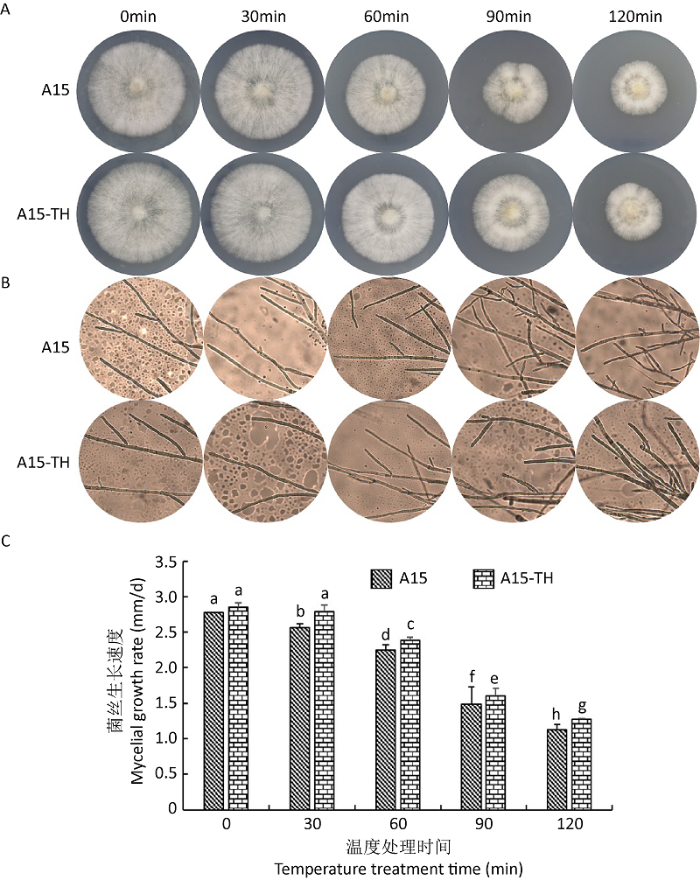
图1
高温胁迫对双孢蘑菇菌丝生长和形态的影响
不同小写字母表示差异显著性(P<0.05). A:PDA平板上菌落生长形态;B:荧光显微镜下菌丝的微观形态(40×);C:菌丝生长速度
Fig. 1
Effects of heat stress on the growth and morphology of mycelia of Agaricus bisporus. Different lowercase letters indicate a significant difference at P<0.05.
A: Morphology of colony on PDA plate; B: Morphology of mycelia under fluorescence microscope (40×); C: Mycelial growth rate.
2.2 高温胁迫下双孢蘑菇氧化损伤及抗氧化系统响应
线粒体不仅是ATP合成的场所,同时也是生成ROS的主要部位。在线粒体中,电子传递链的复合物I和复合物III是ROS产生的主要位点(Chen et al. 2003 ;Nohl et al. 2004 ;Navarro & Boveris 2007)。本研究分别测定了对照菌株和耐高温菌株在高温胁迫下ATP的含量,比较了与活性氧生成相关的线粒体复合物I、II、III的活性,并对超氧阴离子(O2-)和过氧化氢(H2O2)的含量进行了分析,结果见图2。
图2
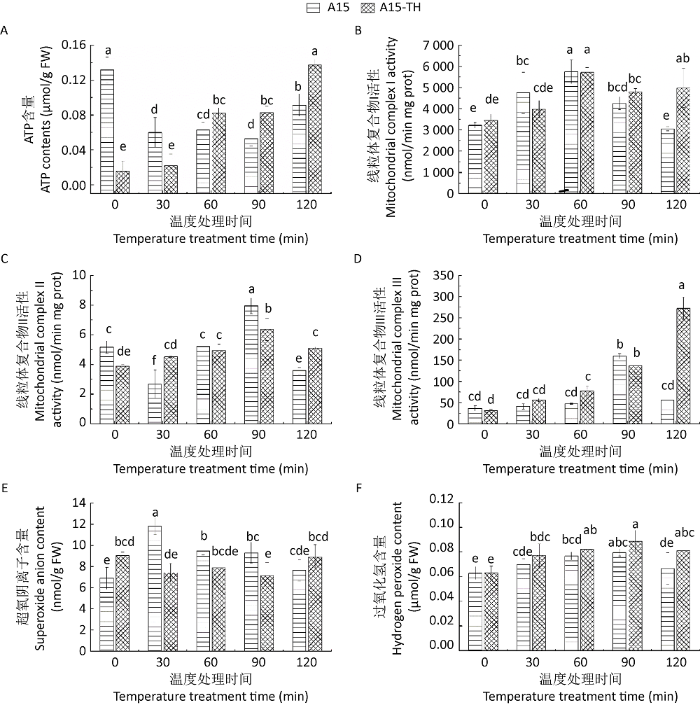
图2
高温胁迫对双孢蘑菇线粒体功能及活性氧含量的影响
不同小写字母表示差异显著性(P<0.05);A:ATP含量;B:线粒体复合物I活性;C:线粒体复合物II活性;D:线粒体复合物III活性;E:超氧阴离子含量;F:过氧化氢含量
Fig. 2
Effects of heat stress on the mitochondrial function and the reactive oxygen species (ROS) content of Agaricus bisporus.
Different lowercase letters indicate a significant difference at P<0.05. A: ATP content; B: Mitochondrial complex I activity; C: Mitochondrial complex II activity; D: Mitochondrial complex III activity; E: Superoxide anion content; F: Hydrogen peroxide content.
对照菌株A15在高温胁迫30、60、90min时,ATP的含量由正常状态的0.13µmol/g鲜重降低至0.05-0.06µmol/g,降低了54.4%-59.6%(图2A),线粒体复合物I、II、III活性呈增加或者先降低再增加的趋势(图2B-2D)。在正常的氧化还原循环中,A15每克菌丝产生6.9nmol的超氧阴离子自由基(O2-);热激30min后,超氧阴离子含量迅速上升至11.8nmol;随着高温处理时间的延长,菌丝抗氧化系统启动,O2-含量逐渐降低,但仍未能恢复至正常水平(图2E),这说明热激后线粒体呼吸链ATP合成和活性氧生成的平衡被打破,机体产生应激反应。在高温胁迫120min时,对照菌株线粒体复合物I、II、III活性的降低可能与高温胁迫导致线粒体功能障碍有关。耐高温菌株A15-TH在没有受到高温胁迫的正常状态下ATP的含量仅为照菌株10%左右,超氧阴离子O2-的含量比对照菌株高30.7%。受到高温胁迫时,耐高温菌株ATP合成量增加,同时超氧阴离子含量并没有在生物体内累积。在高温胁迫30、60、90min时(图2B、2D),耐高温菌株线粒体复合物I、III活性与对照菌株并没有显著差异;至高温胁迫120min时,A15-TH的线粒体复合物I、III活性并没有像对照菌株一样出现大幅度降低,线粒体复合体III活性反而大幅度增加,说明耐高温菌株的线粒体仍在进行正常的应激响应。高温胁迫下,对照菌株和耐高温菌株的过氧化氢(H2O2)含量都呈现先增加(30-90min)后降低(120min)的趋势,但并不显著;且同样的温度处理时间下,耐高温菌株的H2O2含量均高于出发菌株,高温处理120min时呈显著差异 (图2F)。
为缓解超氧阴离子O2-和过氧化氢H2O2积累造成的伤害,双孢蘑菇抗氧化系统启动并发挥作用。在抗氧化过程中,超氧化物歧化酶(SOD)和过氧化氢酶(CAT)是两种最有效的抗氧化酶(Elstner 1982;Madasamy et al. 2014 ;Chakravarthy et al. 2016 ;Wang et al. 2017c )。超氧化物歧化酶(SOD)催化O2-变成H2O2和分子氧,过氧化氢酶(CAT)将H2O2分解为氧气和水,从而减轻了超氧自由基和过氧化氢对细胞的伤害。
图3A表明,高温胁迫下,对照菌株A15 的超氧化物歧化酶(SOD)的酶活性受到抑制,酶活性降低了28.3%-33.6%;而耐高温菌株A15-TH在不同的热处理时间下,均能保持较高的SOD活性,有利于O2-的去除,缓解氧化损伤。进一步比较了超氧化物歧化酶基因相对表达量(图3B、3C)。高温胁迫下,对照菌株A15和耐高温菌株A15-TH的sod1和sod2相对表达量随热处理时间的延长均出现先下调后又上调的趋势。热胁迫对sod1基因相对表达量的影响更为显著,热处理30-90min时,基因相对表达量下调了51%- 57%,热处理120min略有上调;热胁迫90min对sod2基因相对表达量影响最为显著,下调了约40%。耐高温菌株A15-TH在正常状态下及热胁迫时,sod1和sod2的基因相对表达量稍高于对照菌株,但差异不显著。
图3
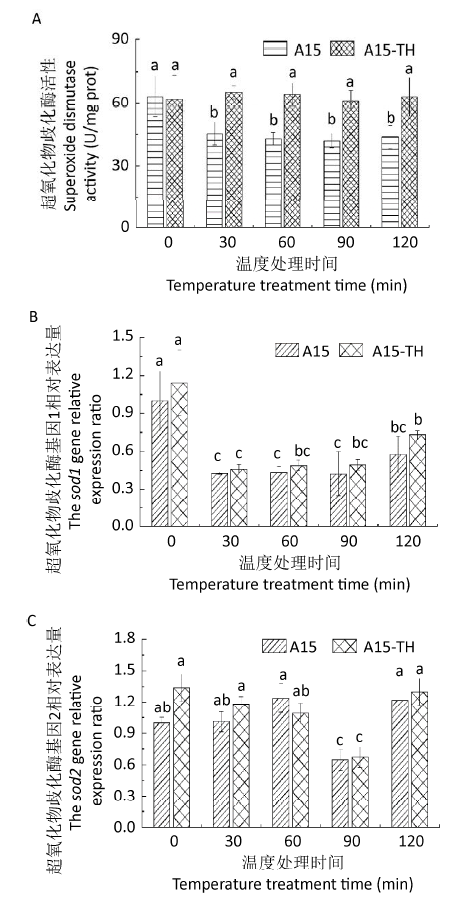
图3
高温胁迫对双孢蘑菇超氧化物歧化酶活性及超氧化物歧化酶基因相对表达量的影响
不同小写字母表示差异显著性(P<0.05). A:超氧化物歧化酶活性;B:超氧化物歧化酶基因1相对表达量;C:超氧化物歧化酶基因2相对表达量
Fig. 3
Effects of heat stress on the superoxide dismutase activity and on the relative expression of sod genes of Agaricus bisporus. Different lowercase letters indicate a significant difference at P<0.05.
A: Superoxide dismutase activity; B: The sod1 gene relative expression ratio; C: The sod2 gene relative expression ratio.
图4比较了高温胁迫下,双孢蘑菇菌株过氧化氢酶和cat基因相对表达量的变化。对照菌株的过氧化氢酶(CAT)活性随处理时间的延长先上升(30-90min)后降低(120min)(图4A),这可能是由于热处理120min对照菌株造成了严重的损伤,导致后期CAT活性的降低。不同热处理时间下,耐高温菌株A15-TH的CAT活性均高于对照菌株,尤其在120min的处理中,耐高温菌株的CAT活性比对照菌株高128%,说明耐高温菌株的抗氧化系统对活性氧有较强的清除能力。高温胁迫下,对照菌株和耐高温菌株的3个cat基因相对表达量有不同的变化趋势。由图4B可知,高温胁迫30min时,对照菌株cat1相对表达量降低了54.4%,延长高温胁迫时间,cat1缓慢回升至没有经过热胁迫的正常水平;耐高温菌株A15-TH在受到热胁迫30min后,cat1相对表达量显著上调至未受到胁迫状态下的1.5倍;在热胁迫作用60min和90min时维持在较高水平;至热胁迫作用120min时出现更大幅度的上调,较正常状态下提高了149.2%;所有热胁迫处理中,耐高温菌株的cat1相对表达量均高于对照菌株。cat2和cat3相对表达量随热胁迫时间的延长分别出现先下调再上调和先上调再下调的趋势,对照菌株和耐高温菌株没有显著差异(图4C、4D)。
图4
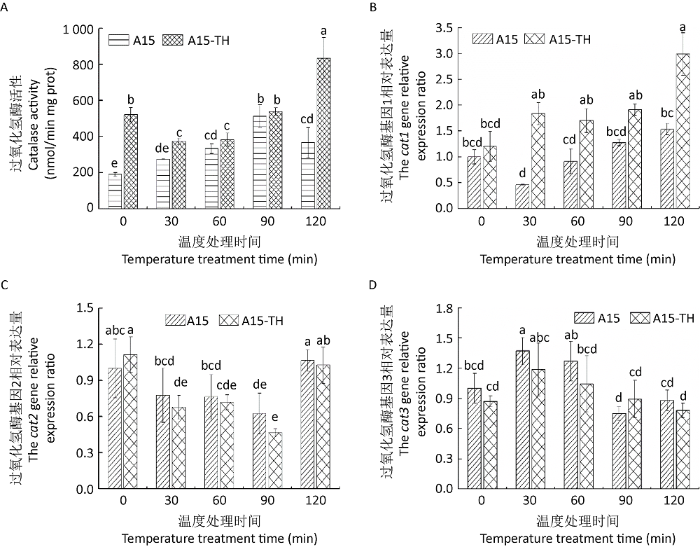
图4
高温胁迫对双孢蘑菇过氧化氢酶活性及过氧化氢酶基因相对表达量的影响
不同小写字母表示差异显著性(P<0.05). A:过氧化氢酶活性;B:过氧化氢酶基因1相对表达量;C:过氧化氢酶基因2相对表达量;D:过氧化氢酶基因3相对表达量
Fig. 4
Effects of heat stress on the catalase activity and on the relative expression of catalase genes of Agaricus bisporus.
Different lowercase letters indicate a significant difference at P<0.05. A: Catalase activity; B: Thecat1 gene relative expression ratio; C: Thecat2 gene relative expression ratio; D: Thecat3 gene relative expression ratio.
2.3 高温胁迫下双孢蘑菇糖酵解途径关键酶活性变化
对高温胁迫下双孢蘑菇基础碳代谢——糖酵解途径中的关键酶进行了测定。受到高温胁迫后,对照菌株A15己糖激酶(HK)和丙酮酸激酶(PK)活性增加,热处理90-120min,酶活性较正常状态分别增加约120%和130%,结果显著。耐高温菌株A15-TH在正常状态下,己糖激酶和丙酮酸激酶的活性显著高于对照菌株;受到热胁迫后,酶活性也维持在高水平,始终高于对照菌株;热胁迫120min,HK和PK活性比对照菌株分别高124%和73%(图5)。
图5
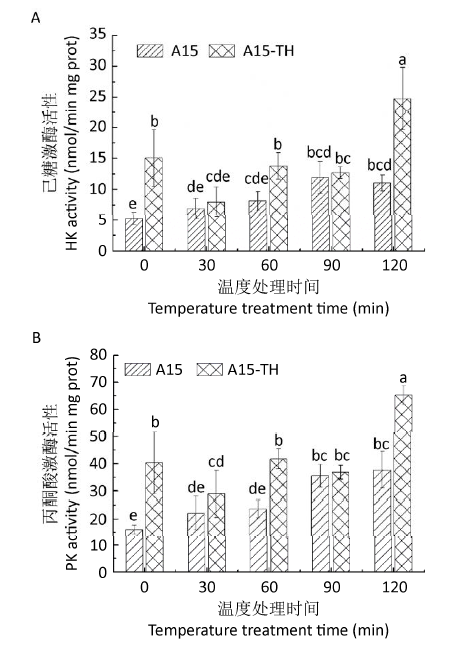
图5
高温胁迫对双孢蘑菇菌丝己糖激酶和丙酮酸激酶活性的影响
不同小写字母表示差异显著性(P<0.05). A:己糖激酶活性;B:丙酮酸激酶活性
Fig. 5
Effects of heat stress on the hexokinase and pyruvate kinase enzyme activities of Agaricus bisporus.
Different lowercase letters indicate a significant difference at P<0.05. A: HK activity; B: PK activity.
3 讨论
生物体在正常情况下,线粒体的ATP合成和ROS生成处于动态平衡,共同维持机体的生长发育,ROS的产生和清除发挥重要的生理功能。而线粒体呼吸链产生的O2-和H2O2是生物体内最大数量ROS的恒定来源(刘树森 2008)。在本研究中,对照菌株受到高温胁迫30-90min时,ATP含量下降54.4%-59.6%,线粒体复合物I、II、III活性迅速升高,O2-含量增加至正常状态下的1.35-1.71倍,这些结果表明高温胁迫下线粒体出现功能障碍,这与高温对小鼠(Song et al. 2016 )、鱼(Banh et al. 2016 )、植物(Rikhvanov et al. 2014 )、糙皮侧耳(闫志宇 2020)等线粒体造成功能损伤的相关研究结果一致。在没有受到热胁迫的状态下,耐高温菌株ATP含量仅为对照组的10%,O2-的含量比对照菌株高30.7%,这说明耐高温菌株的线粒体功能可能发生突变,在正常状态下维持较低的细胞能量代谢和较高的ROS合成量。在植物研究中发现,ROS除了作为强氧化剂攻击植物体内的细胞膜或蛋白分子造成氧化伤害之外,还可以作为信号分子介导植物对各种外界刺激产生胁迫响应(Miller et al. 2008 )。在本研究中,正常状态下耐高温菌株较高的ROS含量是否介导了其他信号通路进行高温胁迫前的防御工作还有待进一步研究。受到热胁迫后,耐高温菌株ATP含量增加,这与对照菌株刚好相反,进一步证明耐高温菌株线粒体ATP合成和ROS生成的平衡机制与对照菌株不同;且O2-含量并没有在菌丝中积累而是维持在稳定状态,表明耐高温菌株对O2-有更好的清除能力。
酶活分析表明,高温胁迫下,对照菌株的抗氧化酶系统受到影响,表现在菌丝CAT活性增加,但SOD活性降低,这可能影响了O2-的去除效率;而耐高温菌株的SOD活性始终维持在较高水平,与对照菌株有显著差异。此外,在热胁迫120min时,对照菌株的抗氧化系统遭受严重破坏,CAT活性下降,但是耐高温菌株的CAT活性不仅没有降低,反而出现大幅度增加,比对照菌株活性高128%,证明该菌株可以更有效地清除过量的活性氧,减轻高温对菌丝的氧化损伤。对抗氧化酶基因表达进行研究发现,对照菌株和耐高温菌株sod1、sod2基因的相对表达量在热胁迫下均出现了先下调再上调的趋势,sod1对高温处理更敏感,变化幅度更大;此外,耐高温菌株的sod基因相对表达量高于对照菌株,但是不显著,猜测两个sod基因的协同表达对稳定耐高温菌株的酶活起到了一定的作用。对照菌株和耐高温菌株的3个cat基因相对表达量随高温胁迫时间的延长有不同的变化趋势,其中耐高温菌株cat1相对表达量显著高于对照菌株,与酶活结果最一致,说明cat1可能在高温胁迫中发挥了主要作用;cat2和cat3分别出现了先下调再上调以及先上调再下调两种截然不同的变化,且A15-TH和A15没有显著差异,这可能因为不同的同工酶CAT在发育和胁迫中发挥的作用不同,这一点在植物(Du et al. 2008 )以及在糙皮侧耳(Wang et al. 2017a )过氧化氢酶基因特征分析及功能研究中都有报道。
己糖激酶和丙酮酸激酶是糖酵解途径的关键酶和限速酶。高温胁迫下,双孢蘑菇菌丝的己糖激酶和丙酮酸激酶活性增加,这说明糖酵解途径加快。闫志宇(2020)研究发现,糙皮侧耳高温胁迫下糖酵解途径和三羧酸循环两大核心碳代谢途径加快,这与我们的研究结果一致。他还提出加入海藻糖可以下调糖酵解关键酶的基因表达,调控核心碳代谢流提高糙皮侧耳的菌丝耐热性;而在我们的研究中耐高温菌株在正常状态下和热胁迫下,己糖激酶和丙酮酸激酶的活性均高于对照菌株,说明耐高温菌株具有更活跃的碳代谢。生物体的代谢网络是十分复杂的,同时生物体在进化过程中演化形成了多种响应环境压力的策略。除了抗氧化系统的响应和代谢途径的响应之外,还包括信号转导系统响应(Shiraishi et al. 2018 )、转录因子响应(Cortijo et al. 2017 )、激素响应(Wang et al. 2018 )、防御蛋白响应(Jacob et al. 2017 ;Wang et al. 2017b )、细胞壁和细胞膜的响应(Kitichantaropas et al. 2016 )等。关于双孢蘑菇菌株在高温胁迫下响应机制还需要从不同的角度加以研究和探索。
参考文献
Mitochondrial reactive oxygen species production by fish muscle mitochondria: potential role in acute heat-induced oxidative stress
DOI:10.1016/j.cbpb.2015.10.001 URL [本文引用: 1]
Intracellular copper zinc superoxide dismutase (icCuZnSOD) from Asian seabass (Lates calcarifer): molecular cloning, characterization and gene expression with reference to Vibrio anguillarum infection
DOI:10.1016/j.dci.2011.11.002 URL [本文引用: 1]
Production of reactive oxygen species by mitochondria: central role of complex III
DOI:10.1074/jbc.M304854200 URL [本文引用: 1]
Transcriptional regulation of the ambient temperature response by H2A.Z nucleosomes and HSF1 transcription factors in Arabidopsis
DOI:S1674-2052(17)30245-9
PMID:28893714
[本文引用: 1]

Temperature influences the distribution, range, and phenology of plants. The key transcriptional activators of heat shock response in eukaryotes, the heat shock factors (HSFs), have undergone large-scale gene amplification in plants. While HSFs are central in heat stress responses, their role in the response to ambient temperature changes is less well understood. We show here that the warm ambient temperature transcriptome is dependent upon the HSFA1 clade of Arabidopsis HSFs, which cause a rapid and dynamic eviction of H2A.Z nucleosomes at target genes. A transcriptional cascade results in the activation of multiple downstream stress-responsive transcription factors, triggering large-scale changes to the transcriptome in response to elevated temperature. H2A.Z nucleosomes are enriched at temperature-responsive genes at non-inducible temperature, and thus likely confer inducibility of gene expression and higher responsive dynamics. We propose that the antagonistic effects of H2A.Z and HSF1 provide a mechanism to activate gene expression rapidly and precisely in response to temperature, while preventing leaky transcription in the absence of an activation signal. Copyright © 2017 The Author. Published by Elsevier Inc. All rights reserved.
Comprehensive functional analysis of the catalase gene family in Arabidopsis thaliana
DOI:10.1111/jipb.2008.50.issue-10 URL [本文引用: 1]
Oxygen activation and oxygen toxicity
DOI:10.1146/annurev.pp.33.060182.000445 URL [本文引用: 1]
Reactive oxygen species and antioxidant machinery in abiotic stress tolerance in crop plants
DOI:10.1016/j.plaphy.2010.08.016 URL [本文引用: 1]
Effects of heat stress on the differential expression of antioxidant enzymes and heat shock protein genes of Agaricus bisporus
The heat‐shock protein/chaperone network and multiple stress resistance
DOI:10.1111/pbi.2017.15.issue-4 URL [本文引用: 1]
Cellular mechanisms contributing to multiple stress tolerance in Saccharomyces cerevisiae strains with potential use in high-temperature ethanol fermentation
DOI:10.1186/s13568-015-0169-5 URL [本文引用: 1]
Mitochodrial respiration chain and reaction oxygen species
Effects of heat stress on Pleurotus eryngii mycelial growth and its resistance toTrichoderma asperellum
Heat stress response of cultivated Pleurotus eryngiivar. tuoliensis germplasms
Copper, zinc superoxide dismutase and nitrate reductase coimmobilized bienzymatic biosensor for the simultaneous determination of nitrite and nitrate
DOI:10.1016/j.bios.2013.08.036 URL [本文引用: 1]
Reactive oxygen signaling and abiotic stress
DOI:10.1111/j.1399-3054.2008.01090.x URL [本文引用: 1]
Reactive oxygen species homeostasis and signalling during drought and salinity stresses
The mitochondrial energy transduction system and the aging process
DOI:10.1152/ajpcell.00213.2006 URL [本文引用: 2]
The mystery of reactive oxygen species derived from cell respiration
DOI:10.18388/abp.2004_3615 URL [本文引用: 1]
Role of mitochondria in the operation of calcium signaling system in heat-stressed plants
DOI:10.1134/S1021443714020125 URL [本文引用: 1]
Balancing the generation and elimination of reactive oxygen species
Yeast Hog1 proteins are sequestered in stress granules during high-temperature stress
Worldwide basket survey of multielemental composition of white button mushroom Agaricus bisporus
DOI:S0045-6535(19)31948-4
PMID:31514008
[本文引用: 1]
Agaricus bisporus is the most commonly cultivated and consumed mushroom species. The aim of this study was to compare the profile of macro- and trace elements in A. bisporus fruit bodies produced commercially in 19 countries in 2018 and distributed worldwide (32 analyzed objects). Trace elements with unknown biological roles were also determined. The content of 36 elements (of 70 taken into account) revealed significant differences among the analyzed objects. Contents of Ca, K, Mg, Na and S varied in wide ranges of 425-2430, 12740-40940, 610-3240, 98-430 and 1030-2650 mg kg dw, respectively. The fruit bodies were characterized by a generally similar content of trace elements with some clear exceptions. Rankings of the objects according to the decreased amount of macroelements, trace elements and all elements jointly, show that mushrooms are significantly diverse as regards the content of particular elements of the mentioned group. The analyzed fruit bodies displayed a relatively high content of Ca, Mo and Se, and a high K/Na ratio. Regardless of origin, A. bisporus did not constitute a source of significant levels of Al, Cd or rare earth elements. An increased level of As and Pb in mushrooms from several producers indicates a need for additional measures to reduce potential dietary exposures to these toxicants. Copyright © 2019 Elsevier Ltd. All rights reserved.
Lenti-siRNA Hsp60 promote bax in mitochondria and induces apoptosis during heat stress
DOI:10.1016/j.bbrc.2016.10.153 URL [本文引用: 1]
Stressed out mitochondria: the role of mitochondria in ageing and cancer focussing on strategies and opportunities in human skin
DOI:10.1016/j.mito.2012.11.007
PMID:23195682
[本文引用: 1]
Mitochondrial DNA damage has been used as a successful and unique biomarker of tissue stress. A valuable example of this is sun damage in human skin which leads to ageing and skin cancer. The skin is constantly exposed to the harmful effects of sunlight, such as ultraviolet radiation, which causes it to age with observable characteristic features as well as clinical precancerous lesions and skin cancer. Formation of free radicals by the sun's harmful rays which contribute to oxidative stress has been linked to the induction of deletions and mutations in the mitochondrial DNA. These markers of mitochondrial DNA damage have been proposed to contribute to the mechanisms of ageing in many tissues including skin and are associated with many diseases including cancer. In this article we highlight the role of this important organelle in ageing and cancer with particular emphasis on experimental strategies in the skin. Copyright © 2012 © Elsevier B.V. and Mitochondria Research Society. All rights reserved. Published by Elsevier B.V. All rights reserved.
Unraveling uranium induced oxidative stress related responses inArabidopsis thaliana seedlings. Part II: responses in the leaves and general conclusions
DOI:10.1016/j.jenvrad.2011.03.013 URL [本文引用: 1]
A mitochondrial paradigm of metabolic and degenerative diseases, aging, and cancer: a dawn for evolutionary medicine
DOI:10.1146/annurev.genet.39.110304.095751 URL [本文引用: 1]
Differential expression patterns of Pleurotus ostreatus catalase genes during developmental stages and under heat stress
DOI:10.3390/genes8110335 URL [本文引用: 2]
Heat-responsive photosynthetic and signaling pathways in plants: insight from proteomics
DOI:10.3390/ijms18102191 URL [本文引用: 1]
Investigation of the fine structure around the copper site in copper/zinc superoxide dismutase by XANES combined with a binitio calculations
DOI:10.1016/j.radphyschem.2016.03.003 URL [本文引用: 1]
Phytomelatonin: a universal abiotic stress regulator
DOI:10.1093/jxb/erx473 URL [本文引用: 1]
Cloning and analyses of two protective enzyme genes in Pleurotus eryngii and effects of temperature stress on their expression
Core carbon metabolism response of Pleurotus ostreatus to high temperature stress
Metabolic response ofPleurotus ostreatusto continuous heat stress
DOI:10.3389/fmicb.2019.03148 URL
Hydrogen-rich water alleviates the toxicities of different stresses to mycelial growth in Hypsizygus marmoreus
DOI:10.1186/s13568-017-0406-1 URL [本文引用: 1]
GC-MS-based nontargeted and targeted metabolic profiling identifies changes in the Lentinula edodes mycelial metabolome under high-temperature stress
DOI:10.3390/ijms20092330 URL [本文引用: 1]
Auxin and auxin analogues enhancing the thermotolerance of Lentinula edodes