


在过去很长时期,蜈蚣衣科曾置于茶渍目Lecanorales。第10版《真菌辞典》(Kirk et al. 2008)将蜈蚣衣科置于黄枝衣目Teloschistales。近期研究(Gaya et al. 2012;Miadlikowska et al. 2014)已将蜈蚣衣科置于粉衣目Caliciales。
本研究基于形态学与地衣化学确认以下5个种为中国新记录:美洲哑铃孢Heterodermia galactophylla,红髓外蜈蚣叶Hyperphyscia crocata,狭叶红髓黑蜈蚣叶Phaeophyscia fumosa,毛裂芽黑蜈蚣叶P. kairamoi和变白蜈蚣衣Physcia albata。
1 材料与方法
1.1 研究标本
研究标本均保存在中国科学院微生物研究所菌物标本馆地衣标本室(HMSA-L)。
1.2 形态和解剖
形态观察使用Zeiss Stemi SV6或Motic体视显微镜,并拍摄物种形态特征图。子囊盘和分生孢子器分别徒手切片或使用冷冻切片机切片,置于光学显微镜(Zeiss Axioscop 40,Zeiss Axioscop 2或Olympus BH-2)下观察子囊盘结构、子囊孢子以及分生孢子等。
1.3 地衣化学
显色反应采用常规试剂10%氢氧化钾(K);5%-10%对苯二胺乙醇溶液(PD);漂白粉饱和水溶液或巴士液(C);Lugols碘液(I)。地衣物质的检测采用薄层色谱(TLC)方法(Culberson 1972),通常使用C溶剂系统。
2 结果与分析
2.1 美洲哑铃孢 图1A
图1
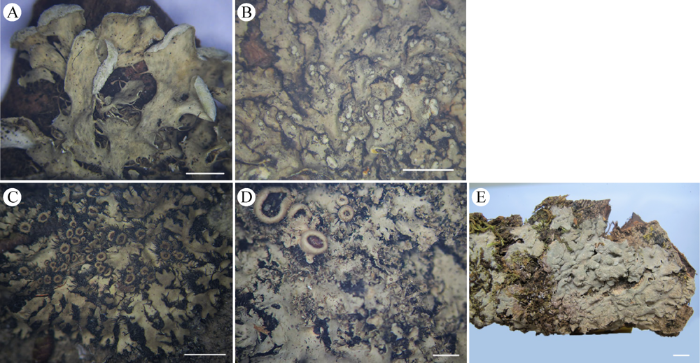
图1
中国蜈蚣衣科5种地衣 A:美洲哑铃孢的粉芽堆(陈健斌等9395);B:红髓外蜈蚣叶(赵继鼎、徐连旺8567);C:狭叶红髓黑蜈蚣叶(陈健斌等9564-1);D:毛裂芽黑蜈蚣叶的裂芽和小裂片上有毛(王先业1261);E:变白蜈蚣衣(王先业等8860). 标尺:A-D=2 mm;E=5 mm
Fig. 1
Five species of Physciaceae. A: Soralia of Heterodermia galactophylla (Chen et al. 9395); B: Hyperphyscia crocata (Zhao & Xu 8567); C: Phaeophyscia fumosa (Chen et al. 9564-1); D: Hairs on isidia and lobules of Phaeophyscia kairamoi (Wang 1261); E: Physcia albata (Wang 8860). Bars: A-D=2 mm; E=5 mm.
Heterodermia galactophylla (Tuck.) W.L. Culb. Bryologist 69: 482, 1967.
≡ Parmelia ciliaris var. galactophylla Tuck., Proc. Amer. Acad. Arts Sci. 1: 224, 1848.
地衣体叶状,连座状至不规则扩展,2-3.5 cm宽,较疏松的常常仅以中央部位贴于基物;裂片二叉式至不规则分裂,亚覆瓦状,裂片顶部抬升,基部0.7-1.5 mm宽,顶部加宽,常呈匙形,顶端略圆,可达3-4 mm宽;上表面淡灰白色至淡灰绿色,平坦或微凸(边缘稍向下卷);髄层白色;下表面无皮层,似蛛网和脉纹状,白色,粉芽顶生,粉芽堆略唇形,无黄色色素;边缘生假根与地衣体同色,顶部常变暗色,单一不分枝至稀分枝,长0.5-1.5(-2.0) mm。子囊盘未见。
化学:上皮层K+黄色;髓层K+黄色,C-,KC-,PD-;含有atranorin,zeorin。
研究标本:福建,武夷山,海拔2 150 m,张恩然wy364-1,wy372。江西,庐山植物园,赵继鼎等399。湖南,桑植县天平山,1 300- 1 400 m,陈健斌等 9395,9525,9873;衡山,海拔750-1 200 m,赵继鼎、徐连旺9992,10134。广西,花坪,海拔900 m,赵继鼎、徐连旺9728。
世界分布:热带至暖温带(Kurokawa 1973)。主要分布于美洲(北美,中美,南美)。
讨论:本种主要特征是具有抬升和匙形裂片,无下皮层,无黄色色素,下表面顶部有粉芽,缺乏norstictic acid,salazinic acid。本种十分相似于丛毛哑铃孢H. comosa和翘哑铃孢H. subascendens,主要区别在于丛毛哑铃孢具有表面生的缘毛型白色毛,不同于翘哑铃孢在于本种下表面缺乏黄色色素。本种还与透明哑铃孢H. pellucida的外形和化学相似,但后者无粉芽。
2.2 红髓外蜈蚣叶 图1B
Hyperphyscia crocata Kashiw., Bull. Natn. Mus., Tokyo, Ser. B, 11(3): 92, 1985.
地衣体叶状,略圆形,直径1-3 cm,紧密贴生基物;裂片二叉至不规则分裂,狭窄,0.5- 1.5 mm宽;上表面淡灰绿色至橄榄色,粉芽堆主要表面生,小圆形和半球形,粉芽颗粒状;髓层红色,至少髓层下半部位红色;下皮层不明显,下表面近黑色,顶部颜色稍浅,假根缺乏或非常稀少。子囊盘表面生,直径0.5-1.5 mm,盘面近黑色,盘缘完整至轻微缺刻,盘缘有时粉芽化,孢子Pachysporaria型,17-25×8-11 µm。
化学:地衣体K-;髓层含有skyrin,zeorin。
基物:树皮。
研究标本:广西,临桂县宛田,赵继鼎、徐连旺8567。云南,思茅附近,陈健斌6587。
世界分布:中国,日本(Kashiwadani 1985)。
讨论:本种主要特征是具有表面生粉芽堆,髓层红色,含有zerion,skyrin。本研究引证的2份标本中有一份标本被Moberg来华期间鉴定为H. pandani (H. Magn.) Moberg。但H. pandani的裂片十分狭窄,0.2-0.5 mm宽(Rogers 2011),或最大达1 mm宽(Moberg 1987),缺乏zeorin。本研究引证的2份标本的裂片0.5-1.5 mm宽,用TLC方法测定的结果含有zeorin。在外蜈蚣叶属地衣中含有zerion是少见的。中国的这2份标本因裂片0.5-1.5 mm宽,具粉芽,红色髓层及含有zeorin等特征,符合产于日本的H. crocata Kashiw. (Kashiwadani 1985)。与原描述相比,中国标本的下表面的颜色较暗近黑色,顶部颜色稍浅,而日本的标本下表面淡褐色至褐色。此外,中国标本的孢子17-25×8-11 µm,稍大于日本标本的孢子16-20×7-8 µm (Kashiwadani 1985)。
2.3 狭叶红髓黑蜈蚣叶 图1C
Phaeophyscia fumosa Moberg, Nord. J. Bot. 3: 514, 1983.
地衣体叶状,近圆形,约2-4 cm宽,裂片近放射状排列,分离至中央部位紧密相连或稍微重叠,十分狭窄,0.3-0.6 mm宽,最大者不超过1 mm宽,平坦至稍稍下凹,上表面淡灰褐色至褐色,无粉芽和裂芽,髓层红色(色素skyrin),下表面黑色,顶部淡色;假根黑色。子囊盘直径0.5-1.5 mm,盘缘完整或缺刻,基部常常有假根,子囊棍棒状,内含8孢;子囊孢子褐色,双胞,厚壁,Pachysporaria型或主要是Pachysporaria型,(20-)23-27(-31)×8.5-12 µm。
化学:地衣体K-;髓层含有色素skyrin。
基物:树皮。
研究标本:福建,武夷山自然保护区专家楼附近,海拔800 m,黄满荣924。湖南,桑植天平山,海拔1 350-1 400 m,陈健斌等9490,9564-1,9636;湖南宜章县莽山,海拔1 300 m,陈健斌等21013。四川,峨眉山万年寺,海拔1 000 m,赵继鼎、徐连旺8320。云南,贡山县,海拔2 300 m,苏京军2323;独龙江,海拔2 000 m,苏京军3923-1;保山市高黎贡山白华岭林场,海拔1 700 m,姜玉梅697;泸水县片马,海拔2 400 m,王先业等2147。
世界分布:中国,东非(Moberg 1983),澳大利亚(McCarthy 2018)。
讨论:本种的主要特征是裂片十分狭窄,通常0.3-0.6 mm宽,最宽不超过1 mm,无粉芽和裂芽,髓层橙红色,不含zeorin,树生。与P. pyrrophora的主要区别在于裂片狭窄,P. pyrrophora的裂片宽1-2.5 mm,日本的标本可达4 mm宽。本种与P. endococcina的区别在于后者是一个石生种,而且髓层含有zeorin。Moberg(1983)记载本种孢子为24-32×12-14 µm,稍大于中国标本的孢子(20-) 23-27(-31)×8.5-12 µm。
2.4 毛裂芽黑蜈蚣叶 图1D
Phaeophyscia kairamoi (Vain.) Moberg, Symb. Bot. Upsal. 22(1): 40, 1977.
≡ Physcia kairamoi Vain., Acta Soc. Fl. Fenn 7: 3, 1921.
地衣体叶状,不规则状至略圆形,疏松着生于基物;裂片不规则分裂,1-2(-3.5) mm宽;上表面灰褐色至暗褐色,平坦或稍凹,末端多向上翘起;上表面末端时有稀疏无色皮层毛,裂芽多边缘生,偶有表面生,常发展成背腹分明的小裂片,这些裂芽和小裂片有时密集呈簇,裂芽或小裂片生有淡色或暗色的毛;髓层白色;下表面黑色,末端常为灰白色;假根通常稠密,黑色,单一不分枝或有简单枝,常伸出裂片边缘。子囊盘少见,圆盘状,直径可达2 mm,盘面黑色,无粉霜,盘缘完整或缺刻,基部常常具黑色假根。子囊孢子双胞,褐色,Physcia型,22-27×9-11 µm。分生孢子器埋生于地衣体中,孔口开于地衣体上表面,暗褐色至黑色,圆点状。分生孢子椭圆形、卵形,2-3×1-1.5 µm。
化学:地衣体K-;髓层K-;未检测出地衣物质。
基物:岩石,石表藓层,树皮。
研究标本:湖北,神农架千家坪,海拔2 000 m,陈健斌11719-1a。四川,若尔盖县铁布,海拔2 800 m,王先业、肖勰11091;卧龙,海拔2 750 m,陈健斌6339-1。云南,中甸小中甸林场,海拔3 600 m,王先业等5529;西畴法斗,海拔1 400 m,陈健斌5313。西藏,林芝县,海拔3 200 m,胡光荣h217,h247。新疆,天山夏塔,海拔2 300-2 900 m,王先业920;北木扎尔台河谷,海拔2 500-2 600 m,王先业1068,1167,1218,1261;天山昭苏县林场和巩留林场,海拔1 950-2 000 m,赵从福2555,2594-1。
世界分布:中国,欧洲,北美,格陵兰,东亚(Moberg 1994,1995)。
讨论:本种由于具有边缘生裂芽和小裂片而相似于P. exornatula,但本种的裂芽和小裂片上有淡色或暗色的毛,而且裂片上表面顶部区域常存在无色皮层毛。在本研究的标本中,新疆、四川的标本比较容易识别。有的标本无皮层毛,或这些皮层毛比较微小,需仔细观察。Moberg(1995)曾经报道过中国和俄罗斯远东地区的黑蜈蚣叶属Phaeophyscia地衣,但其中P. kairamoi并没有来自中国的标本,引证的标本全部来自俄罗斯和蒙古国的有关地区。
2.5 变白蜈蚣衣 图1E
Physcia albata (F. Wilson) Hale, Bryologist 66: 73, 1963.
≡ Parmelia albata F.Wilson, Pap. Proc. Roy. Soc. Tasmania: 173, 1893
地衣体叶状,近圆形或不规则,直径可达9 cm,疏松着生于基物;裂片不规则分裂,相对较宽,1.5-4.0 mm宽,顶端钝圆,时有缺刻;上表面灰白色至淡灰绿色,顶端部位常为暗灰色,无白斑,有时具微弱粉霜,粉芽堆表面生,开始呈斑点形(maculiform),多呈白色,然后粉芽堆发育成大型或连成一片,粉芽颗粒状,有时粉芽消失后,上表面留有疤痕,露出髓层;髓层白色;下表面灰白色至淡褐色,下皮层为假薄壁组织;假根与下表面同色或有时变暗色,中等稠密,单一不分枝。子囊盘及分生孢子器未见。文献记载本种子囊盘稀少,孢子双胞,Pachysporaria-type,17-25×8-12 μm (Moberg 1986);分生孢子杆状,4-6×1 μm (Elix 2011)。
化学:地衣体K+黄色;髓层K+黄色;含有atranorin,zeorin。
基物:树皮(文献记载也生于岩石)。
研究标本:四川,西昌市泸山,海拔1 500 m,王先业等8069;贡嘎山,海拔1 900-3 450 m,王先业等8860,9023。云南,昆明西山,陈健斌6470-1。
世界分布:中国,东非、南非(Moberg 1986,2004),南美(Moberg 1990),澳大利亚,新西兰(Moberg 2001;Galloway & Moberg 2005)。
讨论:本种的主要特征为裂片较宽阔(宽1.5-4.0 mm),粉芽堆表面生,含有atranorin和zeorin。P. albata和P. dilatata是中国蜈蚣衣属地衣中裂片最宽阔的两个种。但P. dilatata无粉芽,二者互为种对(Moberg 1986,1990)。
参考文献
Improved conditions and new data for the identification of lichen products by a standardized thin-layer chromatographic method
DOI:10.1016/0021-9673(72)80013-X URL [本文引用: 1]
The lichen genus Physcia (Schreb.) Michx (Physciaceae: Ascomycota) in New Zealand
Implementing a cumulative supermatrix approach for a comprehensive phylogenetic study of the Teloschistales (Pezizomycotina, Ascomycota)
DOI:10.1016/j.ympev.2012.01.012 URL [本文引用: 1]
Genus Hyperphyscia (lichen) in Japan
Supplementary notes on the genus Anaptychia
Checklist of the lichens of Australia and its island territories. Australian Biological Resources Study, Canberra
A multigene phylogenetic synthesis for the class Lecanoromycetes (Ascomycota): 1307 fungi representing 1139 infrageneric taxa, 317 genera and 66 families
DOI:10.1016/j.ympev.2014.04.003
PMID:24747130
[本文引用: 1]

The Lecanoromycetes is the largest class of lichenized Fungi, and one of the most species-rich classes in the kingdom. Here we provide a multigene phylogenetic synthesis (using three ribosomal RNA-coding and two protein-coding genes) of the Lecanoromycetes based on 642 newly generated and 3329 publicly available sequences representing 1139 taxa, 317 genera, 66 families, 17 orders and five subclasses (four currently recognized: Acarosporomycetidae, Lecanoromycetidae, Ostropomycetidae, Umbilicariomycetidae; and one provisionarily recognized, 'Candelariomycetidae'). Maximum likelihood phylogenetic analyses on four multigene datasets assembled using a cumulative supermatrix approach with a progressively higher number of species and missing data (5-gene, 5+4-gene, 5+4+3-gene and 5+4+3+2-gene datasets) show that the current classification includes non-monophyletic taxa at various ranks, which need to be recircumscribed and require revisionary treatments based on denser taxon sampling and more loci. Two newly circumscribed orders (Arctomiales and Hymeneliales in the Ostropomycetidae) and three families (Ramboldiaceae and Psilolechiaceae in the Lecanorales, and Strangosporaceae in the Lecanoromycetes inc. sed.) are introduced. The potential resurrection of the families Eigleraceae and Lopadiaceae is considered here to alleviate phylogenetic and classification disparities. An overview of the photobionts associated with the main fungal lineages in the Lecanoromycetes based on available published records is provided. A revised schematic classification at the family level in the phylogenetic context of widely accepted and newly revealed relationships across Lecanoromycetes is included. The cumulative addition of taxa with an increasing amount of missing data (i.e., a cumulative supermatrix approach, starting with taxa for which sequences were available for all five targeted genes and ending with the addition of taxa for which only two genes have been sequenced) revealed relatively stable relationships for many families and orders. However, the increasing number of taxa without the addition of more loci also resulted in an expected substantial loss of phylogenetic resolving power and support (especially for deep phylogenetic relationships), potentially including the misplacements of several taxa. Future phylogenetic analyses should include additional single copy protein-coding markers in order to improve the tree of the Lecanoromycetes. As part of this study, a new module ("Hypha") of the freely available Mesquite software was developed to compare and display the internodal support values derived from this cumulative supermatrix approach. Copyright © 2014 Elsevier Inc. All rights reserved.
The genus Phaaeophyscia in East Africa
DOI:10.1111/j.1756-1051.1983.tb01460.x URL [本文引用: 2]
The genus Physcia in East Africa
DOI:10.1111/j.1756-1051.1986.tb00488.x URL [本文引用: 3]
The genus Hyperphyscia and Physconiain East Africa
DOI:10.1111/j.1756-1051.1987.tb02039.x URL [本文引用: 1]
The lichen genus Physciain Central and South America
DOI:10.1111/j.1756-1051.1990.tb01776.x URL [本文引用: 2]
Is the Pacific an area of speciation for some foliose genera of the lichen family Physciaceae?
The lichen genus Phaeophysciain China and Russian Far East
DOI:10.1111/j.1756-1051.1995.tb00158.x URL [本文引用: 2]
The lichen genus Physcia in Australia
Notes on foliose species of the lichen family Physciaceae in southern Africa