



作为一种重要的热带水果,芒果栽培面积大且经济价值高,但在芒果生长期及采后过程中常受到芒果炭疽病菌盘长孢状刺盘孢Colletotrichum gloeosporioides侵染,造成严重的经济损失(李其利等 2020)。目前对该病害的防治方法以化学药剂防治为主,但同时会带来生态污染、农药残留、人畜中毒等一系列环境和食品安全问题的潜在隐患,阻碍了芒果生产的可持续发展(杨普云等 2019)。因此,环保高效、安全无毒的生物制剂成为当前农业发展的重点需求(Ahmad et al. 2018)。由于微生物制剂具有以上特点,受到了广泛的关注和重视,现阶段已发现贝莱斯芽孢杆菌Bacillus velezensis、美极梅奇酵母Metschnikowia pulcherrima和绿色木霉Trichoderma viride等多个生防菌对芒果炭疽病菌展现出良好的防治效果(冯卫华等 2012;Tian et al. 2017;Jin et al. 2020)。
木霉Trichoderma spp.是一类环境中普遍存在的真菌,具有较好的生防作用,目前被广泛应用于农业生产中(冯卫华等 2012)。木霉可产生挥发性和非挥发性物质拮抗病原菌,同时分泌纤维素酶、几丁质酶和β-1,3-葡聚糖酶等一系列水解酶来降解病原真菌细胞壁、破坏组织结构,从而使体内物质外泄引起病原菌的死亡(Benítez et al. 2004;Vinale et al. 2008)。此外,木霉还可以诱导植物产生抗性,促进植物的生长和提高植物对营养的吸收(Mwangi et al. 2011)。
目前已经从土壤、腐木、种籽、根围等不同生态环境中获得大量的木霉(Dou et al. 2019),但是关于从昆虫肠道中分离木霉鲜有报道。由于昆虫广泛分布于各种生态环境、种类繁多且数量巨大,其肠道内更是存在庞大且复杂的微生物种群(Engel & Moran 2013;Jang & Kikuchi 2020)。因此,昆虫肠道是挖掘有益微生物的宝库。本研究以昆虫肠道为材料,从中分离并纯化木霉,同时以芒果炭疽病菌为靶标菌,筛选对其有拮抗作用的木霉菌株,以期在昆虫肠道中获得优良的生防木霉菌株,为芒果炭疽病的防治储备资源。
1 材料与方法
1.1 材料
1.1.1 昆虫样本与供试菌株
白蚁、蛴螬、蟋蟀、蝼蛄、红蝽、中华剑角蝗、拟步甲科昆虫、毒蛾科等105份昆虫材料采自海南省海口市和东方市等地。引起芒果炭疽病的胶孢炭疽菌由海南大学植物保护学院刘晓妹教授提供。
1.1.2 供试培养基和试剂
PDA培养基:马铃薯200 g,葡萄糖15 g,琼脂15 g(液体培养基不加琼脂)。PDAm培养基:马铃薯200 g,葡萄糖15 g,琼脂15 g,虎红0.02 g,氯霉素0.3 g,链霉素0.1 g。SNA培养基:KH2PO4 1.0 g,KCl 0.5 g,KNO3 1.0 g,MgSO4 0.5 g,葡萄糖0.2 g,蔗糖0.2 g,琼脂18 g。发酵培养基:马铃薯200 g,玉米粉10.0 g,葡萄糖20.0 g,0.01%吐温80(Jiang et al. 2016)。上述培养基均定容至1 L,自然pH,121 ℃灭菌30 min。
1.2 昆虫肠道木霉分离和纯化
用无菌水将昆虫表面冲洗干净后,用75%的酒精消毒6 min,再用无菌水漂洗3次。在解剖显微镜下挑取昆虫肠道放入无菌离心管中磨碎,加入10 mL无菌水制成肠道匀浆悬浮液,吸取200 μL肠道匀浆涂布于PDA培养基平板上,于28 ℃恒温培养箱中培养2-3 d后观察菌落形态(夏晓峰等 2013)。使用接菌环挑取颜色与形态特征疑似木霉的菌株转接于PDA培养基上,采用单孢分离法进行菌株纯化,纯化的菌株保存于4 ℃备用。
1.3 木霉形态学鉴定
将纯化的木霉菌株分别转接于PDA和SNA培养基上,28 ℃培养72 h,观察菌落形态、分生孢子和分生孢子梗特征,其特征参照木霉分类系统(Gams & Bissett 1998;Samuels & Hebbar 2015)对木霉不同种的描述进行观察,确定木霉的分类地位。
1.4 木霉分子鉴定
利用CTAB法提取木霉菌株的总DNA,使用引物(Tef1-T28f:5′-CATCGAGAAGTTCGAG AAGG-3′和Tef1Rg:5′-GCCATCCTTGGGAGAT ACCAGC-3′)扩增Tef1基因片段,使用引物(Rpb2-5f:5′-GAYGAYMGWGATCAYTTYGG-3′和Rpb2-7cr:5′-CCCATRGCTTGYTTRCCCAT-3′)扩增Rpb2基因片段。将PCR产物进行测序。测序的Tef1和Rpb2序列提交NCBI数据库进行Blast比对分析,从GenBank中获取与本研究测得昆虫肠道木霉菌株的序列相似度大于97%的Tef1和Rpb2序列,采用MEGA10构建双基因系统发育进化树。
1.5 对峙培养和拮抗系数测定
用打孔器(直径5 mm)在PDA培养基上切取木霉和芒果炭疽病菌,将二者同时转接于PDA培养基平板(直径9 cm)的两端,使木霉与病原菌相距5 cm,28 ℃培养7 d,测量病原菌的菌落半径。以仅接病原菌为对照,试验重复3次。按以下公式计算其抑制率:抑制率(%)=[(对照组菌落半径-处理组菌落半径)/对照组菌落半径]×100%。
木霉的拮抗系数测定按以下标准统计:Ⅰ级,木霉覆盖整个平皿;Ⅱ级,木霉覆盖超2/3平皿;Ⅲ级,木霉覆盖超1/2平皿;Ⅳ级,木霉覆盖不足1/3;Ⅴ级,病原菌覆盖整个平皿(Bell 1982)。
1.6 挥发性物质抑菌活性测定
采用平板对扣培养法,木霉菌株接于PDA培养基培养2 d后,将接有木霉菌株的平板对扣放置于接有芒果炭疽病菌平板上,中间使用略大于培养皿直径的玻璃纸分隔,于28 ℃恒温培养5 d,测量病原菌菌落直径(Dennis & Webster 1971),计算其挥发性物质对病原菌的抑制率。以无对扣木霉的病原菌为对照,试验重复3次。
1.7 非挥发物质抑菌活性测定
用打孔器(φ=5 mm)打取3块木霉菌饼放入液体发酵培养基中,28 ℃、180 r/min培养7 d后,用3层纱布过滤菌丝,过滤液离心后取上清,用0.22 μm微孔滤膜除菌,取过滤液于45 ℃真空旋转蒸发仪中浓缩至1/8体积。将浓缩发酵液与PDA培养基按1:7比例混合倒平板,以无菌水作空白对照,将芒果炭疽病菌(5 mm)转接到培养基中央,28 ℃黑暗培养5 d后,测量菌落直径。
1.8 室内防效测定
选取芒果(品种:台芒)淡绿期叶片,用细针在叶片主脉两侧刺伤形成微伤口。在叶片主脉两侧分别刺伤5处,右侧中间3处预先用木霉孢子悬浮液(106 CFU/mL)涂抹,待叶片上孢悬液晾干后,分别在刺伤处接10 μL芒果炭疽病菌孢悬液(106 CFU/mL);在叶片主脉左侧中间刺伤3处只接病原菌孢子悬浮液,在叶片两端的刺伤处只加无菌水为对照,4 d后分别测量病斑直径,每次处理10片叶子,试验重复3次(韦运谢等 2016)。
1.9 数据统计和分析
利用Excel 2010进行数据统计,采用SPSS 19进行差异显著性分析。
2 结果与分析
2.1 昆虫肠道木霉分离和鉴定
从105份昆虫肠道中分离出10株木霉,其中白蚁和蛴螬肠道中分别获得4株和6株木霉,其他昆虫肠道未分离出木霉。其中木霉HNDF-T-1、T-2和T-4菌株在PDA上气生菌丝为白色絮状,产孢区呈明显同心轮纹,菌落边缘孢子呈黄绿色,中心绿色至深绿色,无明显味道。在SNA培养基上气生菌丝白色且稀薄,孢子颜色呈黄绿色,形成同心轮纹。分生孢子梗分枝呈近直角,多为对生分布,瓶梗中部略有加粗,呈瓶状(图1)。分生孢子浅绿色,卵球状,3株木霉形态特征与棘孢木霉描述一致(Samuels & Hebbar 2015)。
图1

图1
不同木霉菌株形态特征 A:PDA;B:SNA;C:分生孢子梗;D:分生孢子. HNDF-G-4:长枝木霉;HNDF-T-6:加纳木霉;HNDF-G-6:哈茨木霉;HNDF-T-1:棘孢木霉
Fig. 1
Morphological characteristics of different Trichoderma isolates. A: PDA; B: SNA; C: Condiophores; D: Conidia. HNDF-G-4: T. longibrachiatum; HNDF-T-6: T. ghanense; HNDF-G-6: T. harzianum; HNDF-T-1: T. asperellum.
木霉菌株HNDF-T-6在PDA上气生菌丝为白色绒毛絮状,产孢区呈明显同心轮纹,菌落孢子呈绿色至深绿色,无明显味道。在SNA中气生菌丝少且稀薄,孢子堆颜色呈浅黄绿色,同心轮纹不明显,连续覆满全皿。分生孢子梗分支呈近直角,为对生或轮生分布,特征不明显,瓶梗中间微膨大呈柱状。分生孢子浅绿色,椭圆状,形态特征与加纳木霉描述一致(Samuels & Hebbar 2015)。
木霉菌株HNDF-G-1、G-3和G-5在PDA中气生菌丝为白色至灰白色卷曲绒毛状,产孢区呈同心轮纹,覆满整个平皿,孢子颜色绿色至浅黄绿色,无明显味道。在SNA中白色气生菌丝稀薄,孢子颜色呈黄绿色,产孢集中于接菌中心位置,同心轮纹不明显。分生孢子梗分支竖直或微弯曲呈近直角漩涡状分布,整体金字塔形,瓶梗基部溢缩中部膨大呈烧瓶状。分生孢子浅绿色或无色,球状至亚球状,其形态特征与哈茨木霉一致(Samuels & Hebbar 2015)。
木霉菌株HNDF-G-2、G-4和G-6在PDA上气生菌丝为白色棉绒状,产孢区呈轻微轮纹,菌落中心孢子呈黄色,外部为深绿色,边缘为白色菌丝,产孢未完全覆盖,无明显气味。SNA气生菌丝少,孢子堆颜色呈白色至浅绿色,同心轮纹不明显,稀疏覆满全皿。分生孢子梗分支为成对着生,瓶梗中间部膨大呈柱状,直立或弯曲成钩状。分生孢子浅绿色,椭圆状,其形态特征与长枝木霉描述一致(Samuels & Hebbar 2015)。
进一步对10株木霉进行分子生物学鉴定,通过PCR扩增分别获得一个600 bp左右的Tef1基因片段和一个1 200 bp左右的Rpb2基因片段,将测序的Tef1和Rpb2基因序列提交到NCBI/GenBank对比,提取同源性较高的木霉菌株Tef1和Rpb2序列,以Protocrea farinose (EU703892、KJ665352)为外群,建立了基于Tef1-Rpb2序列的基因系统发育树,结果显示菌株HNDF-G-1、G-3和G-6,菌株HNDF-G-2、G-4和G-5以及菌株HNDF-T-6分别与哈茨木霉、长枝木霉和加纳木霉同属一分支。菌株HNDF-T-1、T-2和T-4与棘孢木霉同属一个分支(图2)。
图2
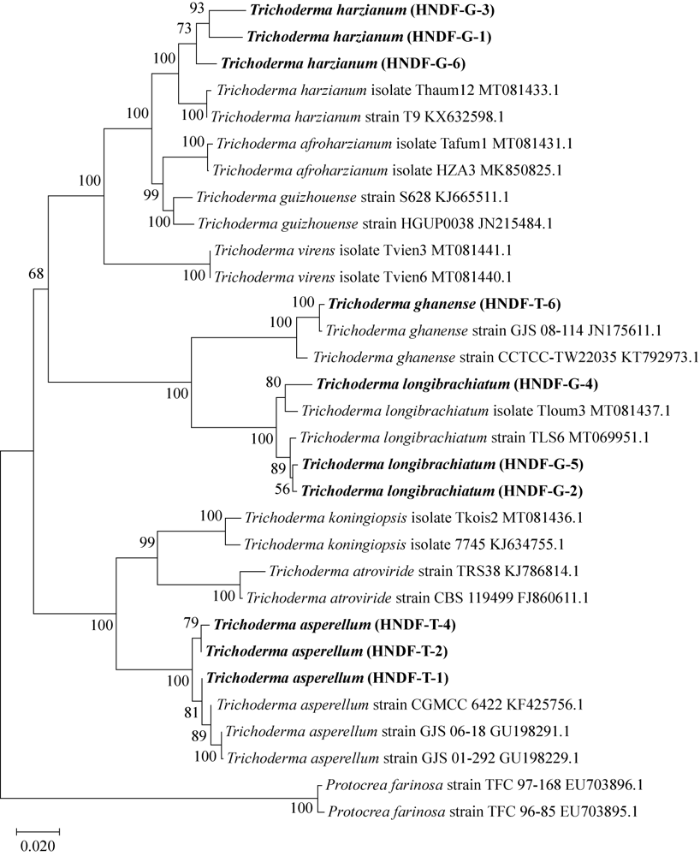
图2
基于Tef1-Rpb2序列构建的昆虫肠道分离木霉及该属相关物种的系统发育进化树 新分离的木霉为粗体字
Fig. 2
Phylogenetic tree based on Tef1-Rpb2 sequences of insect gut isolates of Trichoderma and the related species. The newly isolated Trichoderma strains are in bold face.
结合形态学和分子生物学最终鉴定木霉HNDF-T-1、T-2和T-4为棘孢木霉,木霉HNDF-T-6为加纳木霉,木霉HNDF-G-1、G-3和G-5为哈茨木霉,木霉HNDF-G-2、G-4和G-6为长枝木霉(表1)。
表1 来自不同昆虫肠道的木霉菌株鉴定
Table 1
| 菌株名称 Strain | 样品来源 Samples source | 木霉种名 Trichoderma species | Tef1基因登录号 GenBank accession No. | Rpb2基因登录号 GenBank accession No. |
|---|---|---|---|---|
| HNDF-G-1 | 蛴螬肠道Grub gut | T. harzianum | MW504034 | MZ357386 |
| HNDF-G-2 | 蛴螬肠道Grub gut | T. longibrachiatum | MW504035 | MZ357387 |
| HNDF-G-3 | 蛴螬肠道Grub gut | T. harzianum | MW504036 | MZ357388 |
| HNDF-G-4 | 蛴螬肠道Grub gut | T. longibrachiatum | MW504037 | MZ357389 |
| HNDF-G-5 | 蛴螬肠道Grub gut | T. longibrachiatum | MW504038 | MZ357390 |
| HNDF-G-6 | 蛴螬肠道Grub gut | T. harzianum | MW504039 | MZ357391 |
| HNDF-T-1 | 白蚁肠道Termite gut | T. asperellum | MW504040 | MZ357392 |
| HNDF-T-2 | 白蚁肠道Termite gut | T. asperellum | MW504041 | MZ357393 |
| HNDF-T-4 | 白蚁肠道Termite gut | T. asperellum | MW504042 | MZ357394 |
| HNDF-T-6 | 白蚁肠道Termite gut | T. ghanense | MW504043 | MZ357395 |
2.2 对峙培养和拮抗系数测定
表2 10株木霉菌株对盘长孢状刺盘孢拮抗作用
Table 2
| 菌株名称 Strain | 抑制率 Inhibition rate (%) | 拮抗系数 Coefficient of antagonism |
|---|---|---|
| HNDF-G-1 | 74.53±0.39 e | Ⅰ |
| HNDF-G-2 | 79.57±0.39 cd | Ⅱ |
| HNDF-G-3 | 80.36±0.54 c | Ⅰ |
| HNDF-G-4 | 81.16±0.33 bc | Ⅱ |
| HNDF-G-6 | 77.18±3.87 cde | Ⅱ |
| HNDF-T-1 | 76.58±1.07 cde | Ⅱ |
| HNDF-T-2 | 84.79±0.30 ab | Ⅰ |
| HNDF-T-4 | 75.56±3.21 de | Ⅱ |
| HNDF-T-6 | 86.02±0.56 a | Ⅰ |
注:数据为平均值±标准误,同列数据后不同小写字母表示具有显著差异(P<0.05). 下同
Note: Data were presented as means ± SD. Data in the same column with different lowercase letters indicating significant difference (P<0.05). The same below.
图3
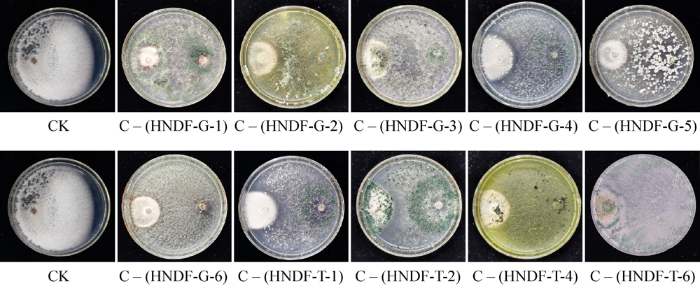
图3
10株木霉菌株对盘长孢状刺盘孢的拮抗效果 CK:在PDA平板生长第7天的盘长孢状刺盘孢;C:盘长孢状刺盘孢
Fig. 3
Antagonistic effects of 10 Trichoderma strains against Colletotrichum gloeosporioides. CK: Colony of C. gloeosporioides on PDA on 7th day; C: C. gloeosporioides.
2.3 挥发性物质和非挥发性物质抑菌活性测定
表3 不同木霉菌株挥发性和非挥发性物质对盘长孢状刺盘孢的抑制效果
Table 3
| 菌株编号 Strain number | 挥发性物质抑制率 Inhibition rate of volatile substances (%) | 非挥发性物质抑制率 Inhibition rate of non-volatile substances (%) |
|---|---|---|
| HNDF-G-1 | 41.53±0.41 ab | 12.65±0.72 b |
| HNDF-G-2 | 6.21±3.79 f | 5.73±1.49 c |
| HNDF-G-3 | 33.17±3.23 c | 12.89±2.89 b |
| HNDF-G-4 | 19.09±1.89 d | 11.46±2.51 b |
| HNDF-G-5 | 39.14±0.72 b | 11.46±1.80 b |
| HNDF-G-6 | 31.26±0.72 c | 12.65±1.89 b |
| HNDF-T-1 | 10.74±2.51 e | 5.73±0.41 c |
| HNDF-T-2 | 8.35±1.89 ef | 10.98±2.98 b |
| HNDF-T-4 | 44.39±2.30 a | 3.54±0.44 d |
| HNDF-T-6 | 38.42±3.99 b | 44.01±1.16 a |
图4
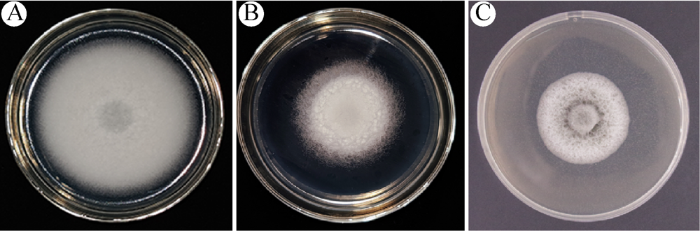
图4
加纳木霉HNDF-T-6挥发性和非挥发性物质对盘长孢状刺盘孢抑制作用 A:CK; B:HNDF-T-6挥发性物质对病原菌抑制作用;C:HNDF-T-6非挥发性物质对病原菌抑制作用
Fig. 4
Inhibitory effects of volatile and non-volatile substances produced by Trichoderma ghanense HNDF-T-6 against Colletotrichum gloeosporioides. A: CK; B: Inhibitory effects of volatile of T. ghanense HNDF-T-6 against C. gloeosporioides; C: Inhibitory effects of non-volatile substances of T. ghanense HNDF-T-6 against C. gloeosporioides.
2.4 室内防效测定
通过离体叶片测定,经加纳木霉HNDF-T-6孢悬液处理芒果叶片后,其病斑直径为(1.85± 0.23) mm,未经处理的对照组病斑直径为(3.43± 0.17) mm,木霉处理后显著抑制了芒果炭疽病菌在叶片上的病斑形成,其病斑直径减小了46.04% (图5),表明加纳木霉HNDF-T-6对芒果炭疽病具有较好的防治效果。
图5
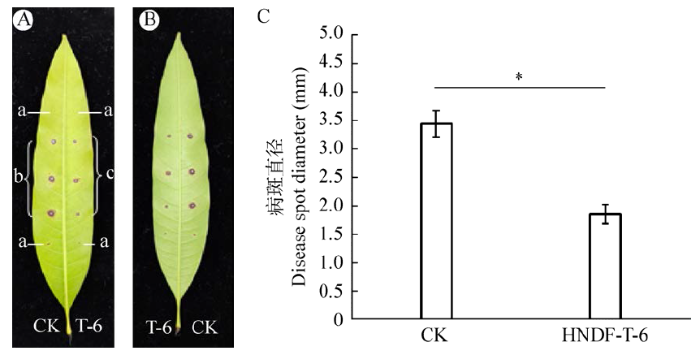
图5
加纳木霉HNDF-T-6对盘长孢状刺盘孢的离体叶片防效 A:叶片正面(a:刺伤+无菌水;b:刺伤+Colletotrichum gloeosporioides;c:刺伤+HNDF-T-6+C. gloeosporioides);B:叶片反面;C:病斑直径. *表示差异显著(P<0.05)
Fig. 5
Control effects of Trichoderma ghanense HNDF-T-6 against pathogen of mango anthracnose on isolated leaves. A: Upper surface of leaf (a: puncture + sterile water; b: puncture + C. gloeosporioides; c: puncture + HNDF-T-6 + C. gloeosporioides); B: Lower surface of leaf; C: Disease spot diameter. * Indicating significant difference (P<0.05).
3 讨论
木霉是一种广泛存在于土壤、枯枝落叶、腐败的果实及植物体内的微生物(Jiang et al. 2016)。研究发现木霉还可以存在于多种昆虫肠道内,对昆虫的消化和健康有重要的影响。例如Tarayre et al. (2015)从白蚁肠道分离出绿色木霉CTGxAviL,该菌株可以产生纤维素酶和木聚糖酶,帮助昆虫对食物的消化。Oyedokun & Adeniyi (2016)从腰果茎叶蜂前肠中也发现木霉属的存在,并占整个肠道真菌的78%,推测可能木霉属的存在有助于昆虫免受致病真菌的侵染。朱虹等(2005)从松墨天牛虫尸上分离出一株木霉Tr-dg,对草莓灰霉病菌具有34%抑制率。Zhang et al. (2020)从蜻蜓肠道中分离出一株哈茨木霉QTYC77,并发现该菌株对黄瓜枯萎病有较好的防治效果。以上研究表明,昆虫肠道不但存在丰富的木霉,而且可以筛选出具有较好生防作用的菌株。本研究从105份昆虫肠道进行木霉分离,只从蛴螬和白蚁肠道中分离出了10株木霉,其他昆虫样品中未分离出木霉,其原因可能是分离的样本过少或者这些昆虫肠道中的木霉数量较少,利用上述方法不能从样品成功分离木霉。另外一个原因可能这些昆虫肠道内不存在木霉。
木霉可以通过快速生长占据病原菌的生存空间并进行养分争夺,同时可以产生拮抗物质对病原菌产生抑制作用(孙虎等 2011)。但是,木霉属内不同种、甚至不同菌株间对病原菌拮抗能力差异较大,其表现的生防功能也不一样,因此,通过对峙培养和代谢产物的抑制试验的筛选,可以获得生防效果较强的菌株。李小杰等(2020)从28株木霉中通过对峙培养筛选获得3株对烟草疫霉菌有较强抑制作用的菌株,且抑菌率可达90%以上,其室内防效达80%以上。陈书华等(2016)从人参土壤和其他土壤中分离107株木霉,通过拮抗筛选获得5株对人参锈腐病菌Cylindrocarpon destructans有较强抑制作用的木霉菌株,防治效果均可达75%以上。本研究通过对峙培养、非挥发性和挥发性物质抑菌试验筛选获得一株对芒果炭疽病菌拮抗效果较好的木霉HNDF-T-6,其中非挥发性物质的拮抗效果最好,表明该菌株可以产生一些抑菌活性较高的次生代谢物质,然而具体是哪些具有抑菌活性的代谢物,需要进一步分离、纯化与鉴定。
由盘长孢状刺盘孢引起的芒果炭疽病是芒果上一种重要病害,它不仅在生长期为害芒果叶片、枝梢和果实,也是芒果上一种重要的采后病害(Sergio et al. 2013)。目前该病害的防治仍然依赖于化学杀菌剂,但是长期使用会造成抗药性、环境污染等问题,因此利用生防微生物防治该病害被广泛研究(Rajaofera et al. 2019)。丁从文等(2020)利用巨大芽孢杆菌LB01发酵液处理芒果果实,可以显著减少病斑发生和扩展。许春青(2013)从芒果叶片上分离了一株季也蒙毕赤酵母Pichia guilliermondii,对芒果炭疽病的防效可达70%。哈茨木霉DGA01孢子悬浮液处理芒果果实,可以减少病斑面积87.90% (Alvindia 2018);绿色木霉T. viride发酵液处理芒果果实,7 d后与对照比较其发病率下降32.91% (刘淑宇 2013)。本研究利用木霉HNDF-T-6孢悬液预处理芒果叶片后,可以显著降低叶片病斑的发生和扩展,在实验室条件下表现出较好的防治效果。但是,利用该木霉处理芒果果实后,其防治效果不稳定,具体原因还需进一步分析与探索。
参考文献
Perspectives of microbial inoculation for sustainable development and environmental management
DOI:10.3389/fmicb.2018.02992 URL [本文引用: 1]
The antagonistic action of Trichoderma harzianum strain DGA01 against anthracnose-causing pathogen in mango cv. ‘Carabao’
In vitro antagonism of Trichoderma species against six fungal plant pathogens
Biocontrol mechanisms of Trichoderma strains
The genus Trichoderma comprises a great number of fungal strains that act as biological control agents, the antagonistic properties of which are based on the activation of multiple mechanisms. Trichoderma strains exert biocontrol against fungal phytopathogens either indirectly, by competing for nutrients and space, modifying the environmental conditions, or promoting plant growth and plant defensive mechanisms and antibiosis, or directly, by mechanisms such as mycoparasitism. These indirect and direct mechanisms may act coordinately and their importance in the biocontrol process depends on the Trichoderma strain, the antagonized fungus, the crop plant, and the environmental conditions, including nutrient availability, pH, temperature, and iron concentration. Activation of each mechanism implies the production of specific compounds and metabolites, such as plant growth factors, hydrolytic enzymes, siderophores, antibiotics, and carbon and nitrogen permeases. These metabolites can be either overproduced or combined with appropriate biocontrol strains in order to obtain new formulations for use in more efficient control of plant diseases and postharvest applications.
Selection of Trichoderma spp. antagonistic to Cylindrocarpon destructans, pathogen of ginseng root rot disease
Antagonistic properties of species-groups of Trichoderma: II. Production of volatile antibiotics
DOI:10.1016/S0007-1536(71)80078-5 URL [本文引用: 1]
Inhibition mechanism of Bacillus megaterium LB01 against Colletotrichum gloeosporioides in postharvest mangos
Trichoderma biodiversity in major ecological systems of China
DOI:10.1007/s12275-019-8357-7 URL [本文引用: 1]
The gut microbiota of insects - diversity in structure and function
DOI:10.1111/1574-6976.12025 URL [本文引用: 1]
Antibacterial properties of Trichoderma viride on Colletotichum gloeosporioides Penz. of mango
Morphology and identification of Trichoderma
Impact of the insect gut microbiota on ecology, evolution, and industry
DOI:10.1016/j.cois.2020.06.004 URL [本文引用: 1]
Trichoderma biodiversity of agricultural fields in East China reveals a gradient distribution of species
DOI:10.1371/journal.pone.0160613 URL [本文引用: 2]
Antifungal mechanism of bacillomycin D from Bacillus velezensis HN-2 against Colletotrichum gloeosporioides Penz
DOI:10.1016/j.pestbp.2019.11.004 URL [本文引用: 1]
Advances in mango anthracnose (Colletotrichum gloeosporioides)
Screening, identification of antagonistic Trichoderma spp. against tobacco black shank and its growth promotion effect on tobacco
Effect of Trichoderma viride fermentation broth on inhibition against Colletotrichum gloeosporioides and preservation of mango fruit
Inoculation of tomato seedlings with Trichoderma harzianum and arbuscular mycorrhizal fungi and their effect on growth and control of wilt in tomato seedlings
DOI:10.1590/S1517-83822011000200015 URL [本文引用: 1]
Microbial diversity in the gut of cashew stem girdler, Analeptes trifasciata fabricius (Coleoptera: Cerambycidae), in Ibadan, Nigeria
DOI:10.4137/IJIS.S31265
PMID:27147898
[本文引用: 1]

The cashew stem girdler, Analeptes trifasciata, is a major insect pest of cashew in Nigeria causing economic damage in cashew plantations even at low density. In this study, newly emerged adults of A. trifasciata reared from field-infested cashew stems were collected from the rearing cages, sexed, and dissected to reveal the internal structures of the insects. The gut was excised and separated into the foregut, midgut, and hindgut. The dissected gut compartments were blotted dry by sandwiching in sterile Whatman No. 1 (150 mm) filter paper for a minute. The inoculated gut parts showed the presence of eight fungi flora, namely, Aspergillus repens, Trichoderma spp., Fusarium verticillioides, Lasiodiplodia theobromae, yeast, Aspergillus niger, Fusarium spp., and Rhizopus stolonifer. The frequencies of occurrence of bacteria in the gut compartments of A. trifasciata were Enterobacter spp.: 83.33%; Escherichia coli and Streptococcus spp.: 55.56% each; Staphylococcus spp.: 44.44%; Klebsiella pneumonia: 50% and Salmonella shigella: 11.11%, while each of Serratia marceascea, Pseudomonas spp., and Micrococcus lutea had 5.56% occurrence. The occurrence of mycoflora and microbiota species varied in the gut compartments of A. trifasciata, indicating the role of these microorganisms in metabolic and other bioprocesses of A. trifasciata during digestion and synthesis of complex food substances from the cashew stem substrate. This study would provide basic information for enzymatic studies of A. trifasciata with a view to developing an integrated pest management (IPM) protocol for managing the pest in cashew plantations.
Volatile organic compounds of Bacillus atrophaeus HAB-5 inhibit the growth of Colletotrichum gloeosporioides
DOI:S0048-3575(18)30620-5
PMID:31027577
[本文引用: 1]
The use of fungicides to control plant diseases creates a potential health risk. One alternative to this problem is the biological control, which has been succesfully applied to control plant diseases. Bacillus atrophaeus HAB-5 exhibits a high inhibitory acitivities against different fungal pathogens and suppresses them. The aim of current studies is to produce and identify the antifungal compounds produced by the strain HAB-5. We found that the submerge fermentation harvested from Luria-Bertani (LB) medium had the highest activity against Colletotrichum gloeosporioides. The petroleum ether crude extract was strongly bioactive and its activity was stable after heat treatment, pH treatment, illuminated light as well as ultra violet exposition. The antifungal compounds were purified using gel chromatography column. Based on Gas Chromatography-Mass Spectrometry (GC-MS) analysis, nineteen different volatile organic compounds (VOCs) were identified included the range of alkanes, alkenes, alcohols, and organics acid. Among these identified compounds, Chloroacetic acid, tetradecyl esters followed by Octadecane and Hexadecanoic acid, methyl ester showed antifungal activity against C. gloeosporioides. Our results clearly showed Chloroacetic acid, tetradecyl esters; Octadecane and Hexadecanoic acid, methyl ester are key inhibitory compounds produced by Bacillus atrophaeus HAB-5 against C. gloeosporioides.Copyright © 2019 Elsevier Inc. All rights reserved.
Trichoderma: identification and agricultural applications
Potential use of Trichoderma asperellum T8a as a biological control agent against anthracnose in mango
DOI:10.1016/j.biocontrol.2012.10.006 URL [本文引用: 1]
Research advances on mechanism of biological control and application about Trichoderma spp
Isolation and cultivation of xylanolytic and cellulolytic Sarocladium kiliense and Trichoderma virens from the gut of the termite Reticulitermes santonensis
DOI:10.1007/s11356-014-3681-2
PMID:25300185
[本文引用: 1]
The purpose of this work was the isolation and cultivation of cellulolytic and xylanolytic microorganisms extracted from the gut of the lower termite Reticulitermes santonensis. Microcrystalline cellulose (with and without lignin) and beech wood xylan were used as diets instead of poplar wood in order to select cellulose and hemicellulose-degrading fungi. The strain Sarocladium kiliense (Acremonium kiliense) CTGxxyl was isolated from the termites fed on xylan, while the strain Trichoderma virens CTGxAviL was isolated from the termites fed on cellulose (with and without lignin). Both molds were cultivated in liquid media containing different substrates: agro-residues or purified polymers. S. kiliense produced maximal β-glucosidase, endo-1,4-β-D-glucanase, exo-1,4-β-D-glucanase and endo-1,4-β-D-xylanase activities of 0.103, 3.99, 0.53, and 40.8 IU/ml, respectively. T. virens produced maximal β-xylosidase, endo-1,4-β-D-glucanase, exo-1,4-β-D-glucanase, and endo-1,4-β-D-xylanase activities of 0.38, 1.48, 0.69, and 426 IU/ml. The cellulase and the xylanase of S. kiliense, less common than T. virens, were further investigated. The optimal activity of the xylanase was observed at pH 9-10 at 60 °C. The cellulase showed its maximal activity at pH 10, 70 °C. Zymography identified different xylanases produced by both molds, and some fragment sizes were highlighted: 35, 100, and 170 kDa for S. kiliense and 20, 40, 80, and 170 kDa for T. virens. In both cases, endo-1,4-β-D-xylanase activities were confirmed through mass spectrometry.
The preservation effect of Metschnikowia pulcherrima yeast on anthracnose of postharvest mango fruits and the possible mechanism
DOI:10.1007/s10068-017-0213-0 URL [本文引用: 1]
Trichoderma-plant-pathogen interactions
DOI:10.1016/j.soilbio.2007.07.002 URL [本文引用: 1]
Correlation between laccase lac1 and pathogenicity of Colletotrichum gloeosporioides causing mango anthracnose
Isolation and identification of bacteria from the larval midgut of the diamondback moth, Plutella xylostella
Screening, identification of a antagonistic yeast against mango anthracnose and evaluation of its protectants
Analysis on environmental costs of crop pest chemical management technologies in China
Dragonfly-associated Trichoderma harzianum QTYC77 is not only a potential biological control agent of Fusarium oxysporum f. sp. cucumerinum but also a source of new antibacterial agents
DOI:10.1021/acs.jafc.0c05760 [本文引用: 1]
Selection of Trichoderma strains for suppression of strawberry mold disease caused by Botrytis cinerea
拮抗烟草疫霉菌的木霉菌株筛选鉴定及防病促生作用研究