



双缘衣属Diploschistes Norman是1852年建立的,当时放在了疣孔衣科Thelotremataceae Stizenb中。但在该科与相关地衣科属的研究中发现,疣孔衣科与文字衣科在地衣体外部形态与内部构造和囊间组织、子囊、子囊孢子的形态上有许多相似之处,难以找到这2个科的区别。唯一区别在于疣孔衣科子囊盘为圆状,而在文字衣科中为线状子囊盘;根据子囊器形态的不同,Henssen & Jahns (1973)和Henssen (1976)把疣孔衣科Thelotremataceae和文字衣科Graphidaceae Dumort分别放在了疣孔衣亚目Ostropineae Nannfeldt和文字亚目Graphidineae Zahlbr中。近几年的关于厚顶盘目的系统学研究过程发现,疣孔衣科是单系类群,但是嵌入到文字衣科中,与其构成并系关系 (Martín et al. 2003;Grube et al. 2004;Lücking et al. 2004; Staiger et al. 2006;Lumbsch et al. 2014)。Mangold et al. (2008)在大量的分子数据基础上,进一步证明了疣孔衣科和文字衣科的关系,并建议疣孔衣科放在文字衣科内。在2010年的《子囊菌大纲》(Outline of the Ascomycota)中采用了这个分类系统(Lumbsch & Huhndorf 2010)。后来,一些学者利用分子生物学手段对文字衣科Graphidaceae进行了深入的分类学研究。Lücking et al. (2013)与Rivas Plata et al. (2013)进一步将文字衣亚科分为3个族(tribe):文字衣族Graphideae Rivas Plata, Lücking & Lumbsch、疣孔衣族Thelotremateae Rivas Plata, Lücking & Lumbsch和点衣族Ocellularieae Rivas Plata, Lücking & Lumbsch,并把双缘衣属Diploschistes作为一分支放在了文字衣族Graphideae里。随后,Lumbsch et al. (2014)在文字衣亚科增加了4个新族:Acanthothecieae Lumbsch, Kraichak & Lücking、双缘衣族Diploschisteae (Zahlbr.) Lumbsch, Kraichak & Lücking、麻衣族Leptotremateae Lumbsch, Kraichak & Lücking和Wirthiotremateae Lumbsch, Kraichak & Lücking。Kraichak et al. (2018)和Lücking (2019)利用时间条带法(temporal banding approach)分别对茶渍纲Lecanoromycetes O.E. Erikss. & Winka内两个主要亚纲的几个目进行了深入研究,其结果把文字衣科Graphidaceae裂成双缘衣科Diploschistaceae Zahlbr、裂隙衣科Fissurinaceae B.P. Hodk、文字衣科Graphidaceae s.str.和疣孔衣科Thelotremataceae 4个科,并重新使用了双缘衣科Diploschistaceae和疣孔衣科Thelotremataceae。在Wijayawardene et al. (2022)发表的真核微生物菌物界的最新分类体系《真菌和类真菌分类群概述》(Outline of Fungi and Fungus-like Taxa)中采用了这个分类系统。
现在的分类系统中,双缘衣属属于双缘衣科、文字衣目、厚顶盘亚纲、茶渍纲、子囊菌门,全世界有48种 (Kirk et al. 2008;Pérez-Vargas et al. 2012;Fernández-Brime et al. 2013;Abbas et al. 2014;Ababaikeli et al. 2016,2018),中国已报道的有15个种1个变型(Wei 2020)。本属主要分布在亚热带到温带,也有少数种延伸到热带地区(Lumbsch 1993;Lumbsch & Aptroot 1993;Pant & Upreti 1993;Breuss & Brunnbauer 1997;Umaña & Sipman 2002),生长在岩石、土壤、苔藓和其他地衣上。
双缘衣属地衣的主要鉴别特征为具有含黑色假薄壁组织的固有盘壁、侧丝侧生,共生藻为共球藻(Lumbsch 1989;Guderley & Lumbsch 1996;Guderley et al. 1997),次生代谢产物主要由缩酚酸类组成(Fernández-Brime et al. 2013)。这个属的地衣子囊果形态表现出显著的可变性,子囊果呈子囊壳状(亚球形或瓶状)至坛状和茶渍型子囊盘状(Lumbsch 1989)。根据地衣体和子囊盘的外部形态和内部构造,Fernández-Brime et al. (2013)把双缘衣属地衣分为3个亚属:Diploschistes Norman subg. Diploschistes、Diploschistes subg. Limborina Fdez.-Brime, Gaya & Llimona和Diploschistes subg. Thorstenia Fdez.-Brime, Gaya & Llimona。
新疆气候属典型的温带大陆性干旱气候,常见种藓生双缘衣Diploschistes muscorum (Scop.) R. Sant在新疆有非常广泛的分布,准噶尔盆地、天山和昆仑山等地都能见到,双缘衣属地衣成为了新疆这样温带、干旱半干旱地区地衣群落的主要组成成分,也参与土壤结皮的形成。有研究证明双壳双缘衣Diploschistes diacapsis (Ach.) Lumbsch可形成广泛的白色地毯,在防止坡面侵蚀和植物集群方面起着重要的作用(Pintado et al. 2005)。
巩乃斯林场位于天山西部,具有7.85万hm2天然林资源,海拔在1 600-2 400 m之间。巩乃斯林场地处天山腹地,属大陆高寒山地气候类型,冬季漫长寒冷多雪,夏季较短,雨量充沛,多东南风。这里是向西开口的喇叭口地形,自然环境拦截了到达新疆上空的大西洋和北冰洋等较湿润的大气环流,形成一定的降水量,植被生长发育繁茂,宛如是突出在整个新疆干旱戈壁荒漠大平原上的一座庞大的“绿色岛屿”。
2018-2021年,对新疆巩乃斯林场进行地衣资源调查过程中发现了双缘衣属地衣一个新种。本文提供了新种的特征、生境的详细描述;从基因库中下载该属13个种、24个ITS序列,并构建了系统发育树。研究结果为我国地衣的生物多样性提供科学性资料。
1 材料与方法
1.1 材料
采自新疆天山西部巩乃斯林场的30余份双缘衣属地衣标本。
1.2 地衣形态解剖和化学物质的鉴定
用体式光学显微镜(SZM45)对地衣体和子囊盘外部形态进行了观察;用光学透视显微镜(Nikon DS-Fi2)对地衣体和子囊盘的内部构造进行观察。用Nikon ECLIPSE NI-E研究级显微镜对显微结构进行拍照。地衣体外部形态照片用NIKON D-810数码相机拍照。
通过显色反应法和薄层层析法(Culberson & Kristisson 1970;Culberson 1972;Orange et al. 2001)鉴定地衣化学成分。显色反应法常用的试剂有K (5%-10%氢氧化钾水溶液)、C (漂白粉饱和水溶液)、KC (先使用K,紧接着补加C)和P (对苯二氨乙醇溶液)等。根据呈色情况,利用检索表鉴定了地衣酸。薄层层析法中所用的溶剂系统为:C系统(甲苯:乙酸=85:15);G系统(甲苯:乙酸乙酯:甲酸=139:83:8)。最后对其在自然光、喷硫酸前和后365、254 nm处紫外光下呈现的颜色和有无荧光物质情况进行记录;并根据参照物确定样品的Rf值,从而确定地衣体所含物质。
1.3 分子和系统发育学分析方法
利用Sangon Biotech 真菌基因组DNA抽提试剂盒[生工生物工程(上海)股份有限公司]提取DNA,选取rDNA-ITS为基因标记,采用引物ITS1F和ITS4进行PCR扩增。PCR反应体系:2×Taq PCR master mix 12.5 μL,引物ITS1F (5'-CTTGGT CATTTAGAGGAAGTAA-3')和ITS4 (5'-TCCTC CGCTTATTGATATGC-3') (10 μmol/L)各0.5 μL,DNA模板2 μL,ddH2O 9.5 μL。PCR反应条件:95 ℃预变性5 min;10个循环(95℃变性30 s,66 ℃退火30 s,72 ℃延伸90 s);34个循环(95 ℃变性30 s,56 ℃退火30 s,72 ℃延伸60 s);72 ℃延伸10 min。PCR扩增产物的测序委托生工生物工程(上海)股份有限公司完成。
1.4 系统发育分析
测序成功的ITS序列由DNASTAR-seqman pro进行拼接,并将序列上传至NCBI,获得序列号为OP070000和OP070001。构建系统发育所用序列的选择参考绿盘双缘衣ITS序列在线BLAST [Nucleotide BLAST: Search nucleotide databases using a nucleotide query (nih.gov)]结果与相关文献(Martín et al. 2003;Fernández-Brime et al. 2013;Abbas et al. 2014;Ababaikeli et al. 2016, 2018)在NCBI下载,所用ITS序列信息列于表1。利用MEGA v11.0.10对上述序列进行比对(alignment),经过编辑修剪后利用ModelFinder (Kalyaanamoorthy et al. 2017)的Akaike information criterion (AIC)准则选择最佳拟合模型,进行最大似然法(maximum likelihood,ML)分析的最适模型为TNe+G4,进行贝叶斯法(Bayes inference,BI)分析的最适模型为K2P+G4。使用IQ-TREE v1.6.12(Nguyen et al. 2015)在TNe+G4模型下进行5 000次超快自展(ultrafast) (Minh et al. 2013),以及Shimodaira-Hasegawa-like近似似然比检验(Guindon et al. 2010)推断最大似然系统发生,构建ML树。使用MrBayes v3.2.6 (Ronquist et al. 2012)在K2P+G模型(2个并行运行,1 000 000代)下推断贝叶斯推断系统进化,其中初始25%的采样数据作为老化数据被丢弃(burn in=0.25),构建BI树。系统发育树的可视化与美化在Figtree中进行。
表1 用于系统发育分析的物种及序列信息
Table 1
| 物种名 Species | 凭证标本号 Voucher No. | 采集地 Locality | 基因库序列号 GenBank No. |
|---|---|---|---|
| Diploschistes ocellatus1 | BCC-Lich 13207 | / | AF098411 |
| Diploschistes ocellatus2 | DUKE 144450 | 澳大利亚Australia | KC167010 |
| Diploschistes cinereocaesius1 | ESS 9364 | 委内瑞拉 Venezuela | AJ458282 |
| Diploschistes cinereocaesius2 | Hb. Palice | 厄瓜多尔 Ecuador | KJ542542 |
| Diploschistes wui1 | Abbas 20093003 | 中国新疆 Xinjiang, China | MG461530 |
| Diploschistes wui2 | Abbas 20093021 | 中国新疆 Xinjiang, China | MG461532 |
| Diploschistes xinjiangensis1 | Abbas 110821s1 | 中国新疆 Xinjiang, China | KJ000011 |
| Diploschistes xinjiangensis2 | Abbas 110821s2 | 中国新疆 Xinjiang, China | KJ000012 |
| Diploschistes diacapsis1 | DUKE 30912 | 西班牙 Spain | KC166978 |
| Diploschistes diacapsis2 | DUKE 130126 | 美国 USA | KC166979 |
| Diploschistes neutrophilus1 | BCN-Lich19357 | 西班牙 Spain | KC166982 |
| Diploschistes neutrophilus2 | BCN-Lich 19329 | 西班牙 Spain | KC166983 |
| Diploschistes scruposus | Hb. Fdez.-Brime | 西班牙 Spain | KJ542545 |
| Diploschistes gypsaceus1 | BCN-Lich 19324 | 西班牙 Spain | KC166988 |
| Diploschistes gypsaceus2 | BCN-Lich 19345 | 西班牙 Spain | KC166989 |
| Diploschistes muscorum1 | BCN-Lich 19344 | 西班牙 Spain | KC167007 |
| Diploschistes muscorum2 | BCN-Lich 19334 | 西班牙 Spain | KC167008 |
| Diploschites viridis1 | 20217673 | 中国新疆 Xinjiang, China | OP070000 |
| Diploschites viridis2 | 20217676 | 中国新疆 Xinjiang, China | OP070001 |
| Diploschistes tianshanensis1 | Abbas 20s1 | 中国新疆 Xinjiang, China | KC959951 |
| Diploschistes tianshanensis2 | Abbas 20s2 | 中国新疆 Xinjiang, China | KC959952 |
| Diploschistes diploschistoides1 | DUKE 144445 | 西班牙 Spain | KC166984 |
| Diploschistes diploschistoides2 | DUKE 18863 | 澳大利亚 Australia | KC166985 |
| Diploschistes rampoddensis1 | BCN-Lich 18011 | 西班牙 Spain | KC166993 |
| Diploschistes rampoddensis2 | BCN-Lich 18008 | 西班牙 Spain | KJ542543 |
| Thelotrema lepadinum | / | / | AF546077 |
注:本研究自测序列加粗表示
Note: The new sequences generated in this study are indicated in boldface.
2 结果与分析
2.1 系统发育分析
ML分析与BI分析所得的系统发育树结果一致,最终系统发育图(图1)。系统发育结果显示,13个双缘衣物种分为了6个分支。双壳双缘衣D. diacapsis (Ach.) Lumbsch、D. neutrophilus (Clauzade & Cl. Roux) Fern和双缘衣D. scruposus (Schreb.) Norman、D. gypsaceus (Ach.) Zahlbr物种以较高的支持率与后验概率聚在分支3 (Clade 3)。新疆双缘衣D. xinjiangensis A. Abbas & S.Y. Guo、吴双缘衣D. wui A. Abbas, S.Y. Guo & Ababaikeli和大环形双缘衣D. cinereocaesius (Sw.) Vain 3个物种聚成分支2 (Clade 2),支持率为81%,BI后验概率为0.99。绿盘双缘衣D. viridis与天山双缘衣D. tianshanensis A. Abbas, S.Y. Guo & Ababaikeli聚在一支,形成姊妹群,说明这2个物种有着较近的亲缘关系,并且这2个物种与藓生双缘衣D. muscorum极好地聚在分支4 (Clade 4),支持率为98%,BI后验概率为1,该分子系统发育的结果与形态鉴定一致,绿盘双缘衣与天山双缘衣、藓生双缘衣有着较相似的结构特征。此外,Clade 4还与Clade 3聚为分支A (Clade A),支持率为57%,BI后验概率为0.86,根据Martín et al. (2003)和Ababaikeli et al. (2016)的研究结果,绿盘双缘衣可能属于D. scruposus组合。D. diploschistoides (Vain.) G. Salisb、斯里兰卡双绿衣D. rampoddensis (Nyl.) Zahlbr和D. ocellatus (Fr.) Norman 3个物种各自形成单系。外类群(Outgroup)帽贝疣孔衣T. lepadinum (Ach.) Ach位于树的基部。
图1
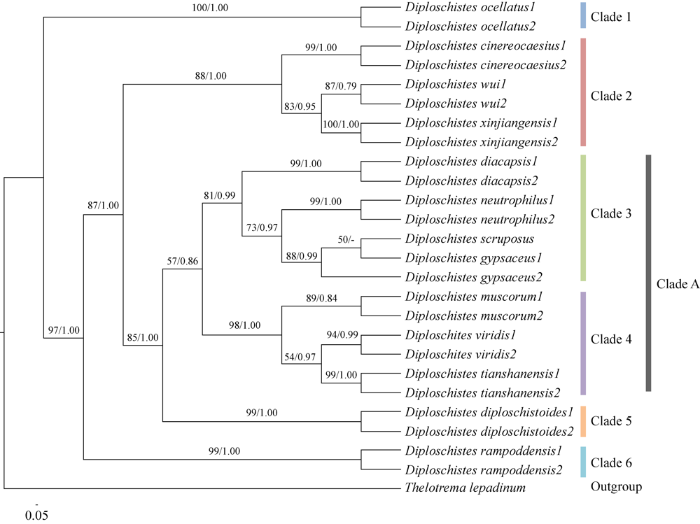
图1
双缘衣属ITS序列系统发育树
仅显示支持率(ML)大于50%和后验概率(BI)大于0.75的数据
Fig. 1
Phylogenetic tree construction of Diploschistes based on ITS.
Maximum likelihood bootstrap value above 50% and Bayes inference posterior probability above 0.75 are shown at nodes.
2.2 分类单元
绿盘双缘衣 图2
图2
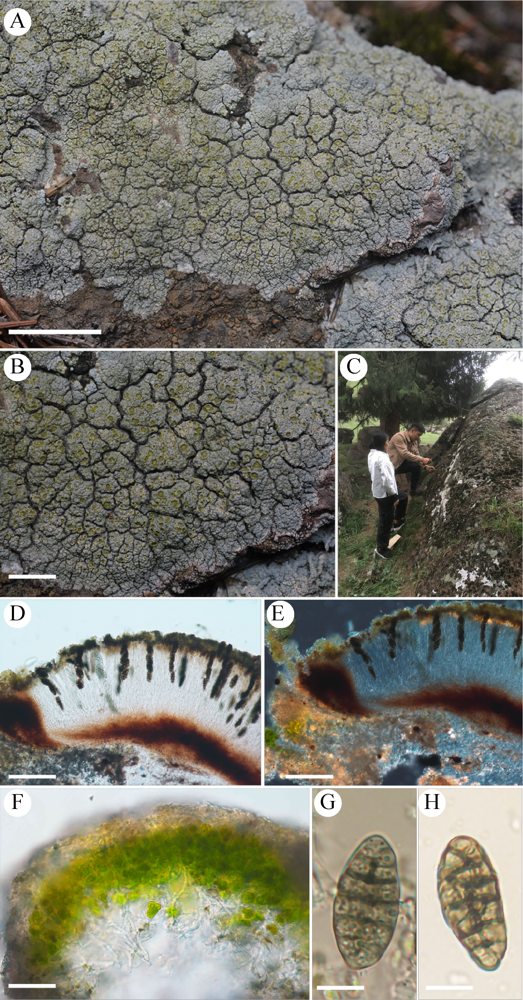
图2
绿盘双缘衣的形态和解剖结构
A:地衣体;B:地衣体的部分放大(示子囊盘);C:生境;D:子囊盘纵切;E:子囊盘纵切(偏光镜下);F:地衣体纵切;G,H:子囊孢子. 比例尺:A,B=1 cm;D,E=100 μm;F=50 μm;G,H=5 μm
Fig. 2
Morphological and anatomical photos of Diploschistes viridis (Specimen No: GNS7673).
A: Thallus; B: Magnified photo of thallus (showing the structure of apothecia); C: Habitat; D: Cross section of apothecia; E: Cross section of apothecia (in polarized light); F: Cross section of thallus; G, H: Ascospore. Scale bars: A, B=1 cm; D, E=100 μm; F=50 μm; G, H=5 μm.。
Diploschistes viridis R. Mamut, J.J. Fang & T. Payzulla, sp. nov.Fig. 2
MycoBank: MB 845080
Diagnosis: Similar to D. tianshanensis A. Abbas, S.Y. Guo & G. Ababaikeli, but differing in having a thick, rimosely areolate thallus, containing orsellinic acid, and saxicolous habitat.
Etymology: viridis referred to the green color of the lichen thallus and apothecia.
Type: China, Xinjiang, Korla, Hejing County, Mt. Tianshan, Gongnaisi forest farm, 84.534 444°E and 43.262 778°N, alt. 1 930 m, Jul. 2021, coll. Mamut R., B.T. Li, GNS 7673 (Holotype, XJU, GenBank OP070000, OP070001; Isotype, HMAS-L, HMAS-L 154766).
Description: Thallus crustose, rimosely areolate, pale grayish green, green pruina of densely distributed apothecial discs giving the thallus a greenish yellow appearance, up to 4 mm thick; margins distinct, whitish; epinecral layer 25-35 µm thick, without a well-developed cortex; photobiont trebouxioid.
Apothecia urceolate, densely distributed, 0.3-1.7 mm in diam., with an orbicular, concave disc with greenish yellow pruina. Proper exciple red brown, 60-80 µm thick. Hymenium hyaline, 140-170 µm high. Hypothecium red brown, without oil droplets, 20-40(-50) μm thick. Paraphyses simple, apices not thickened. Ascospores ellipsoid, brown, muriform, 30-38×14-17 μm. Pycnidia not observed.
Spot tests: K+ yellow, C+ and KC+ vivid red, PD−.
Secondary metabolites: Lecanoric acid, diploschistesic acid and orsellinic acid detected by TLC.
Habitat: It grows on the rocks under Picea schrenkiana Fisch. & C.A. Mey trees.
Additional material examined: China, Xinjiang, Korla, Hejing County, Mt. Tianshan, Gongnaisi forest farm, 84.534 444°E and 43.262 778°N, alt. 1 930 m, Jul. 2021, coll. Mamut R., B.T. Li, GNS7670, paratype; China, Xinjiang, Korla, Hejing County, Mt. Tianshan, Gongnaisi forest farm, 84.534 444°E and 43.262 778°N, alt. 1 930 m, Jul. 2021, coll. Mamut R., B.T. Li, GNS7671, GNS7675, GNS7676, GNS7678.
Remarks: Diploschistes viridis is restrictedly distributed on the shady slope of Gongnaisi forest farm, with low temperature, weak evaporation, and abundant precipitation (Fig. 2C). This new species is characterized by its rimosely areolate, grayish green thallus and yellowish green apothecia. It is morphologically similar to D. tianshanensis having thin, continuous, muddy and uniform thallus, dark brown proper exciple, yellowish brown hypothecium, containing lecanoric acid and diploschistesic acid, without orsellinic acid, and having corticolous habitat. In D. viridis, thallus is rimosely areolate, forms a certain shape; proper exciple and hypothecium are red brown, containing lecanoric acid, diploschistesic acid and orsellinic acid, with a saxicolous habitat. Another similar species is D. scruposus (Schreb.) Norman which differs in having a brownish gray thallus, darkish apothecial disc, 100-140 µm high hymenium, and the predominantly (4-)8-spored asci. Diploschistes viridis has a green apothecial disc and 140-170 µm high hymenium, having always 4-spored asci. Diploschistes viridis is related to D. muscorum in having the same secondary metabolites, but the latter differs in having whitish gray, grayish or whitish pruinose, thinner thallus, being a juvenile parasite on Cladonia spp., and having a smaller ascospores (Lumbsch 2002). Diploschistes wui is also saxicolous, but it is distinguished by its thin bluish gray thallus, epruinose discs, 8-spored asci, and smaller ascospores (Ababaikeli et al. 2018).
Gongnaisi Forest Farm is known as a “old-growth forest”, and is located in nourthwest of Hejing County, Xinjiang, China. In this forest farm dead and dying trees are a favorite habitat of many epiphytic lichens, and lichen diversity on fallen trees is often higher than that on living and vital trees.
特征简介:此种与天山双缘衣相似,但是该新种地衣体龟裂状、较厚,生长基物为岩石。
词源:新种拉丁名种加词“viridis”代表该物种地衣体和子囊盘绿色。
特征:地衣体壳状,龟裂状,疣状隆起,紧密固着于基物上,边缘清晰,白色。地衣体表面浅灰绿色,也因密集子囊盘盘面附着的粉霜颜色而呈绿黄色,厚度达4 mm。地衣体上表面25-35 µm厚,藻胞层藻细胞密集,连续,共生藻为共球藻。
子囊盘坛状,圆形,子囊盘半埋生于地衣体中生长,单生,数量多,直径达0.3-1.7 mm。盘面被浓厚的黄绿色粉霜包围。子囊盘边缘与地衣体同色,不连续,齿裂。囊层被为拟薄壁组织,红褐色,60-80 µm厚。子实层无色,140-170 µm 高。囊层基红褐色,20-40(-50) μm厚。侧丝单一,顶端不增厚。子囊内含4孢子。囊孢子椭圆形,砖壁形,褐色,30-38×14-17 μm。分生孢子器未见。
化学反应:地衣体K+黄色、C+紫红色,地衣体KC+红色,PD−。
化学成分:茶渍酸,双缘衣酸,苔色酸(TLC)。
基物:岩石。研究区域中发现,该种生长在天山云杉Picea schrenkiana Fisch. & C.A. Mey.下的岩石上。
研究标本:GNS7673 (模式标本):东经84.534 444°,北纬43.262 778°,海拔1 930 m,新疆和静县,天山西部巩乃斯林场,采集人:热衣木·马木提,李碧庭,2021年7月;GNS7670、GNS7671、GNS7675、GNS7676、GNS7678:东经84.534 444°,北纬43.262 778°,海拔1 930 m,新疆和静县,天山西部巩乃斯林场,采集人:热衣木·马木提,李碧庭,2021年7月。
3 讨论
调查发现,绿盘双缘衣只限分布在巩乃斯林场阴坡,气温较低,蒸发较弱,为迎风坡,降水较丰富的区域(图2C)。绿盘双缘衣与天山双缘衣D. tianshanensis在地衣体颜色、子囊盘形状和颜色、子囊孢子形状和大小方面很接近。但后者中地衣体连续,薄,泥土形,没有固定形状,囊层被黑褐色,囊层基黄褐色,内含双缘衣酸和茶渍酸,不含苔色酸,生长在树皮上。而绿盘双缘衣地衣体较厚,具一定形状,龟裂状,囊层被和囊层基红褐色,内含双缘衣酸、茶渍酸和苔色酸,生长基物为岩石。绿盘双缘衣与双缘衣D. scruposus具有相似的龟裂状淡绿色地衣体,但双缘衣中子囊盘黑色,子实层100-140 µm高,子囊孢子为(4-)8个;而绿盘双缘衣子囊盘为绿色,子实层140-170 µm高,子囊孢子为4个。绿盘双缘衣与藓生双缘衣D. muscorum 有同样的次生代谢产物,但后者具有灰色和淡灰色或淡白色粉霜、较薄地衣体,未成熟时常寄生在石蕊属地衣上,并具有较小子囊孢子(Lumbsch 2002)。吴双缘衣D. wui和绿盘双缘衣都生长在岩石上,但吴双缘衣中,地衣体薄、淡蓝灰色,子囊盘盘面无粉霜,子囊孢子8个,孢子大小比绿盘双缘衣小(Ababaikeli et al. 2018)。
经考察发现,该森林内死亡的树或朽木作为栖息地的附生植物的地衣种类多,并且地衣多样性往往高于活的树木上生活的地衣种类,因此也是中国濒危地衣研究中的一个重要地区。
参考文献
Diploschistes tianshanensis sp. nov., a corticolous species from northwestern China
DOI:10.5248/131.565 URL [本文引用: 3]
Diploschistes wui sp. nov., an overlooked saxicolous lichen from Northwestern China
DOI:10.5248/133.141 URL [本文引用: 4]
Diploschistes xinjiangensis, a new saxicolous lichen from northwest China
DOI:10.5248/129.465 URL [本文引用: 2]
Flechten aus Sri Lanka. Annalen des Naturhistorischen Museums in Wien
Improved conditions and new data for the identification of lichen products by a standardized thin-layer chromatographic method
Standardized method for the identification of lichen products
DOI:10.1016/S0021-9673(00)83967-9 URL [本文引用: 1]
Phylogenetic study of Diploschistes (lichen-forming Ascomycota: Ostropales: Graphidaceae), based on morphological, chemical, and molecular data
DOI:10.12705/622.10 URL [本文引用: 4]
The phylogeny of Porinaceae (Ostropomyetidae) suggests neotenic origin of perithecia in Lecanoromycetes
DOI:10.1017/S0953756204000826 URL [本文引用: 1]
The lichen genus Diploschistes in South Africa (Thelotremataceae)
Ingvariella, a new genus in the Thelotremataceae (lichenized Ascomycotina)
New algorithms and methods to estimate maximum-likelihood phylogenies: assessing the performance of PhyML 3.0
DOI:10.1093/sysbio/syq010
PMID:20525638
[本文引用: 1]

PhyML is a phylogeny software based on the maximum-likelihood principle. Early PhyML versions used a fast algorithm performing nearest neighbor interchanges to improve a reasonable starting tree topology. Since the original publication (Guindon S., Gascuel O. 2003. A simple, fast and accurate algorithm to estimate large phylogenies by maximum likelihood. Syst. Biol. 52:696-704), PhyML has been widely used (>2500 citations in ISI Web of Science) because of its simplicity and a fair compromise between accuracy and speed. In the meantime, research around PhyML has continued, and this article describes the new algorithms and methods implemented in the program. First, we introduce a new algorithm to search the tree space with user-defined intensity using subtree pruning and regrafting topological moves. The parsimony criterion is used here to filter out the least promising topology modifications with respect to the likelihood function. The analysis of a large collection of real nucleotide and amino acid data sets of various sizes demonstrates the good performance of this method. Second, we describe a new test to assess the support of the data for internal branches of a phylogeny. This approach extends the recently proposed approximate likelihood-ratio test and relies on a nonparametric, Shimodaira-Hasegawa-like procedure. A detailed analysis of real alignments sheds light on the links between this new approach and the more classical nonparametric bootstrap method. Overall, our tests show that the last version (3.0) of PhyML is fast, accurate, stable, and ready to use. A Web server and binary files are available from http://www.atgc-montpellier.fr/phyml/.
Lichenes. Eine Einfuhrung in die Flechtenkunde
ModelFinder: fast model selection for accurate phylogenetic estimates
DOI:10.1038/nmeth.4285
PMID:28481363
[本文引用: 1]
Model-based molecular phylogenetics plays an important role in comparisons of genomic data, and model selection is a key step in all such analyses. We present ModelFinder, a fast model-selection method that greatly improves the accuracy of phylogenetic estimates by incorporating a model of rate heterogeneity across sites not previously considered in this context and by allowing concurrent searches of model space and tree space.
Ainsworth & Bisby’s dictionary of the fungi, 10th ed
A revised classification of orders and families in the two major subclasses of Lecanoromycetes (Ascomycota) based on a temporal approach
Die holarktischen Vertreter der Flechtengattung Diploschistes (Thelotremataceae)
Studien über die Flechtengattung Diploschistes Ⅰ
Studien über die Flechtengattung Diploschistes Ⅱ
The lichen genus Diploschistes (Thelotremataceae) in Australia
New higher taxa in the lichen family Graphidaceae (lichenized Ascomycota: Ostropales) based on a three-gene skeleton phylogeny
DOI:10.11646/phytotaxa.189.1.5 URL [本文引用: 2]
Phylogenetic relationships of Gomphillaceae (Ascomycota): evidence from a combined Bayesian analysis of nuclear and mitochondrial sequences
The phylogeny and systematic position of Gomphillaceae was reconstructed using a combined Bayesian analysis of nuclear LSU rDNA and mitochondrial SSU rDNA sequences. Twenty-four partial sequences of 12 taxa (11 Gomphillaceae and one Asterothyriaceae) plus two new sequences of Stictis radiata (Ostropales outgroup) were generated and aligned with the corresponding sequences retrieved from GenBank, resulting in an alignment of 82 taxa that was analyzed using a Bayesian approach with Markov chain Monte Carlo (B/MCMC) methods. Our results confirm Gomphillaceae sensu Vezda and Poelt plus Asterothyriaceae to be a monophyletic group, with an unresolved relationship between the two families. Placement of Gomphillaceae and Asterothyriaceae within Ostropales sensu Kauff and Lutzoni, as sister of Thelotremataceae, also is strongly supported. Alternative hypotheses placing Gomphillaceae in Lecanorales (Cladoniaceae), Agyriales (Baeomycetaceae) or within bitunicate Ascomycota (Arthoniomycetes, Chaetothyriomycetes, Dothideomycetes) were rejected with our dataset. After recent synonymization of Dimerella with Coenogonium (Ostropales: Coenogoniaceae), we propose the new combination Coenogonium pineti (one of our Ostropales outgroup taxa in this analysis).
Journey from the West: did tropical Graphidaceae (lichenized Ascomycota: Ostropales) evolve from a saxicolous ancestor along the American Pacific coast?
DOI:10.3732/ajb.1200548
PMID:23594913
[本文引用: 1]
This study elucidates the phylogenetic position of a unique taxon of Graphidaceae occurring on rock in coastal desert areas, assessing its importance for our understanding of the evolution of the largest family of tropical lichenized fungi. •We used maximum likelihood and Bayesian approaches to reconstruct a three-gene phylogeny of Graphidaceae and a Bayesian molecular clock approach to estimate divergence dates for major clades, as well as Bayesian ancestral ecogeography state analysis. •The new genus Redonographa represents a new subfamily, Redonographoideae, sister to subfamily Graphidoideae. Redonographa is exclusively saxicolous and restricted to the American Pacific coast from California to central Chile, including Galapagos. It contains four species: Redonographa chilensis comb. nov., R. saxiseda comb. nov., R. saxorum comb. nov., and R. galapagoensis sp. nov. The genus Gymnographopsis, with a similar ecogeography but differing in excipular carbonization and chemistry, is also included in Redonographoideae, with the species G. chilena from Chile and G. latispora from South Africa. Molecular clock analysis indicates that Redonographoideae diverged from Graphidoideae about 132 million years ago (Ma) in the Early Cretaceous. •The divergence date for subfamilies Redonographoideae and Graphidoideae coincides with the early breakup of Gondwana and ancient origin of the Atacama Desert. However, the common ancestor of Redonographoideae plus Graphidoideae was reconstructed to be tropical-epiphytic. Thus, even if Redonographoideae is subtropical-saxicolous, the hypothesis that Graphidoideae evolved from a subtropical-saxicolous ancestor is not supported.
Stop the abuse of time! strict temporal banding is not the future of rank-based classifications in fungi (including lichens) and other organisms
DOI:10.1080/07352689.2019.1650517 URL [本文引用: 1]
Molecular phylogeny suggests synonymy of Thelotremataceae within Graphidaceae (Ascomycota: Ostropales)
Molecular phylogeny of Diploschistes inferred from ITS sequence data
DOI:10.1006/lich.2002.0427 URL [本文引用: 3]
Ultrafast approximation for phylogenetic bootstrap
DOI:10.1093/molbev/mst024
PMID:23418397
[本文引用: 1]
Nonparametric bootstrap has been a widely used tool in phylogenetic analysis to assess the clade support of phylogenetic trees. However, with the rapidly growing amount of data, this task remains a computational bottleneck. Recently, approximation methods such as the RAxML rapid bootstrap (RBS) and the Shimodaira-Hasegawa-like approximate likelihood ratio test have been introduced to speed up the bootstrap. Here, we suggest an ultrafast bootstrap approximation approach (UFBoot) to compute the support of phylogenetic groups in maximum likelihood (ML) based trees. To achieve this, we combine the resampling estimated log-likelihood method with a simple but effective collection scheme of candidate trees. We also propose a stopping rule that assesses the convergence of branch support values to automatically determine when to stop collecting candidate trees. UFBoot achieves a median speed up of 3.1 (range: 0.66-33.3) to 10.2 (range: 1.32-41.4) compared with RAxML RBS for real DNA and amino acid alignments, respectively. Moreover, our extensive simulations show that UFBoot is robust against moderate model violations and the support values obtained appear to be relatively unbiased compared with the conservative standard bootstrap. This provides a more direct interpretation of the bootstrap support. We offer an efficient and easy-to-use software (available at http://www.cibiv.at/software/iqtree) to perform the UFBoot analysis with ML tree inference.
IQ-TREE: a fast and effective stochastic algorithm for estimating maximum-likelihood phylogenies
DOI:10.1093/molbev/msu300 URL [本文引用: 1]
Microchemical methods for the identification of lichens
The lichen genus Diploschistes in India and Nepal
DOI:10.1006/lich.1993.1011 URL [本文引用: 1]
A new saxicolous species of Diploschistes (Thelotremataceae) from the Canary Islands
DOI:10.1017/S0024282911000612 URL [本文引用: 1]
Functional ecology of the biological soil crust in semiarid SE Spain: sun and shade populations of Diploschistes diacapsis (Ach.)Lumbsch
DOI:10.1017/S0024282905015021 URL [本文引用: 1]
A molecular phylogeny of Graphidaceae (Ascomycota, Lecanoromycetes, Ostropales) including 428 species
DOI:10.3897/mycokeys.6.3482 URL [本文引用: 1]
MrBayes 3.2: efficient Bayesian phylogenetic inference and model choice across a large model space
DOI:10.1093/sysbio/sys029
PMID:22357727
[本文引用: 1]
Since its introduction in 2001, MrBayes has grown in popularity as a software package for Bayesian phylogenetic inference using Markov chain Monte Carlo (MCMC) methods. With this note, we announce the release of version 3.2, a major upgrade to the latest official release presented in 2003. The new version provides convergence diagnostics and allows multiple analyses to be run in parallel with convergence progress monitored on the fly. The introduction of new proposals and automatic optimization of tuning parameters has improved convergence for many problems. The new version also sports significantly faster likelihood calculations through streaming single-instruction-multiple-data extensions (SSE) and support of the BEAGLE library, allowing likelihood calculations to be delegated to graphics processing units (GPUs) on compatible hardware. Speedup factors range from around 2 with SSE code to more than 50 with BEAGLE for codon problems. Checkpointing across all models allows long runs to be completed even when an analysis is prematurely terminated. New models include relaxed clocks, dating, model averaging across time-reversible substitution models, and support for hard, negative, and partial (backbone) tree constraints. Inference of species trees from gene trees is supported by full incorporation of the Bayesian estimation of species trees (BEST) algorithms. Marginal model likelihoods for Bayes factor tests can be estimated accurately across the entire model space using the stepping stone method. The new version provides more output options than previously, including samples of ancestral states, site rates, site d(N)/d(S) rations, branch rates, and node dates. A wide range of statistics on tree parameters can also be output for visualization in FigTree and compatible software.
Phylogeny and phenotypic variation in the lichen family Graphidaceae (Ostropomycetidae, Ascomycota)
A phylogenetic study of the lichen family Graphidaceae is presented. Most genera of the family, as well as selected representatives of the closely related Thelotremataceae, are included. The results of the Bayesian analysis of combined mt SSU and nuLSU rDNA sequence data were compared with recently introduced concepts of genera. Species of Fissurina and Dyplolabia form a monophyletic group in an unresolved sister-group relationship to other members of Graphidaceae and Thelotremataceae. The family Graphidaceae as currently circumscribed is paraphyletic and we suggest that the name Graphidaceae is used in a broader sense to include members of Thelotremataceae. The concepts of Glyphis, Phaeographis and Platygramme are confirmed by molecular data. Surprisingly, Graphis species are found in two distinct clades, which can only partly be explained by morphology. Hemithecium as recently circumscribed is polyphyletic: H. implicatum, with hyaline spores groups within the Graphis scripta clade, whereas a second Hemithecium species, representing subgenus Leucogramma with brown spores, forms a well-supported clade with other brown-spored species such as 'Sarcographina'lyphiza, Leiorreuma hypomelaenum and Sarcographa ramificans. The evolutionary pattern of morphological characters of the ascomata such as exciple carbonization, paraphyses types, and ascospore characters (colour, septation, and Lugols reaction) are critically discussed.
The enumeration of lichenized fungi in China
Outline of Fungi and fungus-like taxa - 2021
DOI:10.5943/mycosphere/13/1/2 URL [本文引用: 1]