




氮是维持生命活动的基本元素之一,也是生物生长发育的限制性元素(de Bang et al. 2021)。20世纪中期以来,由于化石燃料的大量开采使用和人工合成氮肥的生产和施用,导致大量活性氮输入生态系统中,目前已突破地球所能承受的氮循环阈值(Rockström et al. 2009;Liu et al. 2013;Song et al. 2016)。2016年全球平均氮沉降水平为每年183.5 kg‧N/km2 (Ackerman et al. 2019),据估计全球氮沉降水平在21世纪中叶将达到20世纪末的2倍(Galloway & Cowling 2002)。我国是全球氮沉降最集中的国家之一,2016年中部地区最高氮沉降已达到每年5 155.6 kg‧N/km2 (Ackerman et al. 2019)。过量的氮沉降会造成一系列严重的危害,如土壤酸化和退化、水体富营养化、空气质量恶化、全球气候变化加剧、动植物多样性丧失、生产力下降和生态系统稳态失调等(Bashir et al. 2013)。
早在4.5亿年前,丛枝菌根(arbuscular mycorrhizal, AM)真菌便与植物形成共生关系,曾在植物登陆过程中发挥重要功能(Selosse et al. 2015)。AM真菌广泛分布于全球陆地生态系统(Sturmer et al. 2018;Sturmer & Kemmelmeier 2020),与大约70%-80%的陆地植物形成共生关系(Smith & Read 2008;Martin et al. 2018)。在丛枝菌根共生体系中,AM真菌帮助植物从土壤中吸收水分和氮磷等养分,作为回报,植物为AM真菌提供光合产物,维持其生长和繁殖。据估计,AM真菌和植物间的资源交换涉及高达30%的光合产物和80% 的氮磷养分(van der Heijen 2008;Drigo et al. 2010;Bi & Zhou 2021)。作为陆地生态系统最重要的共生关系之一,AM真菌在生态系统碳、氮、磷循环(Veresoglou et al. 2012;Hodge & Storer 2015;Saia et al. 2020)、土壤结构形成与维持(Morris et al. 2019)、植物对病虫害和外界不良环境胁迫的抗性(Begum et al. 2019;Diagne et al. 2020;Chandrasekaran et al. 2021)、植物同种和异种个体间的互作和共存(Babikova et al. 2013;Kaur & Suseela 2020;Muller 2021)、植物多样性维持(Bagyaraj et al. 2022)、生态系统生产力和稳定性(van der Heijden et al. 1998;Ma et al. 2021;Bagyaraj et al. 2022)等方面具有重要作用。因此,研究AM真菌对氮沉降的响应对于理解生态系统的稳定性和功能具有重要意义。
1 氮沉降对AM真菌形态结构的影响
AM真菌与宿主植物的共生关系主要是通过其特殊的形态结构实现的,其中根内菌丝、丛枝和菌丝圈负责与宿主植物进行资源交换;根外菌丝能够帮助植物从土壤中获取无机养分和水分(Smith & Read 2008;Bennett & Groten 2022);此外,AM真菌还形成休眠的无性孢子,它们是真菌定殖、扩散和耐受外界环境胁迫的重要载体(Chagnon et al. 2013;Aguilar- Trigueros et al. 2019;Chaudhary et al. 2020)。研究表明,氮添加对AM真菌根内定殖率、根外菌丝密度和孢子密度均有正的(Egerton-Warburton et al. 2007;Zheng et al. 2014)、负的(Jach-Smith & Jackson 2018;Zheng et al. 2018)或不显著的影响(Henning et al. 2018;Lavely et al. 2018)。Liu et al. (2012)在高寒草甸生态系统的研究发现,孢子密度和根系定殖率在适量的氮添加下达到峰值,这表明一定程度的氮添加有利于真菌的产孢和根系定殖。最近的荟萃分析发现,施氮显著降低AM真菌根内定殖率,而不降低根外菌丝密度和孢子密度,AM真菌形态结构对氮沉降的响应与土壤氮磷比、pH、根系生物量和施肥时间等因素有关(Han et al. 2020;Ma et al. 2021)。
不同菌根结构的比例分配对氮沉降的响应也具有差异,这反映了AM真菌在特定环境下生活史策略的权衡。Johnson et al. (2003)在5个草原站点的研究观察到,氮添加分别可能造成菌丝和孢子间的比例及根内和根外菌丝间的比例增加、减少或不显著,但在不同研究地点没有得到一致的结论。例如,在Kellogg和Cedar Creek,Gigasporaceae孢子和根外菌丝都随氮富集而减少,而在Konza则随氮富集而增加。此外,在Konza氮富集减少了对泡囊的分配,但增加了对其他AM结构的分配,这可能是由于Gigasporaceae不形成泡囊。另外,Babalola et al. (2022)观察到,在植物生长早期氮添加导致根外菌丝密度与根内定殖率比率显著下降,表明AM真菌的生存策略可能随着植物生长阶段调整。
此外,研究发现氮沉降影响AM真菌形态结构的时间动态(Johnson et al. 2003;Babalola et al. 2022)。Babalola et al. (2022)在小麦分蘖期、拔节期、开花期和成熟期4个生长阶段,研究了5种氮肥梯度下AM真菌的生长模式和群落动态。研究发现,AM真菌的孢子密度在小麦成熟期显著低于其他生长阶段,且这种时间动态模式不受施肥影响。AM真菌的根外菌丝密度以及根内定殖率均在分蘖期显著高于其他生长阶段;然而,这种时间动态模式仅在对照和低施氮量处理下存在,而当施氮量超过每年140 kg‧N/ha时消失。这可能是因为小麦分蘖期降水量低于其他生长阶段,导致植物光合活性受到抑制,非结构性碳水化合物下降,在土壤水和氮较少时,可能需要维持一定的AM真菌组成用于早期植物发育;而高施氮量缓解了植物养分限制,从而降低了小麦在分蘖期对AM真菌结构的分配(Sapes et al. 2021)。
总体上,氮沉降对AM真菌根系定殖率、根外菌丝密度和孢子密度的影响表现为增加、降低或不变。但大部分研究往往集中于氮沉降对AM真菌某一结构的影响,对于氮沉降如何影响AM真菌在不同形态结构间的分配比例还知之甚少,未来研究应致力于量化AM真菌的结构分配比例,着重探究氮沉降背景下AM真菌生活史策略的改变。此外,研究发现氮沉降影响AM真菌形态结构的时间动态,但相关研究较少,其内在机制尚需进一步研究。
2 氮沉降对AM真菌多样性的影响
关于氮沉降对AM真菌多样性的影响,目前尚无普遍一致的结论。总体来说,大部分研究发现氮沉降对AM真菌丰富度和多样性有显著负面影响(van Diepen et al. 2010;Camenzind et al. 2014;Chen et al. 2017b;Williams et al. 2017),但也有研究发现氮沉降对AM真菌多样性无显著影响(Cao et al. 2020)或增加AM真菌多样性(van Diepen et al. 2011;Zheng et al. 2014)。氮沉降可以通过多种途径导致AM真菌多样性的丧失。一般来说,当土壤养分限制减轻,植物对地上资源(光)的竞争将变强(Hautier et al. 2009),因此会将更多的碳资源分配给地上器官(Johnson 2010),导致地下菌根生物量减少(Johnson et al. 2003)。作为一种高度依赖宿主植物的专性共生真菌,AM真菌的多样性还受到植物群落的显著影响(Burrows & Pfleger 2002)。作物多样性高的农业生态系统具有更丰富和多样化的AM真菌群落(Guzman et al. 2021),氮沉降导致的植物多样性的丧失在一定程度上会降低AM真菌多样性(Suding et al. 2005;Hautier et al. 2009;Borer et al. 2014)。另外,有研究表明氮添加对AM真菌多样性的负面影响可能是由土壤酸化间接所驱动(Pan et al. 2020)。土壤酸化可以抑制AM真菌菌丝生长、根系定殖和孢子萌发(Dumbrell et al. 2010;Sheldrake et al. 2018),还可以改变AM真菌的生理状况并降低土壤胞外酶活性(Waldrop & Zak 2006;Chen et al. 2017a;Ullah et al. 2019)。此外,土壤酸化导致的碱性矿物阳离子的损失和有毒金属的释放也会增加AM真菌对各种胁迫的敏感性(Chen et al. 2015;Chen et al. 2017a)。
氮添加导致的AM真菌多样性的增加可能是研究系统的特殊性导致的。例如,Xiao et al. (2020)发现氮添加显著增加了喀斯特地区人工种植牧草AM真菌的丰富度和多样性。可能是因为该地区严重的石漠化导致土壤保水保肥能力较差,缺乏氮磷等营养元素,且由于高钙镁与pH等条件的制约,土壤速效磷含量较低(米屹东等 2020)。在缺磷条件下,氮添加可能会进一步导致磷限制(Deng et al. 2017),因此植物需要AM真菌帮助其吸收土壤磷素。另外,在半干旱草原的研究也发现,氮添加显著增加了AM真菌的多样性(Porras-Alfaro et al. 2007;Kim et al. 2015)。这种氮添加对AM真菌的积极影响也可能与氮添加的剂量和施肥时间有关(Mueller & Bohannan 2015),例如,Egerton- Warburton et al. (2001)研究发现AM真菌在氮添加初期具有正响应,只有在土壤氮积累超过阈值时才观察到显著的负响应。因此,AM真菌丰富度和多样性对氮沉降的不同响应在一定程度上取决于背景土壤养分水平,尤其是土壤氮、磷的有效性。
植物功能属性的差异也会造成对氮添加响应的差异。一项在温带草原的研究发现2种优势物种的AM真菌群落对氮添加的反应不一致,氮添加减少了Artemisia frigida根系AM真菌的丰富度和定殖率,但对Stipa krylovii根系AM真菌没有显著影响(Zheng et al. 2018)。产生差异的原因可能是氮添加使得A. frigida叶面积累了较多的锰,导致A. frigida光合速率受到抑制,从而减少了向根系和菌根中的碳分配。Zhang et al. (2020)在大豆-玉米间作系统的研究发现,氮添加显著降低了玉米土壤AM真菌的多样性,但对大豆土壤AM真菌多样性无显著影响。这可能与间作系统中,作物种间竞争导致的土壤养分变化有关。在养分吸收方面豆科植物与谷物相比普遍具有较弱的竞争优势,间作系统中谷物的根系可以延伸到豆科植物根系区域,与豆科植物竞争土壤养分。由于玉米吸收大量氮,土壤矿物氮含量较低,在一定程度上降低了氮添加对大豆土壤AM真菌的负面影响。这些结果进一步强调了在AM真菌群落对氮沉降响应的研究中充分考虑植物物种生物学特性的必要性。
综上所述,氮沉降主要通过减少植物对菌根的碳分配来减少AM真菌多样性。同时,氮沉降导致的土壤理化性质的改变(如土壤酸化、重金属污染和养分化学计量变化)也会造成AM真菌多样性的丧失。值得注意的是,有研究表明氮沉降不影响AM真菌的多样性,或增加AM真菌的多样性。造成研究结果不一致的原因可能有:(1) 研究区本底养分水平差异;(2) 氮添加剂量和施肥时间差异;(3) 宿主植物功能属性差异等。
3 氮沉降对AM真菌群落组成的影响
大部分研究发现氮沉降对根系和土壤AM真菌群落组成均有显著影响(Chen et al. 2014;Zhang et al. 2020),但也有研究发现氮沉降不影响AM真菌群落组成(Ceulemans et al. 2019;Maitra et al. 2021)。这可能与土壤理化性质(Pan et al. 2020)、养分有效性(Ceulemans et al. 2019)、宿主植物种类(Lilleskov et al. 2019)等因素有关。研究发现AM真菌群落倾向于从低氮可用性下的Gigasporaceae为主转向高氮下的Glomeraceae为主(Egerton-Warburton & Allen 2000;Treseder & Allen 2002;Egerton-Warburton et al. 2007;Xiang et al. 2016)。这可能是由于不同AM真菌类群对植物碳需求的差异导致的:与Glomeraceae 相比,Gigasporaceae 能够产生更广泛的根外菌丝网络(Klironomos et al. 1998;Dodd et al. 2000;Hart & Reader 2002;Maherali & Klironomos 2007;Powell et al. 2009),因此可能需要更多的植物碳来维持该网络(Chagnon et al. 2013)。当不受地下资源限制时,宿主植物会将更多的资源用于自身生长,对AM真菌的碳分配减少,因此具有广泛根外菌丝的Gigasporaceae多度下降幅度更大(Johnson et al. 2003)。但也有研究提出了相反的结论,即氮沉降有利于具有广泛根外菌丝的AM真菌类群。Johnson (2010)认为氮添加提高了宿主植物的光合作用能力,增加了宿主植物的碳的可用性,同时氮的富集可能会加重宿主植物生长的磷限制。随着氮可用性的增加,宿主植物将更多的碳分配给AM真菌以获得磷。在这种情况下,具有更广泛的根外菌丝,能够为植物提供更好的磷效益的AM真菌类群将成为优势类群。此外,Han et al. (2020)的荟萃分析发现氮添加对Gigasporaceae、Diversisporaceae和Paraglomeraceae无显著影响,显著降低了Glomeraceae和Claroideoglomeraceae的相对多度,而显著升高了Archaeosporaceae的相对多度,这可能是因为Archaeosporaceae具有能够吸收稀缺元素帮助植物生长的特定功能特性(Chagnon et al. 2013)。然而,Babalola et al. (2022)在麦田的研究则发现了不一致的结论,即氮添加降低了Claroideoglomeraceae和Paraglomeraceae的相对多度,增加了Diversisporaceae和Archaeosporaceae的相对多度,而对Glomeraceae相对多度无显著影响。
4 适应策略权衡决定了AM真菌对氮沉降的响应
氮沉降对AM真菌的影响机制主要是由宿主植物和土壤环境介导的(图1)。一方面,氮添加可以通过改变宿主植物与AM真菌的共生关系来影响AM真菌。根据功能平衡模型,养分添加导致的地上生物量增加会减少地下资源对宿主植物的资源限制(Johnson et al. 2003;Konvalinková et al. 2017)。当不受地下资源限制时宿主植物会将更多的资源用于自身生长,因此宿主植物有足够的能力在根内保留一部分稳定的AM真菌群落为自己提供胁迫条件下的保障。此外,植物对AM真菌的依赖降低,对AM真菌的碳分配减少,AM真菌的孢子密度和根内外菌丝密度以及土壤和根系AM真菌多度都随之减少。同时,养分富集也会导致对特定AM真菌类群的偏好,从而导致根际和土壤AM真菌群落组成发生变化。宿主与AM真菌共生关系的改变还会导致AM真菌与植物之间的“公平贸易”被打破。因此,氮添加导致的AM真菌与植物共生关系的变化会通过多种途径影响其形态结构、多样性与群落组成。
图1
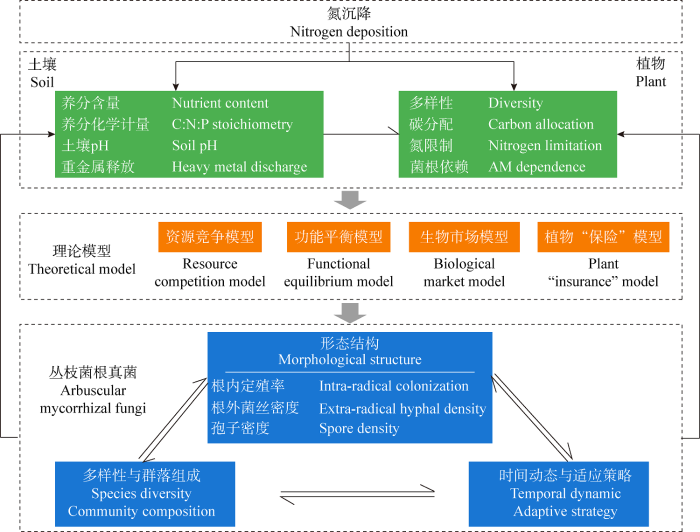
图1
氮沉降对AM真菌群落的影响机制
Fig. 1
Mechanism of the effect of nitrogen deposition on arbuscular mycorrhizal (AM) fungal community.
另一方面,氮添加可以通过改变土壤环境间接影响AM真菌。首先,真菌自身可能受到营养限制并且对土壤性质的变化较为敏感(Treseder & Allen 2002;Guo et al. 2012)。例如,AM真菌对氮沉降的响应受到土壤养分有效性的介导,磷限制土壤中氮添加会推动AM真菌向强共生的方向发展,增加AM真菌的生物量(Mueller & Bohannan 2015),而磷丰富土壤中的氮添加会减少AM 真菌的生物量(Johnson et al. 2004),当氮和磷都不受限制时,AM真菌的生长仅受碳的限制。AM真菌对养分可用性变化的反应也取决于环境,并且与初始土壤养分状态密切相关(Treseder & Allen 2002;Johnson et al. 2003;Johnson 2010)。土壤理化性质的变化例如氮添加导致的土壤酸化也会抑制菌丝生长和孢子萌发(Stevens et al. 2004;Fang et al. 2012;Tian et al. 2015),减少AM真菌定殖和多样性(Coughlan et al. 2000;Postma et al. 2007)。此外,氮添加导致的土壤环境的变化可能有利于特定的AM真菌群落,例如,氮可用性的增加可能导致AM真菌群落由Gigasporaceae转向具有广泛根外菌丝的Glomeraceae。因此,氮添加导致的土壤养分有效性及土壤理化性质的变化也会对AM真菌的根系定殖、生物量、形态结构、多样性及群落组成等造成间接的影响。
综上所述,结合资源竞争(resource competition model)、功能平衡(functional equilibrium model)和生物市场 (biological market model)等理论模型,我们提出共生菌根响应氮添加的新框架(图1)。氮沉降对菌根结构功能和时间动态的影响由多条相互交联的途径共同决定(Babalola et al. 2022):(1) 缓解植物氮限制,导致植物对菌根的依赖度降低;(2) 植物分配给菌根的碳占比下降;(3) 菌根生物量在土壤与根系间的比率下降;(4) 刺激植物生长,使植物维持根内菌根组成作为应对未来扰动的“保险”(plant “insurance” model);(5) 降低磷及其他土壤资源的可用性,从而增加植物对菌根的依赖;(6) 增加土壤酸度,抑制菌根生物量及多样性;(7) 直接影响AM真菌群落等。
5 展望
复杂互作体系对氮沉降的响应机制:丛枝菌根作为最成功的共生体系之一,不但涉及AM真菌和宿主植物,还包含其他土壤生物如细菌(解磷、内共生)、其他真菌(腐生、病原)、线虫和原生生物(捕食者)、病毒等。不同的生物互作涉及到信号协调和资源分配等复杂过程。研究氮沉降如何影响不同生物组分间的交互调节及其生态后果对于认识生物互作机制和功能具有重要意义。建议未来研究整合不同生物类群的基因组、转录组、蛋白组和代谢组,结合同位素标记和荧光探针等技术,利用生态网络和深度学习等数据分析方法,聚焦信息流、物质流和能量流,从整体论的角度探究复杂互作体系对氮沉降的响应机制。
AM真菌对氮沉降响应的生态后果:如前所述,尽管AM真菌与生物地球化学循环、植物群落构建和多样性维持、生态系统功能和稳定性等息息相关,此前的研究主要关注AM真菌多样性和结构如何响应氮沉降,而进一步关于AM真菌对氮沉降响应的生态后果还知之甚少。建议未来依托人工模拟氮沉降控制实验样地,开展AM真菌多样性和群落组成的长期观测,整合植物群落动态、碳氮磷循环、土壤结构及生态系统稳定性等研究内容,从学科交叉的角度开展深度研究,利用多元统计、结构方程模型等数据分析方法探究AM真菌对氮沉降响应的生态后果。
参考文献
Global estimates of inorganic nitrogen deposition across four decades
Bridging reproductive and microbial ecology: a case study in arbuscular mycorrhizal fungi
DOI:10.1038/s41396-018-0314-7 URL [本文引用: 1]
Nitrogen fertilisation disrupts the temporal dynamics of arbuscular mycorrhizal fungal hyphae but not spore density and community composition in a wheat field
DOI:10.1111/nph.18043
PMID:35179789
[本文引用: 5]

Elucidating the temporal dynamics of arbuscular mycorrhizal (AM) fungi is critical for understanding their functions. Furthermore, research investigating the temporal dynamics of AM fungi in response to agricultural practices remain in its infancy. We investigated the effect of nitrogen fertilization and watering reduction on the temporal dynamics of AM fungi, across the lifespan of wheat. Nitrogen fertilization decreased AM fungal spore density, extra-radical hyphal density, and intra-radical colonization rate in both watering conditions. Nitrogen fertilization affected AM fungal community composition in soil but not in roots, regardless of watering conditions. The temporal analysis revealed that AM fungal extra-radical hyphal density and intra-radical colonization rate were higher under conventional watering and lower under reduced watering in March than in other growth stages at low (≤ 70 kg N ha yr ) but not at high (≥ 140) nitrogen fertilization levels. AM fungal spore density was lower in June than in other growth stages and community composition varied with plant development at all nitrogen fertilization levels, regardless of watering conditions. This study demonstrates that high nitrogen fertilization levels disrupt the temporal dynamics of AM fungal hyphal growth but not sporulation and community composition.This article is protected by copyright. All rights reserved.
Underground signals carried through common mycelial networks warn neighbouring plants of aphid attack
DOI:10.1111/ele.12115
PMID:23656527
[本文引用: 1]
The roots of most land plants are colonised by mycorrhizal fungi that provide mineral nutrients in exchange for carbon. Here, we show that mycorrhizal mycelia can also act as a conduit for signalling between plants, acting as an early warning system for herbivore attack. Insect herbivory causes systemic changes in the production of plant volatiles, particularly methyl salicylate, making bean plants, Vicia faba, repellent to aphids but attractive to aphid enemies such as parasitoids. We demonstrate that these effects can also occur in aphid-free plants but only when they are connected to aphid-infested plants via a common mycorrhizal mycelial network. This underground messaging system allows neighbouring plants to invoke herbivore defences before attack. Our findings demonstrate that common mycorrhizal mycelial networks can determine the outcome of multitrophic interactions by communicating information on herbivore attack between plants, thereby influencing the behaviour of both herbivores and their natural enemies.© 2013 John Wiley & Sons Ltd/CNRS.
Impact of excessive nitrogen fertilizers on the environment and associated mitigation strategies
Role of arbuscular mycorrhizal fungi in plant growth regulation: implications in abiotic stress tolerance
DOI:10.3389/fpls.2019.01068
PMID:31608075
[本文引用: 1]
Abiotic stresses hamper plant growth and productivity. Climate change and agricultural malpractices like excessive use of fertilizers and pesticides have aggravated the effects of abiotic stresses on crop productivity and degraded the ecosystem. There is an urgent need for environment-friendly management techniques such as the use of arbuscular mycorrhizal fungi (AMF) for enhancing crop productivity. AMF are commonly known as bio-fertilizers. Moreover, it is widely believed that the inoculation of AMF provides tolerance to host plants against various stressful situations like heat, salinity, drought, metals, and extreme temperatures. AMF may both assist host plants in the up-regulation of tolerance mechanisms and prevent the down-regulation of key metabolic pathways. AMF, being natural root symbionts, provide essential plant inorganic nutrients to host plants, thereby improving growth and yield under unstressed and stressed regimes. The role of AMF as a bio-fertilizer can potentially strengthen plants' adaptability to changing environment. Thus, further research focusing on the AMF-mediated promotion of crop quality and productivity is needed. The present review provides a comprehensive up-to-date knowledge on AMF and their influence on host plants at various growth stages, their advantages and applications, and consequently the importance of the relationships of different plant nutrients with AMF.Copyright © 2019 Begum, Qin, Ahanger, Raza, Khan, Ashraf, Ahmed and Zhang.
The costs and benefits of plant-arbuscular mycorrhizal fungal interactions
DOI:10.1146/annurev-arplant-102820-124504 URL [本文引用: 1]
Changes in peanut canopy structure and photosynthetic characteristics induced by an arbuscular mycorrhizal fungus in a nutrient-poor environment
DOI:10.1038/s41598-020-79139-8 URL [本文引用: 1]
Herbivores and nutrients control grassland plant diversity via light limitation
DOI:10.1038/nature13144 URL [本文引用: 1]
Arbuscular mycorrhizal fungi respond to increasing plant diversity
DOI:10.1139/b01-138 URL [本文引用: 1]
Nitrogen and phosphorus additions impact arbuscular mycorrhizal abundance and molecular diversity in a tropical montane forest
DOI:10.1111/gcb.12618
PMID:24764217
[本文引用: 1]
Increased nitrogen (N) depositions expected in the future endanger the diversity and stability of ecosystems primarily limited by N, but also often co-limited by other nutrients like phosphorus (P). In this context a nutrient manipulation experiment (NUMEX) was set up in a tropical montane rainforest in southern Ecuador, an area identified as biodiversity hotspot. We examined impacts of elevated N and P availability on arbuscular mycorrhizal fungi (AMF), a group of obligate biotrophic plant symbionts with an important role in soil nutrient cycles. We tested the hypothesis that increased nutrient availability will reduce AMF abundance, reduce species richness and shift the AMF community toward lineages previously shown to be favored by fertilized conditions. NUMEX was designed as a full factorial randomized block design. Soil cores were taken after 2 years of nutrient additions in plots located at 2000 m above sea level. Roots were extracted and intraradical AMF abundance determined microscopically; the AMF community was analyzed by 454-pyrosequencing targeting the large subunit rDNA. We identified 74 operational taxonomic units (OTUs) with a large proportion of Diversisporales. N additions provoked a significant decrease in intraradical abundance, whereas AMF richness was reduced significantly by N and P additions, with the strongest effect in the combined treatment (39% fewer OTUs), mainly influencing rare species. We identified a differential effect on phylogenetic groups, with Diversisporales richness mainly reduced by N additions in contrast to Glomerales highly significantly affected solely by P. Regarding AMF community structure, we observed a compositional shift when analyzing presence/absence data following P additions. In conclusion, N and P additions in this ecosystem affect AMF abundance, but especially AMF species richness; these changes might influence plant community composition and productivity and by that various ecosystem processes. © 2014 John Wiley & Sons Ltd.
盐碱胁迫对染内生菌和不染菌苇状羊茅根系丛枝菌根真菌群落多样性和组成的影响
贵州煤矸石山香根草根系及根际土丛枝菌根真菌(AMF)群落的季节动态研究
Warming exerts a stronger effect than nitrogen addition on the soil arbuscular mycorrhizal fungal community in a young subtropical Cunninghamia lanceolata plantation
Arbuscular mycorrhizal fungi in European grasslands under nutrient pollution
DOI:10.1111/geb.12994
[本文引用: 2]
Aim Our aim was to quantify the extent to which nutrient pollution explains arbuscular mycorrhizal fungal community richness and composition. Location Europe. Time period 2014-2016. Major taxa studied Arbuscular mycorrhizal fungi. Methods We sampled soils of calcareous and acidic grasslands and roots of 34 host plant species across a large geographical gradient of atmospheric nitrogen deposition and soil phosphorus availability. Furthermore, we performed an independent pairwise comparison between fertilized and unfertilized grasslands in Belgium and Iceland to compare results. Results We found that nitrogen deposition had a significant negative relationship to arbuscular mycorrhizal fungal richness, with a negative community threshold of 7.7 kg N/ha/year corresponding to the greatest reduction in operational taxonomic units. Additionally, we found that soil phosphorus had a significant negative relationship to mycorrhizal fungal richness. Main conclusions Our results highlight the necessity to revisit the critical loads of atmospheric nitrogen deposition used in European environmental policy, currently set at 10-15 kg N/ha/year. Importantly, our observed threshold of 7.7 kg N/ha/year does not correspond to a critical load below which there is no environmental harm, because the least negative changes in arbuscular mycorrhizal fungal communities were observed at < 5 kg N/ha/year. Therefore, to avoid compromising the policy tenet of no environmental harm with respect to grassland mycorrhizal fungi, areas of zero tolerance to nitrogen pollution should be delimited. Our results also indicate that environmental policy biased towards reducing nitrogen pollution alone will fail to preserve mycorrhizal biodiversity in European grasslands. We advocate increased policy attention to avoid phosphorus enrichment, particularly through agricultural fertilization. Here too, areas of zero phosphorus input, ideally set in the currently unpolluted (or least polluted) areas, seem key for effective environmental policy, because elevated levels of soil phosphorus after phosphorus fertilization are known to be extremely persistent.
A trait-based framework to understand life history of mycorrhizal fungi
DOI:10.1016/j.tplants.2013.05.001 URL [本文引用: 3]
Comprehensive assessment of ameliorative effects of AMF in alleviating abiotic stress in tomato plants
DOI:10.3390/jof7040303 URL [本文引用: 1]
Trait-based aerial dispersal of arbuscular mycorrhizal fungi
DOI:10.1111/nph.16667 URL [本文引用: 1]
Effects of nitrogen enrichment on belowground communities in grassland: relative role of soil nitrogen availability vs. soil acidification
DOI:10.1016/j.soilbio.2015.06.028 URL [本文引用: 1]
Soil-mediated effects of acidification as the major driver of species loss following N enrichment in a semi-arid grassland
DOI:10.1007/s11104-017-3367-x URL [本文引用: 2]
Nitrogen deposition and precipitation induced phylogenetic clustering of arbuscular mycorrhizal fungal communities
DOI:10.1016/j.soilbio.2017.08.024 URL [本文引用: 1]
Six-year fertilization modifies the biodiversity of arbuscular mycorrhizal fungi in a temperate steppe in Inner Mongolia
DOI:10.1016/j.soilbio.2013.11.020 URL [本文引用: 1]
Arbuscular mycorrhizal fungal communities and global change: an uncertain future
Soil pH-induced changes in root colonization, diversity, and reproduction of symbiotic arbuscular mycorrhizal fungi from healthy and declining maple forests
DOI:10.1139/x00-090 URL [本文引用: 1]
The molecular-physiological functions of mineral macronutrients and their consequences for deficiency symptoms in plants
DOI:10.1111/nph.17074
PMID:33175410
[本文引用: 1]
The visual deficiency symptoms developing on plants constitute the ultimate manifestation of suboptimal nutrient supply. In classical plant nutrition, these symptoms have been extensively used as a tool to characterise the nutritional status of plants and to optimise fertilisation. Here we expand this concept by bridging the typical deficiency symptoms for each of the six essential macronutrients to their molecular and physiological functionalities in higher plants. We focus on the most recent insights obtained during the last decade, which now allow us to better understand the links between symptom and function for each element. A deep understanding of the mechanisms underlying the visual deficiency symptoms enables us to thoroughly understand how plants react to nutrient limitations and how these disturbances may affect the productivity and biodiversity of terrestrial ecosystems. A proper interpretation of visual deficiency symptoms will support the potential for sustainable crop intensification through the development of new technologies that facilitate automatised management practices based on imaging technologies, remote sensing and in-field sensors, thereby providing the basis for timely application of nutrients via smart and more efficient fertilisation.© 2020 The Authors New Phytologist © 2020 New Phytologist Foundation.
Responses of terrestrial ecosystem phosphorus cycling to nitrogen addition: a meta-analysis
DOI:10.1111/geb.12576 URL [本文引用: 1]
Roles of arbuscular mycorrhizal fungi on plant growth and performance: importance in biotic and abiotic stressed regulation
DOI:10.3390/d12100370 URL [本文引用: 1]
Mycelium of arbuscular mycorrhizal fungi (AMF) from different genera: form, function and detection
DOI:10.1023/A:1026574828169 URL [本文引用: 1]
Relative roles of niche and neutral processes in structuring a soil microbial community
DOI:10.1038/ismej.2009.122 URL [本文引用: 1]
Shifts in arbuscular mycorrhizal communities along an anthropogenic nitrogen deposition gradient
Mycorrhizal community dynamics following nitrogen fertilization: a cross-site test in five grasslands
Long-term nitrogen addition leads to loss of species richness due to litter accumulation and soil acidification in a temperate steppe
DOI:10.1371/journal.pone.0047369 URL [本文引用: 1]
Reactive nitrogen and the world: 200 years of change
This paper examines the impact of food and energy production on the global N cycle by contrasting N flows in the late-19th century with those of the late-20th century. We have a good understanding of the amounts of reactive N created by humans, and the primary points of loss to the environment. However, we have a poor understanding of nitrogen's rate of accumulation in environmental reservoirs, which is problematic because of the cascading effects of accumulated N in the environment. The substantial regional variability in reactive nitrogen creation, its degree of distribution, and the likelihood of increased rates of reactive-N formation (especially in Asia) in the future creates a situation that calls for the development of a Total Reactive Nitrogen Approach that will optimize food and energy production and protect environmental systems.
Soil organic carbon dynamics in a dryland cereal cropping system of the Loess Plateau under long-term nitrogen fertilizer applications
DOI:10.1007/s11104-011-1034-1 URL [本文引用: 1]
Crop diversity enriches arbuscular mycorrhizal fungal communities in an intensive agricultural landscape
DOI:10.1111/nph.17306
PMID:33638170
[本文引用: 1]
●Arbuscular mycorrhizal fungi (AMF) are keystone symbionts of agricultural soils but agricultural intensification has negatively impacted AMF communities. Increasing crop diversity could ameliorate some of these impacts by positively affecting arbuscular mycorrhizal fungi. However, the underlying relationship between plant diversity and AMF community composition has not been fully resolved. ●We examined how greater crop diversity affected AMF across farms in an intensive agricultural landscape, defined by high nutrient input, low crop diversity, and high tillage frequency. We assessed AMF communities across 31 field sites that were either monocultures or polycultures (growing >20 different crop types) in three ways: (1) richness, (2) diversity, and (3) composition. We also determined root colonization across these sites. ●We found polycultures drive the available AMF community into richer and more diverse communities while soil properties structure AMF community composition. AMF root colonization did not vary by farm management (monocultures versus polycultures), but did vary by crop host. ●We demonstrate that crop diversity enriches AMF communities, counteracting the negative effects of agricultural intensification on AMF, providing the potential to increase agroecosystem functioning and sustainability.This article is protected by copyright. All rights reserved.
Responses of arbuscular mycorrhizal fungi to nitrogen addition: a meta-analysis
DOI:10.1111/gcb.15369 URL [本文引用: 3]
Taxonomic basis for variation in the colonization strategy of arbuscular mycorrhizal fungi
DOI:10.1046/j.0028-646X.2001.00312.x URL [本文引用: 1]
Competition for light causes plant biodiversity loss after eutrophication
DOI:10.1126/science.1169640
PMID:19407202
[本文引用: 2]
Human activities have increased the availability of nutrients in terrestrial and aquatic ecosystems. In grasslands, this eutrophication causes loss of plant species diversity, but the mechanism of this loss has been difficult to determine. Using experimental grassland plant communities, we found that addition of light to the grassland understory prevented the loss of biodiversity caused by eutrophication. There was no detectable role for competition for soil resources in diversity loss. Thus, competition for light is a major mechanism of plant diversity loss after eutrophication and explains the particular threat of eutrophication to plant diversity. Our conclusions have implications for grassland management and conservation policy and underscore the need to control nutrient enrichment if plant diversity is to be preserved.
Mycorrhizal fungal spore community structure in a manipulated prairie
DOI:10.1111/rec.12548 URL [本文引用: 1]
Arbuscular mycorrhiza and nitrogen: implications for individual plants through to ecosystems
DOI:10.1007/s11104-014-2162-1 URL [本文引用: 1]
N addition undermines N supplied by arbuscular mycorrhizal fungi to native perennial grasses
DOI:10.1016/j.soilbio.2017.10.009 URL [本文引用: 1]
Plant communities affect arbuscular mycorrhizal fungal diversity and community composition in grassland microcosms
DOI:10.1046/j.1469-8137.2003.00938.x
PMID:33873500
[本文引用: 1]
• The diversity of arbuscular mycorrhizal (AM) fungi was investigated in an unfertilized limestone grassland soil supporting different synthesized vascular plant assemblages that had developed for 3 yr. • The experimental treatments comprised: bare soil; monocultures of the nonmycotrophic sedge Carex flacca; monocultures of the mycotrophic grass Festuca ovina; and a species-rich mixture of four forbs, four grasses and four sedges. The diversity of AM fungi was analysed in roots of Plantago lanceolata bioassay seedlings using terminal-restriction fragment length polymorphism (T-RFLP). The extent of AM colonization, shoot biomass and nitrogen and phosphorus concentrations were also measured. • The AM diversity was affected significantly by the floristic composition of the microcosms and shoot phosphorus concentration was positively correlated with AM diversity. The diversity of AM fungi in P. lanceolata decreased in the order: bare soil > C. flacca > 12 species > F. ovina. • The unexpectedly high diversity in the bare soil and sedge monoculture likely reflects differences in the modes of colonization and sources of inoculum in these treatments compared with the assemblages containing established AM-compatible plants.
Resource stoichiometry elucidates the structure and function of arbuscular mycorrhizas across scales
DOI:10.1111/j.1469-8137.2009.03110.x
PMID:19968797
[本文引用: 4]
Despite the fact that arbuscular mycorrhizal (AM) associations are among the most ancient, abundant and important symbioses in terrestrial ecosystems, there are currently few unifying theories that can be used to help understand the factors that control their structure and function. This review explores how a stoichiometric perspective facilitates integration of three complementary ecological and evolutionary models of mycorrhizal structure and function. AM symbiotic function should be governed by the relative availability of carbon, nitrogen and phosphorus (trade balance model) and allocation to plant and fungal structures should depend on the availabilities of these resources (functional equilibrium model). Moreover, in an evolutionary framework, communities of plants and AM fungi are predicted to adapt to each other and their local soil environment (co-adaptation model). Anthropogenic enrichment of essential resources in the environment is known to impact AM symbioses. A more predictive theory of AM structure and function will help us to better understand how these impacts may influence plant communities and ecosystem properties.
Nitrogen enrichment alters mycorrhizal allocation at five mesic to semiarid grasslands
Unraveling arbuscular mycorrhiza-induced changes in plant primary and secondary metabolome
DOI:10.3390/metabo10080335 URL [本文引用: 1]
Reciprocal rewards stabilize cooperation in the mycorrhizal symbiosis
DOI:10.1126/science.1208473
PMID:21836016
[本文引用: 1]
Plants and their arbuscular mycorrhizal fungal symbionts interact in complex underground networks involving multiple partners. This increases the potential for exploitation and defection by individuals, raising the question of how partners maintain a fair, two-way transfer of resources. We manipulated cooperation in plants and fungal partners to show that plants can detect, discriminate, and reward the best fungal partners with more carbohydrates. In turn, their fungal partners enforce cooperation by increasing nutrient transfer only to those roots providing more carbohydrates. On the basis of these observations we conclude that, unlike many other mutualisms, the symbiont cannot be "enslaved." Rather, the mutualism is evolutionarily stable because control is bidirectional, and partners offering the best rate of exchange are rewarded.
Arbuscular mycorrhizal fungal community response to warming and nitrogen addition in a semiarid steppe ecosystem
DOI:10.1007/s00572-014-0608-1 URL [本文引用: 1]
Interspecific differences in the response of arbuscular mycorrhizal fungi to Artemisia tridentata grown under elevated atmospheric CO2
DOI:10.1046/j.1469-8137.1998.00141.x URL [本文引用: 1]
Carbon flow from plant to arbuscular mycorrhizal fungi is reduced under phosphorus fertilization
DOI:10.1007/s11104-017-3350-6 URL [本文引用: 1]
Root and mycorrhizal fungal foraging responses to fruit removal in apple trees
DOI:10.1007/s11104-018-3773-8 URL [本文引用: 1]
Atmospheric nitrogen deposition impacts on the structure and function of forest mycorrhizal communities: a review
DOI:S0269-7491(18)33029-X
PMID:30543941
[本文引用: 1]
Humans have dramatically increased atmospheric nitrogen (N) deposition globally. At the coarsest resolution, N deposition is correlated with shifts from ectomycorrhizal (EcM) to arbuscular mycorrhizal (AM) tree dominance. At finer resolution, ectomycorrhizal fungal (EcMF) and arbuscular mycorrhizal fungal (AMF) communities respond strongly to long-term N deposition with the disappearance of key taxa. Conifer-associated EcMF are more sensitive than other EcMF, with current estimates of critical loads at 5-6 kg ha yr for the former and 10-20 kg ha yr for the latter. Where loads are exceeded, strong plant-soil and microbe-soil feedbacks may slow recovery rates after abatement of N deposition. Critical loads for AMF and tropical EcMF require additional study. In general, the responses of EcMF to N deposition are better understood than those of AMF because of methodological tractability. Functional consequences of EcMF community change are linked to decreases by fungi with medium-distance exploration strategies, hydrophobic walls, proteolytic capacity, and perhaps peroxidases for acquiring N from soil organic matter. These functional losses may contribute to declines in forest floor decomposition under N deposition. For AMF, limited capacity to directly access complexed organic N may reduce functional consequences, but research is needed to test this hypothesis. Mycorrhizal biomass often declines with N deposition, but the relative contributions of alternate mechanisms for this decline (lower C supply, higher C cost, physiological stress by N) have not been quantified. Furthermore, fungal biomass and functional responses to N inputs probably depend on ecosystem P status, yet how N deposition-induced P limitation interacts with belowground C flux and mycorrhizal community structure and function is still unclear. Current 'omic analyses indicate potential functional differences among fungal lineages and should be integrated with studies of physiology, host nutrition, growth and health, fungal and plant community structure, and ecosystem processes.Published by Elsevier Ltd.
Enhanced nitrogen deposition over China
DOI:10.1038/nature11917 URL [本文引用: 1]
Direct and indirect influences of 8 yr of nitrogen and phosphorus fertilization on Glomeromycota in an alpine meadow ecosystem
DOI:10.1111/j.1469-8137.2012.04050.x
PMID:22292929
[本文引用: 1]
We measured the influences of soil fertility and plant community composition on Glomeromycota, and tested the prediction of the functional equilibrium hypothesis that increased availability of soil resources will reduce the abundance of arbuscular mycorrhizal (AM) fungi. Communities of plants and AM fungi were measured in mixed roots and in Elymus nutans roots across an experimental fertilization gradient in an alpine meadow on the Tibetan Plateau. As predicted, fertilization reduced the abundance of Glomeromycota as well as the species richness of plants and AM fungi. The response of the glomeromycotan community was strongly linked to the plant community shift towards dominance by Elymus nutans. A reduction in the extraradical hyphae of AM fungi was associated with both the changes in soil factors and shifts in the plant community composition that were caused by fertilization. Our findings highlight the importance of soil fertility in regulating both plant and glomeromycotan communities, and emphasize that high fertilizer inputs can reduce the biodiversity of plants and AM fungi, and influence the sustainability of ecosystems.© 2012 The Authors. New Phytologist © 2012 New Phytologist Trust.
Global negative effects of nutrient enrichment on arbuscular mycorrhizal fungi, plant diversity and ecosystem multifunctionality
DOI:10.1111/nph.17077
PMID:33188641
[本文引用: 2]
Despite widespread anthropogenic nutrient enrichment, it remains unclear how nutrient enrichment influences plant-arbuscular mycorrhizal fungi (AMF) symbiosis and ecosystem multifunctionality at the global scale. Here, we conducted a meta-analysis to examine the worldwide effects of nutrient enrichment on AMF and plant diversity and ecosystem multifunctionality using data of field experiments from 136 papers. Our analyses showed that nutrient addition simultaneously decreased AMF diversity and abundance belowground and plant diversity aboveground at the global scale. The decreases in AMF diversity and abundance associated with nutrient addition were more pronounced with increasing experimental duration, mean annual temperature (MAT) and mean annual precipitation (MAP). Nutrient addition-induced changes in soil pH and available phosphorus (P) predominantly regulated the responses of AMF diversity and abundance. Furthermore, AMF diversity correlated with ecosystem multifunctionality under nutrient addition worldwide. Our findings identify the negative effects of nutrient enrichment on AMF and plant diversity and suggest that AMF diversity is closely linked with ecosystem function. This study offers an important advancement in our understanding of plant-AMF interactions and their likely responses to ongoing global change.© 2020 The Authors New Phytologist © 2020 New Phytologist Foundation.
Influence of phylogeny on fungal community assembly and ecosystem functioning
DOI:10.1126/science.1143082
PMID:17588930
[本文引用: 1]
Ecology seeks to explain species coexistence and its functional consequences, but experimental tests of mechanisms that simultaneously account for both processes are difficult. We used an experimental mycorrhizal plant system to test whether functional similarity among closely related species (phylogenetic conservatism) can drive community assembly and ecosystem functioning. Communities were constructed with the same number of fungal species, but after 1 year of growth, realized species richness was highest where the starting species were more distantly related to each other. Communities with high realized species richness also stimulated plant productivity more than those with low realized species richness. Our findings suggest that phylogenetic trait conservatism can promote coexistence because of reduced competition between distinct evolutionary lineages and enhance ecosystem function because of functional complementarity among those same lineages.
Phosphorus fertilization rather than nitrogen fertilization, growing season and plant successional stage structures arbuscular mycorrhizal fungal community in a subtropical forest
DOI:10.1007/s00374-021-01554-4 URL [本文引用: 1]
Cross-scale integration of mycorrhizal function
DOI:10.1111/nph.15493 PMID:30408219 [本文引用: 1]
Research advance of arbuscular mycorrhizal fungi diversity in karst areas
Visualizing the dynamics of soil aggregation as affected by arbuscular mycorrhizal fungi
DOI:10.1038/s41396-019-0369-0 URL [本文引用: 1]
Shifts in the phylogenetic structure of arbuscular mycorrhizal fungi in response to experimental nitrogen and carbon dioxide additions
DOI:10.1007/s00442-015-3337-z
PMID:25990297
[本文引用: 2]
Global N inputs and atmospheric CO2 concentrations have increased as a result of human activities, and are predicted to increase along with population growth, with potentially negative effects on biodiversity. Using taxonomic and phylogenetic measures, we examined the response of arbuscular mycorrhizal fungi (AMF) to experimental manipulations of N and CO2 at the Jasper Ridge Global Change Experiment. No significant interactions between N and CO2 were observed, but individual effects of N and CO2 were found. Elevated CO2 resulted in changes in phylogenetic similarity, and a shift to phylogenetic clustering of AMF communities. N addition resulted in higher phylogenetic diversity and evenness, with no shifts in community composition and no significant signal for phylogenetic clustering. N addition resulted in an increase in both available N and the N:P ratio in N-amended plots, which suggests that changing patterns of nutrient limitation could have lead to altered species interactions. These findings suggest that elevated levels of N and CO2 altered patterns of AMF community assembly, with potential effects on ecosystem function.
Underground connections: arbuscular mycorrhizal fungi influence on interspecific plant-plant interactions
DOI:10.1093/plphys/kiab397 PMID:34734288 [本文引用: 1]
Nitrogen-induced acidification, not N-nutrient, dominates suppressive N effects on arbuscular mycorrhizal fungi
DOI:10.1111/gcb.15311 URL [本文引用: 2]
Effect of long-term nitrogen fertilization on mycorrhizal fungi associated with a dominant grass in a semiarid grassland
DOI:10.1007/s11104-007-9290-9 URL [本文引用: 1]
Root colonisation by arbuscular mycorrhizal, fine endophytic and dark septate fungi across a pH gradient in acid beech forests
DOI:10.1016/j.soilbio.2006.08.007 URL [本文引用: 1]
A safe operating space for humanity
DOI:10.1038/461472a URL [本文引用: 1]
Plant carbohydrate depletion impairs water relations and spreads via ectomycorrhizal networks
DOI:10.1111/nph.17134
PMID:33280134
[本文引用: 1]
Under prolonged drought and reduced photosynthesis, plants consume stored nonstructural carbohydrates (NSCs). Stored NSC depletion may impair the regulation of plant water balance, but the underlying mechanisms are poorly understood, and whether such mechanisms are independent of plant water deficit is not known. If so, carbon costs of fungal symbionts could indirectly influence plant drought tolerance through stored NSC depletion. We connected well-watered Pinus ponderosa seedling pairs via ectomycorrhizal (EM) networks where one seedling was shaded (D) and the other kept illuminated (LD) and compared responses to seedling pairs in full light (L). We measured plant NSCs, osmotic and water potential, and transfer of CO through EM to explore mechanisms linking stored NSCs to plant water balance regulation and identify potential tradeoffs between plant water retention and EM fungi under carbon-limiting conditions. NSCs decreased from L to LD to D seedlings. Even without drought, NSC depletion impaired osmoregulation and turgor maintenance, both of which are critical for drought tolerance. Importantly, EM networks propagated NSC depletion and its negative effects on water retention from carbon stressed to nonstressed hosts. We demonstrate that NSC storage depletion influences turgor maintenance independently of plant water deficit and reveal carbon allocation tradeoffs between supporting fungal symbionts and retaining water.© 2020 The Authors New Phytologist © 2020 New Phytologist Foundation.
Plants, fungi and oomycetes: a 400-million year affair that shapes the biosphere
DOI:10.1111/nph.13371 URL [本文引用: 1]
Responses of arbuscular mycorrhizal fungi to long-term inorganic and organic nutrient addition in a lowland tropical forest
DOI:10.1038/s41396-018-0189-7 URL [本文引用: 1]
Management practices regulate the response of Moso bamboo foliar stoichiometry to nitrogen deposition
DOI:10.1038/s41598-016-0001-8 URL [本文引用: 1]
Impact of nitrogen deposition on the species richness of grasslands
A transect of 68 acid grasslands across Great Britain, covering the lower range of ambient annual nitrogen deposition in the industrialized world (5 to 35 kg Nha-1 year-1), indicates that long-term, chronic nitrogen deposition has significantly reduced plant species richness. Species richness declines as a linear function of the rate of inorganic nitrogen deposition, with a reduction of one species per 4-m2 quadrat for every 2.5 kg Nha-1 year-1 of chronic nitrogen deposition. Species adapted to infertile conditions are systematically reduced at high nitrogen deposition. At the mean chronic nitrogen deposition rate of central Europe (17 kg Nha-1 year-1), there is a 23% species reduction compared with grasslands receiving the lowest levels of nitrogen deposition.
Biogeography of arbuscular mycorrhizal fungi (Glomeromycota): a phylogenetic perspective on species distribution patterns
DOI:10.1007/s00572-018-0864-6
PMID:30187122
[本文引用: 1]
Information on the biogeography of arbuscular mycorrhizal fungi (AMF) is important because this group of obligately symbiotic soil microbes is a ubiquitous and functionally critical component of terrestrial ecosystems. In this paper, we utilize a biogeography database summarizing data on AMF species distribution linked to geographic and environmental conditions to describe global distribution patterns and interpret these patterns within a phylogenetic perspective. The data were obtained from accessions in living culture collections (INVAM, CICG), species descriptions, and other published literature from 1960 to 2012. The database contains 7105 records, 6396 of them from 768 published papers and the remaining 709 from culture accessions. Glomeromycotan species were recorded in all seven continents, 87 countries, 11 biogeographical realms, and 14 biomes. The distribution of families differed among climatic zones and continents, but they, together with all genera, appear to be cosmopolitan. Distribution of AMF species shows a slight decrease from low to high latitudes, but this decrease is steeper in the southern than in the northern hemisphere. A total of 189 species is shared between ancient supercontinents Gondwana and Laurasia and 78 species are common to all climatic zones. Ninety-five species (43% of the total) have known cosmopolitan distribution, including members of all genera except Redeckera. Some species have disjunct distribution and 26% of species have been registered from only one continent. Data on AMF distribution challenge the "Everything is everywhere" hypothesis in favor of the "moderate endemicity model" for species distribution. Data from this study provide a foundation to formulate and test hypotheses of biogeographic patterns and processes in Glomeromycota.
The Glomeromycota in the Neotropics
DOI:10.3389/fmicb.2020.553679 URL [本文引用: 1]
Functional- and abundance-based mechanisms explain diversity loss due to N fertilization
Effects of soil saline-alkali stress on arbuscular mycorrhizal fungal community diversity and composition of roots of endophyte-infected and endophyte-free tall fescue
Disruption of metal ion homeostasis in soils is associated with nitrogen deposition-induced species loss in an Inner Mongolia steppe
DOI:10.5194/bg-12-3499-2015 URL [本文引用: 1]
Arbuscular mycorrhizal fungi as mediators of ecosystem responses to nitrogen deposition: a trait-based predictive framework
DOI:10.1111/1365-2745.12919 URL [本文引用: 1]
Direct nitrogen and phosphorus limitation of arbuscular mycorrhizal fungi: a model and field test
DOI:10.1046/j.1469-8137.2002.00470.x
PMID:33873310
[本文引用: 3]
• Since mycorrhizal fungi constitute an important component of the soil-plant interface, their responses to changes in nutrient availability may mediate shifts in ecosystem function. We tested the hypothesis that initial soil nutrient availability may determine effects of nitrogen (N) and phosphorus (P) additions on the growth and community of arbuscular mycorrhizal (AM) fungi. • Extraradical hyphal lengths and degree of root colonization of AM fungi were measured in control and fertilized plots along a soil fertility gradient in Hawaii. Responses of individual AM genera were assessed through immunofluorescent labeling. • The AM biomass was increased by N and P additions in the N- and P-limited sites, respectively, and reduced by P fertilization in the fertile site only. The abundance of Scutellospora was lower under N than under P fertilization, whereas the incidence of Glomus was higher in the fertile site than the N-limited site. Gigaspora and Acaulospora did not vary among sites or treatments. • Our results indicate that a decrease in AM abundance following nutrient additions cannot be assumed to occur and the effects may differ among AM genera and ecosystems with varying soil nutrients. Limitation of N and P may be one possible explanation.
The responses of extracellular enzyme activities and microbial community composition under nitrogen addition in an upland soil
DOI:10.1371/journal.pone.0223026 URL [本文引用: 1]
The unseen majority: soil microbes as drivers of plant diversity and productivity in terrestrial ecosystems
DOI:10.1111/j.1461-0248.2007.01139.x
PMID:18047587
[本文引用: 1]
Microbes are the unseen majority in soil and comprise a large portion of life's genetic diversity. Despite their abundance, the impact of soil microbes on ecosystem processes is still poorly understood. Here we explore the various roles that soil microbes play in terrestrial ecosystems with special emphasis on their contribution to plant productivity and diversity. Soil microbes are important regulators of plant productivity, especially in nutrient poor ecosystems where plant symbionts are responsible for the acquisition of limiting nutrients. Mycorrhizal fungi and nitrogen-fixing bacteria are responsible for c. 5-20% (grassland and savannah) to 80% (temperate and boreal forests) of all nitrogen, and up to 75% of phosphorus, that is acquired by plants annually. Free-living microbes also strongly regulate plant productivity, through the mineralization of, and competition for, nutrients that sustain plant productivity. Soil microbes, including microbial pathogens, are also important regulators of plant community dynamics and plant diversity, determining plant abundance and, in some cases, facilitating invasion by exotic plants. Conservative estimates suggest that c. 20 000 plant species are completely dependent on microbial symbionts for growth and survival pointing to the importance of soil microbes as regulators of plant species richness on Earth. Overall, this review shows that soil microbes must be considered as important drivers of plant diversity and productivity in terrestrial ecosystems.
Mycorrhizal fungal diversity determines plant biodiversity, ecosystem variability and productivity
DOI:10.1038/23932 URL
Simulated nitrogen deposition affects community structure of arbuscular mycorrhizal fungi in northern hardwood forests
DOI:10.1111/j.1365-294X.2010.04969.x
PMID:21210962
Our previous investigation found elevated nitrogen deposition caused declines in abundance of arbuscular mycorrhizal fungi (AMF) associated with forest trees, but little is known about how nitrogen affects the AMF community composition and structure within forest ecosystems. We hypothesized that N deposition would lead to significant changes in the AMF community structure. We studied the diversity and community structure of AMF in northern hardwood forests after more than 12 years of simulated nitrogen deposition. We performed molecular analyses on maple (Acer spp.) roots targeting the 18S rDNA region using the fungal-specific primers AM1 and NS31. PCR products were cloned and identified using restriction fragment length polymorphism (RFLP) and sequencing. N addition significantly altered the AMF community structure, and Glomus group A dominated the AMF community. Some Glomus operational taxonomic units (OTUs) responded negatively to N inputs, whereas other Glomus OTUs and an Acaulospora OTU responded positively to N inputs. The observed effect on community structure implies that AMF species associated with maples differ in their response to elevated nitrogen. Given that functional diversity exists among AMF species and that N deposition has been shown to select less beneficial fungi in some ecosystems, this change in community structure could have implications for the functioning of this type of ecosystem.Published 2011. This article is a US Government work and is in the public domain in the USA.
Simulated nitrogen deposition causes a decline of intra- and extraradical abundance of arbuscular mycorrhizal fungi and changes in microbial community structure in northern hardwood forests
DOI:10.1007/s10021-010-9347-0 URL
Arbuscular mycorrhiza and soil nitrogen cycling
DOI:10.1016/j.soilbio.2011.11.018 URL [本文引用: 1]
Response of oxidative enzyme activities to nitrogen deposition affects soil concentrations of dissolved organic carbon
DOI:10.1007/s10021-004-0149-0 URL [本文引用: 1]
Seasonal dynamic changes of community of arbuscular mycorrhizal fungi (AMF) in root system and rhizosphere soil of Vetiveria zizanioides in coal gangue in Guizhou of Southwest China
Analyses of the research status of arbuscular mycorrhizal fungi in the last 30 years based on CiteSpace software
Long-term agricultural fertilization alters arbuscular mycorrhizal fungal community composition and barley (Hordeum vulgare) mycorrhizal carbon and phosphorus exchange
DOI:10.1111/nph.14196
PMID:27643809
[本文引用: 1]
Agricultural fertilization significantly affects arbuscular mycorrhizal fungal (AMF) community composition. However, the functional implications of community shifts are unknown, limiting understanding of the role of AMF in agriculture. We assessed AMF community composition at four sites managed under the same nitrogen (N) and phosphorus (P) fertilizer regimes for 55 yr. We also established a glasshouse experiment with the same soils to investigate AMF-barley (Hordeum vulgare) nutrient exchange, using carbon ( C) and P isotopic labelling. N fertilization affected AMF community composition, reducing diversity; P had no effect. In the glasshouse, AMF contribution to plant P declined with P fertilization, but was unaffected by N. Barley C allocation to AMF also declined with P fertilization. As N fertilization increased, C allocation to AMF per unit of P exchanged increased. This occurred with and without P fertilization, and was concomitant with reduced barley biomass. AMF community composition showed no relationship with glasshouse experiment results. The results indicate that plants can reduce C allocation to AMF in response to P fertilization. Under N fertilization, plants allocate an increasing amount of C to AMF and receive relatively less P. This suggests an alteration in the terms of P-C exchange under N fertilization regardless of soil P status.© 2016 The Authors. New Phytologist © 2016 New Phytologist Trust.
Rapid response of arbuscular mycorrhizal fungal communities to short-term fertilization in an alpine grassland on the Qinghai-Tibet Plateau
Nitrogen input through chemical and biological pathway affects arbuscular mycorrhizal fungal communities in forage grass cultivation in southwest China
DOI:10.1016/j.apsoil.2019.103454 URL [本文引用: 1]
Arbuscular mycorrhizal fungal diversity of Cinnamomum camphora seedlings bred with ‘root production method’ and conventional method
Response of the arbuscular mycorrhizal fungi diversity and community in maize and soybean rhizosphere soil and roots to intercropping systems with different nitrogen application rates
DOI:10.1016/j.scitotenv.2020.139810 URL [本文引用: 2]
Differential responses of arbuscular mycorrhizal fungi to nitrogen addition in a near pristine Tibetan alpine meadow
DOI:10.1111/1574-6941.12361
PMID:24890754
[本文引用: 2]
Elucidating the responses of soil microbial abundance and community composition to nitrogen (N) addition is important for predicting ecosystem function under increased atmospheric N deposition. We examined the arbuscular mycorrhizal (AM) fungal community under three N forms (NH4(+)-N, NO3(-)-N, and NH4NO3-N) and two N rates (1.5 and 7.5 g N m(-2) year(-1)) in an alpine meadow of the Qinghai-Tibetan Plateau. AM fungal extraradical hyphal density was significantly decreased by NH4(+)-N in May, but was not affected by N form nor N rate in August. N rate, but not N form, significantly affected AM fungal spore density; high N rate decreased spore density. No direct N addition effect was observed on AM fungal community; however, soil available phosphorus, pH, and NO3(-)-N were considered as important factors that influenced AM fungal community composition. Structural equation model results showed that N rate, not N form, strongly affected soil characteristics, which directly influenced community compositions of plants and AM fungi, as well as spore density. Therefore, AM fungal community was influenced by N addition, primarily because of altered soil characteristics, and partially by a modified plant community, but not or just slightly by direct N addition effects in this alpine meadow ecosystem.© 2014 Federation of European Microbiological Societies. Published by John Wiley & Sons Ltd. All rights reserved.
Arbuscular mycorrhizal fungal communities associated with two dominant species differ in their responses to long-term nitrogen addition in temperate grasslands
DOI:10.1111/1365-2435.13081 URL [本文引用: 2]
Research progress of arbuscular mycorrhizal fungi associated with plants in desert areas