




我国地域辽阔、生态类型多样,孕育了丰富的菌物多样性。我们的祖先在认知和应用菌物资源方面有着悠久的历史,在6 800多年前的河姆渡文化遗址中,就发现了灵芝Ganoderma spp.标本(袁媛等 2018)。而汉代的《神农本草经》是我国最早记载菌物的古籍,记载了茯苓、猪苓、六芝、木耳等菌物的药用价值。南宋时期的《菌谱》记载了11种菌类的信息,是世界首部以“菌”而作的著作。但是,我国古代的菌物文化、著作和应用并未形成科学的知识体系,而菌物学尤其是菌物分类学作为一门研究和认识菌物的学科,最早起源于欧洲。此后,一些西方传教士、商人、学者和军人在中国游历并采集菌物,逐渐开始了对我国菌物多样性的研究,也将菌物学的知识传播过来。20世纪初,我国第一辈菌物学者开始了对这门学科的探索,历经艰苦、波折与繁荣,经过几代人的努力,如今已走入世界前列。为深入了解中国菌物分类学的发展历史,本研究通过收集、梳理和分析中国菌物新物种、新分类单元等发表记录,从中总结不同时间阶段中国学者在菌物分类学研究中取得的成果及中国菌物新物种发现的趋势,并进一步阐述分类学的发展历史,以期为学科的当下和未来发展提供参考。
1 研究方法
本研究的数据来自于Fungal Names世界菌物名称信息库(Wang et al. 2022),数据获取时间截至2022年9月30日。以发表作者为条件,筛选获得中国学者发表的菌物分类单元记录共 16 587条,剔除无效发表、不合格及不合法名称,获得分类单元数量15 626个。以模式标本产地为条件,筛选获得发现自中国的菌物新物种记录11 311条,剔除无效发表、不合格及不合法名称,最终获得中国菌物新物种10 233种。上述每条数据包含菌物名称、命名作者、分类阶元、发表年份、发表期刊、模式标本产地等信息,用以开展分类学相关的数据挖掘与统计分析。
2 中国菌物新分类单元发表概况
迄今,中国学者一共发表了15 626个菌物新分类单元,包括3个新纲、26个新目、1个新亚目、110个新科、7个新亚科、724个新属、45个新亚属和组、11 100个新种、322个新种下单元和3 288个新组合。中国学者参与构建的最高等级分类单元有3个纲,均是与外国学者合作发表,包括了属于大型真菌类的一个新纲Geoglossomycetes (Schoch et al. 2009)和担子菌酵母类的两个新纲Moniliellomycetes、Spiculogloeomycetes (Wang et al. 2014)。在类群方面,中国学者研究较多的类群是植物病原菌(球腔菌、锈菌、亚隔孢壳)、木生真菌(刺革菌、多孔菌)和伞菌(牛肝菌)。
参与发表上述菌物新分类单元的中国学者共有2 214位,占全球菌物命名作者总数的9.82%。在中国学者的个人贡献方面,有57位学者发表了100个以上菌物新分类单元。发表数量最多的是从事大型真菌研究的戴玉成教授,共发表3科46属1亚属514种及种下单元和310个新组合共874个分类单元;发表高阶分类单元最多的是从事酵母菌研究的白逢彦研究员,共发表包括2纲4目18科57属在内的554个新分类单元;发表新物种最多的是从事小型子囊菌研究的蔡磊研究员,共发表包括546个新种、2个新变种在内的752个新分类单元。
3 中国发现的菌物新物种
迄今,从中国发现的菌物新物种有10 233种,隶属于3界13门44纲174目572科2 379属,占全球已知物种多样性的6.84%,仅次于美国(24 643种,16.48%),居全球第二位(图1)。这些新物种涵盖了广义菌物的真菌、黏菌、卵菌和微孢子虫类群。其中真菌10 027种,隶属于9门39纲160目542科2 318属,占物种总数的97.99%;卵菌115种,隶属于1门1纲4目8科21属;黏菌71种,隶属于1门2纲6目11科25属;微孢子虫20种,隶属于2门2纲4目11科15属。参与发表上述新物种的学者共有2 514位,其中中国学者1 816位,占72.23%。在所有中国新物种中,由中国学者独立发表的有6 966种,占总数的68.07%。此外,中外学者合作发表的有1 593种(15.57%),而完全由外国学者发表的有1 674种(16.36%)。
图1
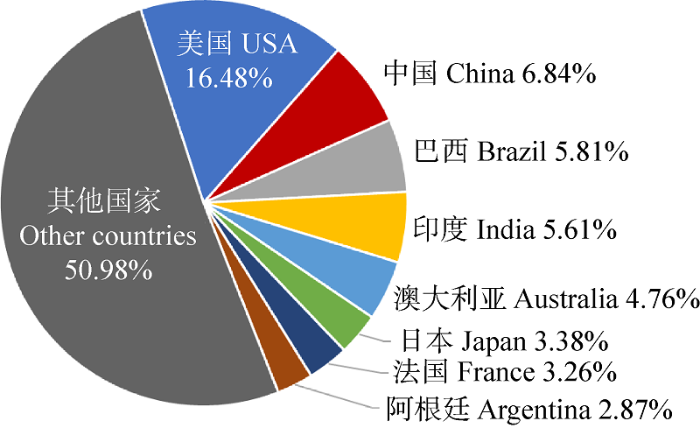
表1 中国各省区发现的菌物新物种数量
Table 1
| 省/地区 Province/Region | 物种数 Number of species | 省/地区 Province/Region | 物种数 Number of species | 省/地区 Province/Region | 物种数 Number of species |
|---|---|---|---|---|---|
| 云南 Yunnan | 2 136 | 新疆 Xinjiang | 198 | 内蒙古 Inner Mongolia | 103 |
| 中国台湾 Taiwan, China | 1 470 | 北京 Beijing | 190 | 河南 Henan | 99 |
| 广东 Guangdong | 614 | 湖南 Hunan | 173 | 山东 Shandong | 96 |
| 海南 Hainan | 532 | 江西 Jiangxi | 169 | 江苏 Jiangsu | 87 |
| 四川 Sichuan | 473 | 陕西 Shaanxi | 161 | 河北 Hebei | 74 |
| 贵州 Guizhou | 451 | 安徽 Anhui | 141 | 宁夏 Ningxia | 30 |
| 广西 Guangxi | 404 | 浙江 Zhejiang | 141 | 重庆 Chongqing | 29 |
| 西藏 Tibet | 358 | 青海 Qinghai | 118 | 上海 Shanghai | 8 |
| 吉林 Jilin | 267 | 辽宁 Liaoning | 116 | 澳门 Macau, China | 3 |
| 香港 Hong Kong, China | 248 | 山西 Shanxi | 114 | 天津 Tianjin | 3 |
| 湖北 Hubei | 235 | 黑龙江 Heilongjiang | 113 | 省份未知 Unknown | 538 |
| 福建 Fujian | 234 | 甘肃 Gansu | 107 |
在所有中国菌物新物种中,留存有模式标本记录的有8 794种,其中8 453份记录了保藏机构,共保藏在254家国内机构和137家国外机构中。在这些主模式标本中,保藏于国内的有7 221份,占85.43%;其余1 232份保藏在国外的标本馆或保藏机构。按照保藏中心进行统计,有13家国内机构和2家国外机构保藏了超过100份中国菌物新物种的主模式标本,其中保藏量最多的是中国科学院微生物研究所菌物标本馆(HMAS),共有1 745份。
4 中国菌物分类学发展历史
4.1 外人在华采菌及研究(1750s-1929)
以林奈(1707-1778)时期为起点,近现代菌物分类学在西方国家逐渐开始发展,在菌物分类学知识流传到中国之前,西方人士率先在中国开始了菌物标本采集和分类学研究工作。最早一批在中国采菌的是西方传教士,他们收集了大量植物和菌物标本,法国人P.M. Cibot就是其中之一。1774年,他在沙俄科学院的院报发表了关于中国菌物的研究论文,并描述了一个新种(Phallus mokusin Cibot),是中国菌物最早的发表记录,其种加词“mokusin”像是中国古籍中“蘑菇蕈”的音译(戴芳澜 1979)。然而,受到《国际藻类、菌物和植物命名法规》对于优先权的限制,直到1823年,Fries (1823)将其重新组合为Lysurus mokusin (Cibot ex Persoon) Fr.并再次发表,该名称才正式被命名法认可(Turland et al. 2018)。根据物种描述来看,即是现在的五棱散尾鬼笔(图2A)。在此前一年,Fries (1822)在他的另一部著作中发表了另一个来自中国的新物种(Pachyma hoelen Fr.),然而这一名称却在历史的长河中被湮灭,直至近两年,最新的研究才发现这一物种即是我国著名的药用菌茯苓,并为其指定了新模式(图2B) (Wu et al. 2020)。但是,由于Wolfiporia作为茯苓的属名已被广泛使用,在最新的研究中基于Pachyma hoelen Fr.建立了新组合名Wolfiporia hoelen (Fr.) Y.C. Dai & V. Papp并将其作为中国及东亚茯苓的现用名称(Stalpers et al. 2021)。
图2
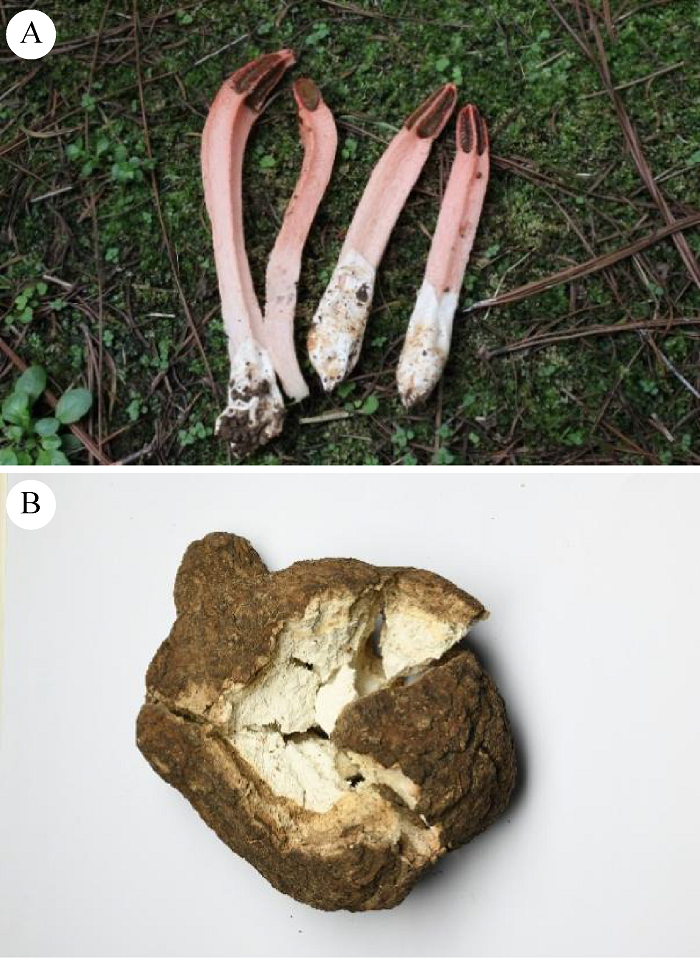
图2
最早发表的中国菌物新物种
A:五棱散尾鬼笔Lysurus mokusin (Cibot ex Persoon) Fries (syn. Phallus mokusin Cibot发表于1774年).B:茯苓Wolfiporia hoelen (Fr.) Y.C. Dai & V. Papp (syn. Pachyma hoelen Fr.发表于1822年)
Fig. 2
The earliest published new species of fungi discovered from China.
A: Lysurus mokusin (Cibot ex Persoon) Fries (syn. Phallus mokusin Cibot, published in 1774). B: Wolfiporia hoelen (Fr.) Y.C. Dai & V. Papp (syn. Pachyma hoelen Fr., published in 1822).
从18世纪中叶直到1929年间,一共有330个菌物新物种自中国发现,但相关研究成果全部由外国人发表。随着1840年鸦片战争开始,中国闭关锁国的政策被打破,更多欧美传教士、军人、官吏和学者等人士开始在华采集标本,首先被开放的中国台湾、香港、东北地区、广东、福建等沿海和陆上边疆地区成为了这一时期中国菌物新物种发现的主要地区(表2)。1860年,英国学者M.J. Berkeley和美国学者M.A. Curtis发表了采自中国香港的23个大型真菌新物种,这些模式标本被保藏在了英国皇家植物园,是最早一批来自中国的菌物模式标本。在这一时期对于中国菌物研究最多的学者是H. Sydow和其父亲P. Sydow,他们虽然未曾来中国采集,但是鉴定了不少美国人士在华采集的菌物标本,并发表了63个新物种,其模式标本主要采自中国台湾、广东等地。1894年之后,先后有大批日本人到中国台湾地区调查真菌资源,其中以K. Sawada为代表,这位日本学者自1919-1944年期间发表《中国台湾产菌类调查报告》共10编,记录中国台湾真菌2 500多种(戴芳澜 1979),其中包含850多个新种,但多数缺乏必要的描述和特征集要而被命名法认定为不合格名称,被认可的正确新物种仅有226种。
表2 不同历史阶段中国菌物新物种发现最多的省区
Table 2
| 年 Year | 地区 Region of China | 物种数 Number of species |
|---|---|---|
| 1750s-1929 | 中国台湾 Taiwan, China | 112 |
| 中国香港 Hong Kong, China | 33 | |
| 东北地区Northeast China | 20 | |
| 广东 Guangdong | 18 | |
| 福建 Fujian | 15 | |
| 1930-1949 | 中国台湾 Taiwan, China | 166 |
| 云南 Yunnan | 76 | |
| 四川 Sichuan | 38 | |
| 广西 Guangxi | 24 | |
| 东北地区Northeast China | 18 | |
| 1950-1977 | 中国台湾 Taiwan, China | 208 |
| 云南 Yunnan | 24 | |
| 贵州 Guizhou | 15 | |
| 吉林 Jilin | 13 | |
| 四川 Sichuan | 12 | |
| 1978-2010 | 中国台湾 Taiwan, China | 678 |
| 云南 Yunnan | 531 | |
| 广东 Guangdong | 308 | |
| 四川 Sichuan | 189 | |
| 中国香港 Hong Kong, China | 177 | |
| 2011- | 云南 Yunnan | 1 493 |
| 海南 Hainan | 397 | |
| 贵州 Guizhou | 327 | |
| 中国台湾 Taiwan, China | 306 | |
| 广东 Guangdong | 275 |
4.2 中国菌物分类学起步(1930-1949)
外国人在华的采集,往往不加限制,在我国国土上如入无人之境,使我国流失了许多菌物资源,但同时也让世界认识了中国菌物的多样性和特有性,促使中国学者着手发展自己的菌物学科(裘维蕃 1998)。
中国人自己采集和研究菌物始于20世纪初,由于当时的中国十分积弱,怀揣着科学救国之心,我国学者首先选择了应用性较强的植物病原真菌展开研究。1929年,我国植物学的奠基人之一刘慎谔,在法国留学期间从事植物病原菌研究,并发表了9个法国的锈菌新物种,是中国学者最早的菌物新分类单元发表成果。随后,留学归来的学者们逐渐开始了对自己国家菌物资源的研究。1930年,作为我国菌物学重要奠基人的戴芳澜,发表了一个白粉菌新种——南京钩丝壳Uncinula nankinensis (Tai 1930),是第一个由中国学者自己研究与发表的中国菌物新物种。这份白粉菌的模式标本有幸得以完好保存,目前保藏在中国科学院微生物研究所菌物标本馆(图3)。在此之后,中国菌物分类学迎来了第一个发展高潮(余永年和卯晓岚 2015)。1932年,另一位我国菌物学奠基人邓叔群首先开始了高等真菌的研究并发表了最早的大型真菌新物种,同年,邓叔群还发表了一个黏菌新属Verrucosia,是我国学者发表的第一个高阶分类单元(Teng 1932a, 1932b)。1936年,周宗璜首先开展了对我国黏菌的研究(Chow 1936)。方心芳(1937)发表了我国最早的酵母菌新物种。然而,随着1937年日本全面侵华开始,我国菌物学的发展受战乱影响逐渐放缓,标本采集和研究转移至受战乱影响较小的西南地区(云南和四川)。
图3
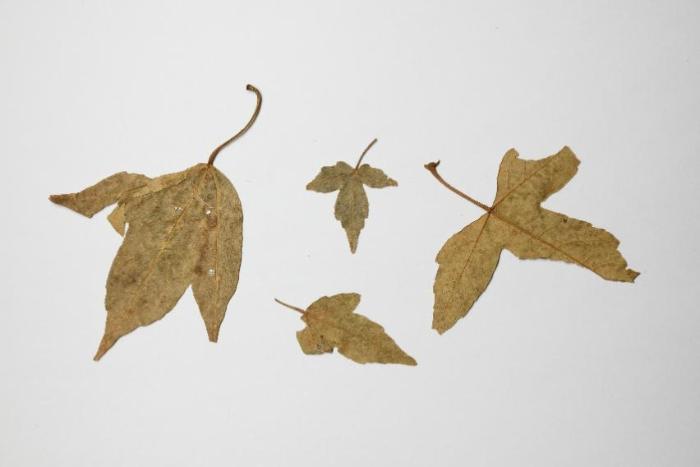
图3
第一个由中国学者发表的中国菌物新物种:南京钩丝壳模式标本(HMAS 14185)
Fig. 3
Holotype of Uncinula nankinensis F.L. Tai (HMAS 14185), the first China’s new fungal species published by Chinese scholar.
在1930-1949这20年间,25位中国学者发表了442个新分类单元,包括11个新属、323个新种、39个种下单元和69个新组合,其中只有5个新分类单元是中外学者合作发表,其余全部是中国学者独立发表。两位我国菌物学先驱邓叔群和戴芳澜院士是发表新分类单元最多的学者,前者发表了5个新属、123新种、13个新变种和25个新组合,后者发表了1个新属、78新种、9个新变种和11个新组合。植物病原真菌(小煤炱科Meliolaceae、锈菌科Pucciniaceae和白粉菌科Erysiphaceae)是这一时期最受关注的研究类群(表3)。与此同时,外国人对于中国菌物资源的研究仍在继续,外国学者一共发表了314个产自中国的新物种,尤其是日本人在中国台湾地区开展了大量的菌物采集和研究工作,一共有166个菌物新物种在中国台湾被发现,为全国最多的省份。
表3 不同历史阶段中国菌物分类学的主要研究类群
Table 3
| 年代 Year | 1750s-1929 | 1930-1949 | 1950-1977 | 1978-2010 | 2011- |
|---|---|---|---|---|---|
| 科 Family | 锈菌科 Pucciniaceae | 小煤炱科 Meliolaceae | 锈菌科 Pucciniaceae | 球囊菌科 Mycosphaerellaceae | 牛肝菌科 Boletaceae |
| 球囊菌科 Mycosphaerellaceae | 锈菌科 Pucciniaceae | 球囊菌科 Mycosphaerellaceae | 格孢腔菌科 Pleosporaceae | 刺革菌科 Hymenochaetaceae | |
| 虫囊菌科 Laboulbeniaceae | 白粉菌科 Erysiphaceae | 星质炱科 Asterinaceae | 锈菌科 Pucciniaceae | 多孔菌科 Polyporaceae | |
| 霜霉科 Peronosporaceae | 球囊菌科 Mycosphaerellaceae | 白粉菌科 Erysiphaceae | 白粉菌科 Erysiphaceae | 肉座菌科 Hypocreaceae | |
| 蘑菇科 Agaricaceae | 牛肝菌科 Boletaceae | 梅衣科 Parmeliaceae | 多孔菌科 Polyporaceae | 间座壳科 Diaporthaceae |
4.3 新中国菌物分类学早期发展(1950‒1977)
新中国成立之前的菌物学研究,多以学者分散在各地开展,并未有专门的研究机构。随着新中国的成立,国家将菌物学人才汇集在一起,先后建立了北京农业大学(现中国农业大学)、中国科学院微生物研究所和中国科学院中南真菌研究室(现广东省科学院微生物研究所)等机构,并设立了菌物学相关的室、系,有效整合了从事菌物学研究的学者力量,为学科发展提供了有利的条件。然而,由于自然灾害和社会动荡的影响,再加之中国的经济发展仍较落后,影响了包括菌物学在内的科学发展。
在1950-1977年间,中国学者共发表了603个菌物新分类单元,包括了10个新属、406个新种、22个新变种、10个新变型和155个新组合,年均发表数量(22.33个),尚不及菌物分类学起步时期(22.55个),尤其在1950-1962年间,年均仅发表7个菌物分类单元,菌物分类学研究陷入低潮。在这20多年间,发表新分类单元的中国学者一共有85位,其中发表数量最多的学者是阎若珉和邓叔群,分别发表了204个和107个分类单元,两人发表数量占这一时期中国学者发表总数的51.58%。较前一阶段相比,外国学者对中国菌物资源的研究有所减少,有194个中国菌物新物种被外国学者发表,较上一时期减少了40%,而外国学者对于中国菌物的研究主要集中在中国台湾地区,仅K. Sawada和W. Yamamoto两位日本学者就命名了93个来自中国台湾的新物种。而中国台湾也是这一时期发现新物种最多的地区,共有208种,多于中国所有其他地区的总和。
4.4 全国性菌物标本采集和研究(1978-2010)
1978年,十一届三中全会的召开,结束了国内十余年的动荡,中国进入了改革开放的新时期,包括菌物学在内的科学界迎来了发展的高潮。在这一时期,全国性的菌物资源科考陆续开展,先后包括天山托尔木峰(1977-1978)、南迦巴瓦峰(1982-1983)、横断山区(1982-1984)、神农架(1984)、西南地区(1988-1990)、西藏珠峰地区(1990)、秦岭(1991)、热带地区(1997-2000)和西北地区(2003-2004)等,藉由这些科考工作,我国菌物标本保藏量稳步提升,针对这些标本开展的分类学研究也取得了出色的进展,出版了《中国真菌志》《西藏真菌》《横断山区真菌》《西南地区大型经济真菌》《秦岭真菌》《中国热带高等真菌》《中国西北地区菌物》等一系列著作。同时,学术性组织中国菌物学会和学术期刊《菌物学报》《菌物研究》均在这一阶段创办,为菌物学学术交流与成果发表提供了良好的平台。
改革开放所带来的另一个影响就是打通了国内外学者交流与合作的桥梁。截至1980年,中外学者合作发表的菌物分类单元仅有129个,合作比率尚不到10%,且多数合作是中国学者在海外留学期间发表的,双方几乎没有合作开展针对中国菌物资源的研究。而自1981年起,双方合作发表的科研成果陆续出现,中外合作发表比率达到近38.89%,且每年约有15%的中国新物种是由中外学者合作命名的(图4)。
图4
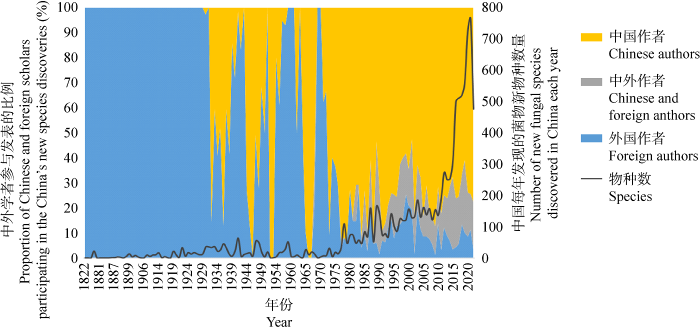
图4
中国每年发现的菌物新物种数量及中外学者参与发表的比例
Fig. 4
Number of new fungal species discovered in China each year and the proportion of Chinese and foreign scholars participating in the China’s new species discoveries.
在1978-2010年,这30多年的时间内,中国学者共发表了5 564个菌物新分类单元,包括了1个新纲、5个新目、12个新科、3个新亚科、187个新属、6个新亚属和组、3 875个新种、222个新种下单元和1 253个新组合。年均发表分类单元数量从之前的仅有20多个,大幅提升至160个以上。参与上述分类单元发表的中国学者有871位,年均学者数量从1977年之前的不到5人,增加到70人以上(图5),从事菌物分类学研究的学者队伍持续扩大,其中朱宇敏、庄文颖和郭英兰3位学者发表的分类单元最多,分别有293、280和218个。研究类群方面,植物病原菌(球囊菌科、格孢腔菌科Pleosporaceae、锈菌科、白粉菌科)依然是发表新分类单元最多的类群,而木生真菌(多孔菌科Polyporaceae)的研究开始受到较多关注(表3)。在此期间,有3 696个中国菌物新物种被发现和命名,其中3 230种由中国学者参与发表,占87.39%。除了数量的增加,新物种发现的地域也更加全面,全国34个省、自治区、直辖市均有新物种发现,而集中科考的西南地区(云南531种、四川189种、西藏117种)、热带地区(广东308种、香港177种、海南127种)、西北地区(新疆84种、陕西76种)是发现新物种较多的地区。与此同时,海峡对岸的中国台湾地区,延续了此前菌物分类学多年的积淀,多位中外学者共发表了678个新种,为全国最多的省份。
图5
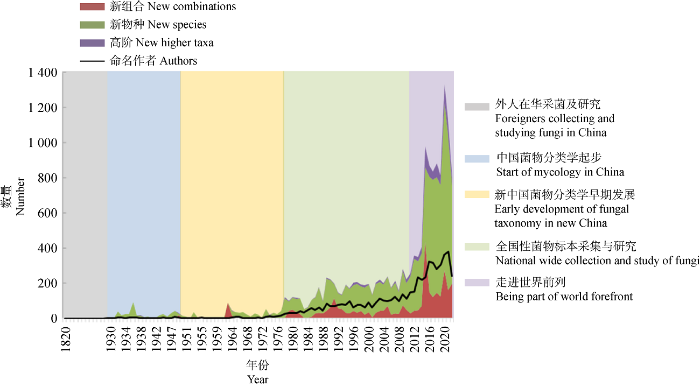
图5
中国学者发表的菌物新分类单元数量随时间变化的趋势
Fig. 5
Number of new fungal taxa published by Chinese authors each year.
4.5 走进世界前列(2011至今)
中国菌物分类学研究经过了30多年的持续发展与进步,在21世纪初就已逐渐达到世界一流水平,每年发表的新分类单元和新物种数量居于世界前列。而自2011年开始,学科在保持快速进步的趋势下再次迎来了发展的高峰。
近11年来,中国学者发表的新分类单元数量呈现爆发式增长,共发表2个新纲、22个新目及亚目、102个新科及亚科、553个新属及亚属、6 513个新种及种下单元和1 811个新组合共9 003个新分类单元,占同期全球总数(43 550个)的1/5。参与发表的中国命名学者有1 370人,其中发表数量最多的2位学者分别是从事植物病原菌的蔡磊研究员和从事木生真菌研究的戴玉成教授,两人分别发表了703和696个菌物新分类单元。当代新一辈学者接过老一辈学者的传承,不断学习和应用新技术、新方法,不仅持续发现菌物新物种,还参与构建多个类群的高阶分类系统、并对以往的研究成果进行总结和修订,产出了大量具有引领性和创新性的分类学与多样性研究成果。与此同时,中国菌物分类学的研究类群愈加广泛,每年研究内容涉及100个科、200个属以上。重点研究类群与过去的发展阶段有所不同,伞菌(牛肝菌科Boletaceae)和木生真菌(刺革菌科Hymenochaetaceae和多孔菌科)成为了最受关注的研究类群。中国菌物物种的发现速度同样在加快,在这一阶段共发现了5 334个菌物新物种,占全球新物种总数的1/5,是第二名美国的2.66倍(2 003种),其间每年发现的新物种数量均位居世界第一,年度发表数量从2011年的不到200种步步攀升到2021年的750种以上。
在这一时期,中国菌物学者的目光不仅仅局限在新物种发现和有限地域的研究,而是着眼于世界范围、大类群的系统性研究。魏江春院士团队在地衣型真菌(魏江春 2020;Jiang et al. 2021;魏鑫丽 2021);庄文颖院士在盘菌和肉座菌(庄文颖 2013,2014,2018,2020;Zhu & Zhuang 2015);白逢彦研究员在酵母菌(Liu et al. 2015;Wang et al. 2015a,2015b;Li et al. 2020);杨祝良研究员在牛肝菌和鹅膏(Zeng et al. 2013;Wu et al. 2014;Cui et al. 2018);戴玉成教授团队在木生真菌(Dai 2011,2012;Zhao et al. 2013;Han et al. 2016;Cui et al. 2019;Wu et al. 2022);蔡磊研究员在植物病原真菌(Liu et al. 2014;Chen et al. 2017;Hou et al. 2020;Zhao et al. 2021);赵瑞琳研究员联合多国学者修订了担子菌门分类系统(Zhao et al. 2016, 2017;He et al. 2019)。我国学者在这些重要菌物类群持续取得系统性成果,发表了一系列世界性专著,修订了很多类群的分类系统。依托于对中国及世界样本的大规模收集和研究,这些研究工作除了描述和发现大量新物种,还构建了多个高等级分类单元,并对已有的分类单元进行了组合和修订。
随着已认知菌物的逐渐增多,我国逐渐开始了菌物多样性编目工作。截至2011年,“中国生物物种名录”中还没有收录菌物类群。2011年,中国菌物名录数据库建立,菌物多样性的编目工作由此开启,2022年最新发布的“中国生物物种名录 2022年度版”,已收录菌物17 173种(The Biodiversity Committee of Chinese Academy of Sciences 2022)。纸质编目的编写工作也在同步开展,《中国生物物种名录 第三卷 菌物》已出版了4个分册,共收录中国的盘菌、锈菌、黏菌等菌物物种共3 667种。在志书编研方面,《中国真菌志》和《中国地衣志》已完成了68卷的编写和出版,其中28卷在2011年之后完成,占总卷数的41.18%,为48科490属3 582种菌物完成了编目。2018年,《中国生物多样性红色名录——大型真菌卷》(姚一建等 2020)正式发布,记录了9 302种大型真菌的受威胁状况,菌物资源的保护工作由此全面展开。
5 展望
中国菌物分类学于20世纪初从零开始发展,较西方晚了150多年,在早期达到发展高潮随即却陷入了战争的灾难,直至20世纪80年代才再次迎来了快速发展的契机。时至今日,中国菌物分类学已建立百年有余,在几辈科学家不懈奋斗、共同努力下,终于走在了世界的前列。目前的成就远远不是终点,中国的菌物工作者仍在以更快的速度发现中国及全球的菌物多样性,在2022年上半年,全球已发表菌物新分类单元 2 327种,而中国学者发表了其中802个,占比超过1/3。截至目前,中国乃至世界的物种多样性认知尚不及估计数字的10% (魏江春 2010; Wang et al. 2020)。而全球菌物已知的10 000多个属中,尚有超过1/5存在高阶分类单元未定(incertae sedis)的情况,亟须进一步研究和解决。由此可见,若要完整认知菌物分类系统以及我国乃至全球的菌物多样性仍有很长的路要走,中青年学者要积极传承老一辈科学家勇于探索、艰苦奋斗之精神,继续保持学科快速发展的趋势,逐渐完善对菌物的认知,让这一类重要生物资源在医药、生产和生态等多个层面发挥重要作用。
参考文献
Species novae Usneae Sinicae
Didymellaceae revisited
DOI:10.1016/j.simyco.2017.06.002
PMID:28706324
[本文引用: 1]

The is one of the most species-rich families in the fungal kingdom, and includes species that inhabit a wide range of ecosystems. The taxonomy of has recently been revised on the basis of multi-locus DNA sequence data. In the present study, we investigated 108 isolates newly obtained from 40 host plant species in 27 plant families, and various substrates from caves, including air, water and carbonatite, originating from Argentina, Australia, Canada, China, Hungary, Israel, Italy, Japan, South Africa, the Netherlands, the USA and former Yugoslavia. Among these, 68 isolates representing 32 new taxa are recognised based on the multi-locus phylogeny using sequences of LSU, ITS, and, and morphological differences. Within the, five genera appeared to be limited to specific host families, with other genera having broader host ranges. In total 19 genera are recognised in the family, with being reduced to synonymy under. This study has significantly improved our understanding on the distribution and biodiversity of, although the placement of several genera still need to be clarified.
Myxomycetes from Hsiao-Wu-Tai-Shan
Species diversity, taxonomy and phylogeny of Polyporaceae (Basidiomycota) in China
DOI:10.1007/s13225-019-00427-4 URL [本文引用: 1]
The family Amanitaceae: molecular phylogeny, higher-rank taxonomy and the species in China
DOI:10.1007/s13225-018-0405-9 URL [本文引用: 1]
A revised checklist of corticioid and hydnoid fungi in China for 2010
DOI:10.1007/S10267-010-0068-1 URL [本文引用: 1]
Polypore diversity in China with an annotated checklist of Chinese polypores
DOI:10.1007/s10267-011-0134-3 URL [本文引用: 1]
Diversity and systematics of the important macrofungi in Chinese forests
Country focus:China
In: Willis KJ (ed.) State of the world’s fungi. Royal Botanic Gardens, Kew. 48-55
Study on several yeasts in China
Taxonomy and phylogeny of the brown-rot fungi: Fomitopsis and its related genera
DOI:10.1007/s13225-016-0364-y URL [本文引用: 1]
Notes, outline and divergence times of Basidiomycota
DOI:10.1007/s13225-019-00435-4 URL [本文引用: 1]
The phoma-like dilemma
DOI:10.1016/j.simyco.2020.05.001
PMID:32904212
[本文引用: 1]
Species of have a cosmopolitan distribution and are geographically widespread, occurring in diverse ecosystems. The family includes several important plant pathogenic fungi associated with fruit, leaf, stem and root diseases on a wide variety of hosts, as well as endophytic, saprobic and clinically relevant species. The was recently revised based on morphological and phylogenetic analyses of ex-type strains subjected to DNA sequencing of partial gene data of the LSU, ITS, and loci. Several poly- and paraphyletic genera, including, and were redefined, along with the introduction of new genera. In the present study, a global collection of 1 124 strains from 92 countries, 121 plant families and 55 other substrates, including air, coral, human tissues, house dust, fungi, insects, soil, and water were examined via multi-locus phylogenetic analyses and detailed morphological comparisons, representing the broadest sampling of to date. Among these, 97 isolates representing seven new genera, 40 new species and 21 new combinations were newly introduced in. In addition, six epitypes and six neotypes were designated to stabilise the taxonomy and use of older names. A robust, multi-locus reference phylogenetic tree of was generated. In addition, was revealed as the most effective locus for the identification of at species level, and is proposed as a secondary DNA marker for the family.© 2020 Westerdijk Fungal Biodiversity Institute. Production and hosting by ELSEVIER B.V.
246 Reallocation of foliicolous species of the genus Strigula into six genera (lichenized Ascomycota, Dothideomycetes, Strigulaceae)
DOI:10.1007/s13225-020-00445-7 URL [本文引用: 1]
Diversity and phylogeny of basidiomycetous yeasts from plant leaves and soil: proposal of two new orders, three new families, eight new genera and one hundred and seven new species
DOI:10.1016/j.simyco.2020.01.002
PMID:32206137
[本文引用: 1]
Nearly 500 basidiomycetous yeast species were accepted in the latest edition of published in 2011. However, this number presents only the tip of the iceberg of yeast species diversity in nature. Possibly more than 99 % of yeast species, as is true for many groups of fungi, are yet unknown and await discovery. Over the past two decades nearly 200 unidentified isolates were obtained during a series of environmental surveys of yeasts in phyllosphere and soils, mainly from China. Among these isolates, 107 new species were identified based on the phylogenetic analyses of nuclear ribosomal DNA (rDNA) [D1/D2 domains of the large subunit (LSU), the small subunit (SSU), and the internal transcribed spacer region including the 5.8S rDNA (ITS)] and protein-coding genes [both subunits of DNA polymerase II (RPB1 and RPB2), the translation elongation factor 1-α (TEF1) and the mitochondrial gene cytochrome b (CYTB)], and physiological comparisons. Forty-six of these belong to 16 genera in the (). The other 61 are distributed in 26 genera in the. Here we circumscribe eight new genera, three new families and two new orders based on the multi-locus phylogenetic analyses combined with the clustering optimisation analysis and the predicted similarity thresholds for yeasts and filamentous fungal delimitation at genus and higher ranks. Additionally, as a result of these analyses, three new combinations are proposed and 66 taxa are validated.© 2020 Westerdijk Fungal Biodiversity Institute. Production and hosting by ELSEVIER B.V.
The Colletotrichum gigasporum species complex
DOI:10.3767/003158514X684447
PMID:25737595
[本文引用: 1]
In a preliminary analysis, 21 Colletotrichum strains with large conidia preserved in the CBS culture collection clustered with a recently described species, C. gigasporum, forming a clade distinct from other currently known Colletotrichum species complexes. Multi-locus phylogenetic analyses (ITS, ACT, TUB2, CHS-1, GAPDH) as well as each of the single-locus analyses resolved seven distinct species, one of them being C. gigasporum. Colletotrichum gigasporum and its close allies thus constitute a previously unknown species complex with shared morphological features. Five of the seven species accepted in the C. gigasporum species complex are described here as novel species, namely C. arxii, C. magnisporum, C. pseudomajus, C. radicis and C. vietnamense. A species represented by a single sterile strain, namely CBS 159.50, was not described as novel species, and is treated as Colletotrichum sp. CBS 159.50. Furthermore, C. thailandicum is reduced to synonymy with C. gigasporum.
Phylogeny of tremellomycetous yeasts and related dimorphic and filamentous basidiomycetes reconstructed from multiple gene sequence analyses
DOI:10.1016/j.simyco.2015.08.001
PMID:26955196
[本文引用: 1]
Liu, X. -Z.; Wang, Q. -M.; Bai, F. -Y.; Boekhout, T. Chinese Acad Sci, State Key Lab Mycol Inst Microbiol, Beijing 100101, Peoples R China. Theelen, B.; Groenewald, M.; Bai, F. -Y.; Boekhout, T. CBS Fungal Biodivers Ctr CBS KNAW, Utrecht, Netherlands. Boekhout, T. Second Mil Med Univ, Changzheng Hosp, Shanghai Key Lab Mol Med Mycol, Shanghai, Peoples R China.
Extensive Mycology
Geoglossomycetes cl. nov., Geoglossales ord. nov. and taxa above class rank in the Ascomycota Tree of Life
DOI:10.3767/003158509X461486 URL [本文引用: 1]
Competing sexual-asexual generic names in Agaricomycotina (Basidiomycota) with recommendations for use
DOI:10.1186/s43008-020-00052-w URL [本文引用: 1]
A species of Uncinula on Acer trifidium Hook Arn
Collection of fungi in China by foreign explorers
Fungi of Nanking I
Fungi of Nanking II
International Code of Nomenclature for Algae, Fungi, and Plants (Shenzhen Code)
Fungal names: a comprehensive nomenclatural repository and knowledge base for fungal taxonomy
The development trends in taxonomy, with a special reference to Fungi
DOI:10.1111/jse.12538 URL [本文引用: 1]
Phylogeny of yeasts and related filamentous fungi within Pucciniomycotina determined from multigene sequence analyses
DOI:10.1016/j.simyco.2015.08.002 URL [本文引用: 1]
Moniliellomycetes and Malasseziomycetes, two new classes in Ustilaginomycotina
DOI:10.3767/003158514X682313
PMID:25737592
[本文引用: 1]
Ustilaginomycotina (Basidiomycota, Fungi) has been reclassified recently based on multiple gene sequence analyses. However, the phylogenetic placement of two yeast-like genera Malassezia and Moniliella in the subphylum remains unclear. Phylogenetic analyses using different algorithms based on the sequences of six genes, including the small subunit (18S) ribosomal DNA (rDNA), the large subunit (26S) rDNA D1/D2 domains, the internal transcribed spacer regions (ITS 1 and 2) including 5.8S rDNA, the two subunits of RNA polymerase II (RPB1 and RPB2) and the translation elongation factor 1-alpha (EF1-alpha), were performed to address their phylogenetic positions. Our analyses indicated that Malassezia and Moniliella represented two deeply rooted lineages within Ustilaginomycotina and have a sister relationship to both Ustilaginomycetes and Exobasidiomycetes. Those clades are described here as new classes, namely Moniliellomycetes with order Moniliellales, family Moniliellaceae, and genus Moniliella; and Malasseziomycetes with order Malasseziales, family Malasseziaceae, and genus Malassezia. Phenotypic differences support this classification suggesting widely different life styles among the mainly plant pathogenic Ustilaginomycotina.
Phylogenetic classification of yeasts and related taxa within Pucciniomycotina
DOI:10.1016/j.simyco.2015.12.002 URL [本文引用: 1]
A new subgenus of Lasallia Merat emend. Vej
The biodiversity of pan-fungi and the sustainable development of human beings
The Enumeration of Lichenized Fungi in China
Flora Lichenum Sinicorum. Vol.6. Parmeliacae (III)
The genus Pachyma (Syn. Wolfiporia) reinstated and species clarification of the cultivated medicinal mushroom “Fuling” in China
DOI:10.3389/fmicb.2020.590788 URL [本文引用: 1]
Global diversity and systematics of Hymenochaetaceae with poroid hymenophore
DOI:10.1007/s13225-021-00496-4 URL [本文引用: 1]
Molecular phylogenetic analyses redefine seven major clades and reveal 22 new generic clades in the fungal family Boletaceae
DOI:10.1007/s13225-014-0283-8 URL [本文引用: 1]
Development of red list assessment of macrofungi in China
Macrofungi are important with both their ecological and socioeconomic values. Due to environmental pollution, climate change, habitat loss and fragmentation, and over-exploitation of resources, the diversity of macrofungi is under serious threatened. To evaluate the threatened status of macrofungi nationwide in China, the project of “Red List Assessment of Macrofungi in China” was officially launched in 2016 by the Ministry of Ecology and Environment (formerly the Ministry of Environmental Protection) in conjunction with the Chinese Academy of Sciences. Based on extensive and comprehensive collection of literature on the occurrence and distribution of macrofungi in China, and referring to the categories and criteria of the International Union for Conservation of Nature (IUCN) Red List of Species, the evaluation methods and process of the Red List of China's macrofungi were formulated according to the biological features of macrofungi and the current understanding of macrofungi in China. Experts on macrofungi around China were mobilized and organized to assess the threatened status of 9,302 species of macrofungi reported in China. Ninety-seven species are considered under threatened (including Possibly Extinct, Critically Endangered, Endangered and Vulnerable), accounting for 1.04% of the total number of species assessed; 101 species are Near Threatened, 2,764 species are Least Concern and 6,340 species are Data Deficient, occupying 1.09%, 29.71% and 68.16%, successively, of the species assessed. The assessment, which brings together the wisdom of more than 140 experts all over the country, is the first nationwide attempt to assess the threaten status of macrofungi in China, involving the largest number of macrofungal species, the widest range of macrofungal groups, the widest coverage of distribution area and the largest number of expert participants at home and abroad. It is of great significance to the conservation and management of the diversity of macrofungi in China.
100 Years of Mycology in China
Archaeological evidence suggests earlier use of Ganoderma in Neolithic China
The genus Phylloporus (Boletaceae, Boletales) from China: morphological and multilocus DNA sequence inference
DOI:10.1007/s13225-012-0184-7 URL [本文引用: 1]
New species and phylogeny of Perenniporia based on morphological and molecular characters
DOI:10.1007/s13225-012-0177-6 URL [本文引用: 1]
Contribution to rust flora in China I, tremendous diversity from natural reserves and parks
DOI:10.1007/s13225-021-00482-w URL [本文引用: 1]
A six-gene phylogenetic overview of Basidiomycota and allied phyla with estimated divergence times of higher taxa and a phyloproteomics perspective
DOI:10.1007/s13225-017-0381-5 URL [本文引用: 1]
Towards standardizing taxonomic ranks using divergence times - a case study for reconstruction of the Agaricus taxonomic system
DOI:10.1007/s13225-016-0357-x URL [本文引用: 1]
Trichoderma (Hypocrea) species with green ascospores from China
DOI:10.3767/003158515X686732
PMID:26240449
[本文引用: 1]
Stromata of Trichoderma species having green ascospores were collected in various regions of China. Based on morphology of the sexual and asexual morph, culture characteristics, and sequence analyses of rpb2 and tef1 genes, 17 species with green ascospores were identified. Among them, Trichoderma rosulatum, T rufo-brunneum and T stipitatum are described as new species, and seven other species are reported for the first time from China. Trichoderma rosulatum produces small bright yellow or pale greenish stromata with dense dark green ostioles and gliocladium-like conidiophores, shows a close relationship to T thelephoricola, and belongs to the Chlorospora clade. Trichoderma rufobrunneum, which typically forms reddish brown stromata, is recognised as a member of the Harzianum clade. Trichoderma stipitatum is characterised by turbinate, pale yellow to nearly orange stromata and verticillium-like conidiophores; it forms a distinct, independent lineage with strong bootstrap support in the phylogenetic trees. The distinctions between the new species and their close relatives are discussed, and their phylogenetic positions are explored.
Flora Fungorum Sinicorum. Vol.47. Nectriaceae et Bionectriaceae
Flora Fungorum Sinicorum. Vol.48. Pyronemataceae
Flora Fungorum Sinicorum. Vol.56. Helotiaceae
Flora Fungorum Sinicorum. Vol.60. Hypocreaceae
中国森林大型真菌重要类群多样性和系统学研究
中国大型真菌红色名录评估研究进展
DOI:10.17520/biods.2019173
[本文引用: 1]
大型真菌具有重要的生态价值和经济价值, 但由于环境污染、气候变化、生境丧失与破碎化, 以及资源过度利用等因素, 其生物多样性受到严重威胁。为了全面评估中国大型真菌的生存状况, 国家生态环境部(原环境保护部)联合中国科学院于2016年启动了《中国生物多样性红色名录——大型真菌卷》的编制工作。经广泛和全面收集文献资料, 依据IUCN物种红色名录等级与标准, 结合大型真菌特点和国内研究现状, 制定了中国大型真菌红色名录评估方法和流程, 动员和组织了全国相关研究力量, 对9,302种大型真菌的受威胁状况进行了评估。结果显示, 中国大型真菌受威胁物种(包括疑似灭绝、极危、濒危、易危)共97个, 占被评估物种总数的1.04%; 近危101种, 占总数的1.09%; 无危2,764种, 占总数的29.71%; 数据不足6,340种, 占总数的68.16%。此次评估工作汇集了全国140多位专家的智慧, 是国内外迄今为止涉及物种数量最大、类群范围最宽、覆盖地域最广、参与人员最多的一次大型真菌生存状况评估, 对我国大型真菌多样性保护与管理具有重要意义。