


黑木耳Auricularia heimuer F. Wu, B.K. Cui & Y.C. Dai隶属于担子菌门Basidiomycota、蘑菇纲Agaricomycetes、木耳目Auriculariales、木耳科Auriculariaceae,是我国传统的食药用菌(戴玉成和杨祝良2008;吴芳和戴玉成2015;戴玉成等2021)。黑木耳新品种‘农黑2号’ (闽鉴菌2020004)是以‘黑耳9号’和‘木耳黑龙3号’的单孢为亲本进行杂交选育而来,具有流耳率低、抗逆性强(抗杂菌、高温、高湿等)的优点,适合福建省工厂化周年生产(李建等2021)。黑木耳中富含多种营养物质与活性成分,如多糖、黑色素、膳食纤维及维生素等,具有补血、抗衰老和增强免疫力等药用功效(朱丽云等2010;Wu et al. 2019)。
热裂解气相色谱质谱法(pyrolysis gas chromatography mass spectrometry, Py-GC/MS)是对样品热分离后的挥发组分引入气相色谱-质谱仪中,直接进行GC分离和MS检测,用质谱法进行定性分析,并用峰面积归一法进行半定量分析,操作简单快速、样品少、分离效能高(郑坚强等2014)。热裂解气相色谱-质谱联用的方法可以直接鉴定裂解产物碎片,样品的分子结构及其所吸收的能力会决定其断裂方式,因而可以利用最后裂解碎片产物反推被测化合物的组成和结构(汪杰等2022)。本研究以黑木耳新品种‘农黑2号’为试验材料,在前期的基础上,拟先通过碱溶酸沉法提取黑色素,并通过光谱特征、Py-GC/MS等检测方法鉴定黑色素及其裂解产物,为进一步研究黑木耳黑色素结构提供理论和科学依据。
1 材料与方法
1.1 供试材料
1.1.1 实验菌株
黑木耳新品种:黑木耳‘农黑2号’由福建农林大学菌物研究中心选育。
1.1.2 试剂和仪器
试剂:氢氧化钠、盐酸、氯仿、乙酸乙酯、95%乙醇等均为分析纯,购自国药集团化学试剂有限公司。
仪器:KFJ-65多功能粉碎机(浙江瑞昊机械制造有限公司)、ST16R高速冷冻离心机(Thermo公司)、HWS12电热恒温水浴锅(上海一恒科技仪器有限公司)、FA1004B电子天平(上海精密仪器仪表有限公司)、UV-5200紫外分光光度计(上海元析仪器有限公司)、LGJ-12冷冻干燥机(北京松源华兴生物科技有限公司)、Helios G4 CX扫描电子显微镜(苏州科帝斯怀特工业设备有限公司)、Elemantar Vario El cube有机元素分析仪[艾力蒙塔贸易(上海)有限公司]、Thermo Scientific Nicolet 10傅立叶红外光谱仪(武汉德盟科技有限公司)、FrontierEGA/PY3030D热裂解仪(Frontier公司)、TRACE1310气相色谱仪[瑾恒仪器(上海)有限公司]、ISQ EC质谱仪[百道亨仪器设备(北京)有限公司]等。
1.2 黑木耳‘农黑2号’黑色素的提取
参照Hou et al. (2019)的方法,并稍作修改。将黑木耳子实体进行粉碎、过筛,按固液比1:30加入1 mol/L NaOH溶液,通过超声波提取1 h后,10 000 r/min离心3 min,上清液用HCl调节溶液pH值至1.5,80 ℃水浴10 h,随后 10 000 r/min离心3 min,收集沉淀,将沉淀进行干燥即为黑色素粗品。沉淀依次用蒸馏水、氯仿、乙酸乙酯、95%乙醇、75%乙醇及蒸馏水进行除杂,弃上清。将沉淀用0.1 mol/L NaOH复溶,再用0.1 mol/L HCl将溶液调pH至中性,流水透析48 h,进行冷冻干燥即可获得黑色素纯品。后续研究均采用黑色素纯品。
1.3 黑木耳‘农黑2号’黑色素紫外全吸收光谱检测
称取1 mg黑色素加入至0.1 mol/L NaOH溶液中,待完全溶解后,3 000 r/min离心5 min,取上清液在分光光度计上测量200-700 nm波长范围内的吸光值,以0.1 mol/L的NaOH溶液作为空白对照,并绘制紫外全吸收光谱。
1.4 黑木耳‘农黑2号’黑色素红外光谱检测
取1 mg干燥的黑色素纯品与200 mg KBr充分混合,在油压机上压成薄片,将黑色素放入红外光谱仪中测试,波长范围在4 000-400 cm-1,扫描次数32,分辨率4 cm-1。
1.5 黑木耳‘农黑2号’黑色素的形态学观察
取少量黑木耳‘农黑2号’黑色素粉末进行喷金镀膜处理,以增强其导电性,使用高分辨率扫描电子显微镜对黑色素进行成像,观察其表面形态并拍照。
1.6 黑木耳‘农黑2号’黑色素有机元素分析
准确称取50 mg黑色素粉末,采用元素分析仪(vario EL cube)检测黑色素样品中的C、H、N、S和O元素的含量。
1.7 黑木耳‘农黑2号’黑色素Py-GC/MS分析
称取少量黑木耳‘农黑2号’黑色素,采用单步裂解法(PY-23030D)裂解黑色素,经GC/MS分析,并在NIST谱库进行检索。
PY-3030D裂解常规条件:离子源温度300 ℃,传输线温度320 ℃,扫描离子范围40-800;色谱柱:DB-5 (5%联苯-95%聚甲基硅氧烷)弱极性石英毛细管柱(30 m×0.25 mm× 0.25 μm);柱温程序:50 ℃恒温1 min;10 ℃/min升到300 ℃;300 ℃恒温1 min;进样口温度:320 ℃;进样方式:分流;分流比:100;载气模式:恒流;载气流速:1.0 mL/min。
2 结果与分析
2.1 黑木耳‘农黑2号’黑色素的紫外-可见光谱分析
图1
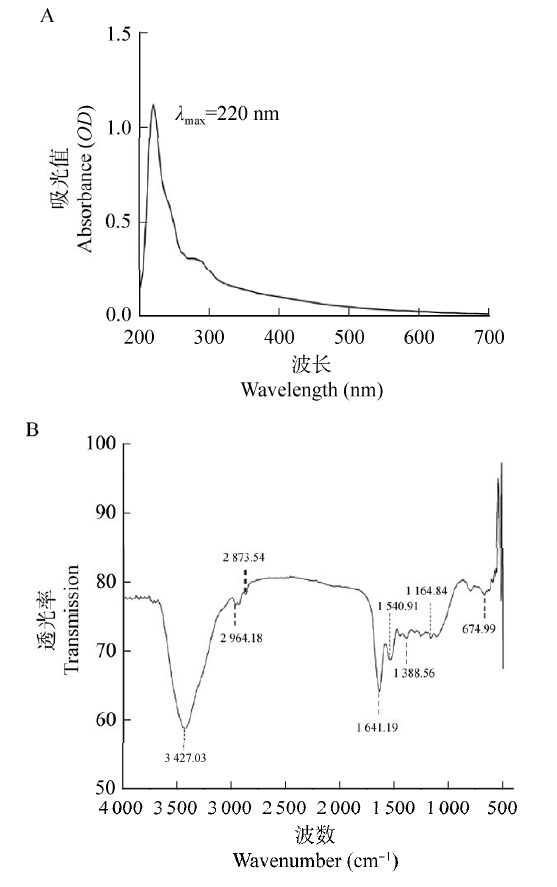
图1
黑木耳‘农黑2号’黑色素的光谱分析 A:黑木耳‘农黑2号’黑色素的紫外可见吸收光谱, 最大吸收峰在波长220 nm处. B:黑木耳‘农黑2号’黑色素的傅立叶红外光谱分析
Fig. 1
Spectral analysis of melanin in Auricularia heimuer Nonghei No. 2. A: UV-visible (UV-vis) absorption spectrum of the melanin. The maximum absorption peak is at the wavelength of 220 nm. B: FTIR analysis of the melanin.
2.2 黑木耳‘农黑2号’黑色素的红外光谱分析
黑色素是一种具有复杂结构的生物大分子,经傅立叶红外光谱分析获得具有一系列宽而强的吸收峰(图1B),可用来判断主要功能基团的信息。在3 427 cm-1处观察到强烈且宽的特征吸收峰,可能是羟基(-OH)或吲哚氨基(-NH)基团之间的氢键伸缩振动产生的;2 873 cm-1和2 964 cm-1处的小尖峰对应于脂肪族C-H基团,表明有CH2CH3存在;在1 641 cm-1处出现吸收峰表明分子中存在羰基(C=O),这与刘秋鸣(2019)的研究一致;黑色素在1 540 cm-1左右的峰可能与N=H弯曲振动或C=C/C=N变形振动有关,表明该黑色素具有典型的黑色素吲哚结构;在1 388 cm-1处的吸收峰是由C-CH3的弯曲和骨架振动吸收形成的;1 164 cm-1处的吸收峰表示C-O-C键的不对称伸缩振动;在674 cm-1处的吸收峰表明芳香环被共轭体系取代。
2.3 黑木耳‘农黑2号’黑色素的扫描电镜分析
图2
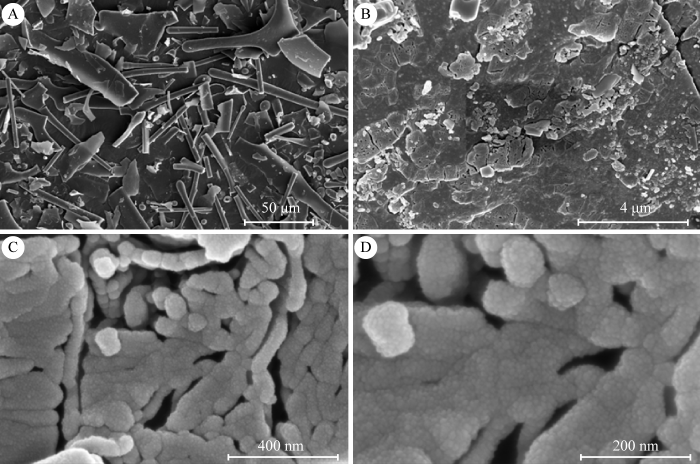
图2
黑木耳‘农黑2号’黑色素的微观形态 A-D:‘农黑2号’黑色素分别在500×、10 000×、1 000 000×和2 000 000×倍数下的扫描电镜图
Fig. 2
The micromorphology of the melanin in Auricularia heimuer Nonghei No. 2. A-D: The scanning electron micrographs at 500×, 10 000×, 1 000 000× and 2 000 000× magnification, respectively.
2.4 黑木耳‘农黑2号’黑色素的有机元素分析
有机元素分析可用来分析黑色素的主要元素组成,并可初步鉴定黑色素的类型。不同类型的黑色素具有不同元素含量,其中真黑色素含氮元素不含硫元素,棕黑色素含氮、硫元素,异黑色素不含氮、硫元素。黑木耳‘农黑2号’黑色素的元素分析见表1,C、H、N和O的含量分别为43.47%、5.24%、11.71%和39.58%,未检测出硫元素。结果表明,黑木耳‘农黑2号’黑色素为真黑色素。
表1 黑木耳‘农黑2号’黑色素的有机元素分析
Table 1
| 元素 Element | 黑木耳‘农黑 2号’黑色素 Melanin of Auricularia heimuer Nonghei No. 2 (%) | 真黑色素* Eumelanin (%) | 棕黑色素* Phaeomelanin (%) |
|---|---|---|---|
| C | 43.47 | 56.45 | 46.24 |
| H | 5.24 | 3.15 | 4.46 |
| N | 11.71 | 8.49 | 9.36 |
| S | 0 | 0.09 | 9.78 |
| O | 39.58 | 31.82 | 30.16 |
O%=100%-N%-C%-H%-S%;*数据来源于Ito & Fujita (
O%=100%-N%-C%-H%-S%; * These data were derived from Ito & Fujita (
2.5 黑木耳‘农黑2号’黑色素的Py-GC/MS分析
Py-GC/MS可解析黑色素高温裂解后的产物组成,为鉴定黑色素的结构提供新信息。黑木耳‘农黑2号’黑色素热裂解后,其挥发成分总离子色谱图见图3。黑木耳‘农黑2号’黑色素的热裂解部分产物见表2,包括甲苯、苯酚、苯乙腈、吲哚、少量烃等化合物。黑色素的热裂解产物可根据化学组成不同分为以下几组:苯类(1、3、8、18和19)、吲哚类(2、6和17)、苯酚类(4、7)、苯基腈类(9、11、13、14)、烃类(5、18)和嘧啶类(12)等。含量最多的产物是苯及其衍生物,其次是吲哚及其衍生物。苯、苯酚、吲哚及他们的衍生物是真黑色素最显著的热裂解产物(Dzierzega-Lecznar et al. 2006)。此外,没有检测到喹啉和异喹啉分子,这些分子是棕黑色的特征性热裂解产物(Gómez-Marín & Sánchez 2010)。该结果表明这些化合物不仅来自黑色素结构本身,还有可能来自其他聚合物亚单位的降解。在黑木耳‘农黑2号’黑色素中发现了少量的苯基腈,这与天然黑色素的研究相似(刘秋鸣2019)。
图3
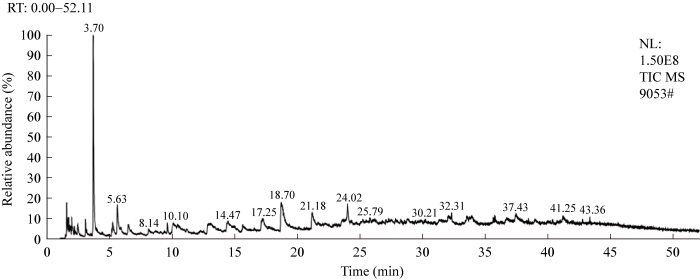
图3
黑木耳‘农黑2号’黑色素热裂解的挥发成分总离子色谱图
Fig. 3
The total ion chromatogram of the volatile components in the pyrolysis of melanin of Auricularia heimuer Nonghei No. 2.
表2 黑木耳‘农黑2号’黑色素的Py-GC/MS的产物
Table 2
| 序号 Serial No. | 出峰时间 RT (min) | 化合物名称 Compound name | 信噪比 S/N | 峰面积 Area (%) |
|---|---|---|---|---|
| 1 | 3.70 | 甲苯 Methylbenzene | 20 253.34 | 17.19 |
| 2 | 18.70 | 吲哚 Indole | 2 702.92 | 5.51 |
| 3 | 5.63 | 乙苯、N-苄基苯胺 Ethylbenzene, N-benzylaniline | 2 937.42 | 3.58 |
| 4 | 12.87 | 4-甲基苯酚、间甲酚 p-cresol, m-cresol | 880.33 | 3.45 |
| 5 | 1.59 | 2-丁烯、异丁烯、环丁烷 2-butene, 2-methylpropene, cyclobutane | 3 350.44 | 2.81 |
| 6 | 21.18 | 3-甲基吲哚、4-甲基吲哚、 2-甲基吲哚 3-methylindole, 4-methylindole, 2-methylindole | 1 430.03 | 2.42 |
| 7 | 10.09 | 苯酚、4-羟基磷酸苯酯Phenol, 4-hydroxyphenyl phosphonic acid | 832.75 | 2.19 |
| 8 | 24.02 | 联苄 Bibenzyl | 1 706.81 | 1.92 |
| 9 | 1.99 | 丙腈 Propanenitrile | 1 528.31 | 1.71 |
| 10 | 1.71 | 4-甲基环己醇、1-甲基环丙烷甲醇 4-methylcyclohexanol, 1-methylcyclopropanemethanol | 1 494.18 | 1.59 |
| 11 | 17.17 | 4-甲基苯乙腈 Benzenepropanenitrile | 926.12 | 1.56 |
| 12 | 37.43 | 4-甲基-5-(4-甲氧基苯基)嘧啶、1,3,5-三嗪-2,4-二胺、2-苄基-6-甲基-4(3H)-嘧啶酮 4-methyl-5-(4-methoxyphenyl) pyrimidine, 6-benzyl-1,3,5-triazine-2,4-diamine, 2-benzyl-6-methyl-1H-pyrimidin-4-one | 562.93 | 1.10 |
| 13 | 17.25 | 苯代丙腈 Benzenepropanenitrile | 897.12 | 1.09 |
| 14 | 14.47 | 苯乙腈、邻甲基苯腈 Benzyl cyanide, o-tolunitrile | 720.49 | 1.07 |
| 15 | 32.31 | 反式-9,10-环氧十八烷酸、2-(十八烷-9-烯氧基)乙醇、E-9-十八烯-1-醇乙酸酯 Trans-9,10-epoxy-octadecanoic acid, 2-(octadec-9-enyloxy) ethanol, E-9-octadecen-1-ol acetate | 971.42 | 0.86 |
| 16 | 41.25 | 3-亚苄基六氢吡咯并[1,2-a]吡嗪-1,4-二酮、1,3,5-三嗪-2-甲硫基乙氨基、2-苄基-2-甲基-5-苯基-1,3-二氢吡啶-4-酮 (3Z)-3-benzylidenehexahydropyrrolo[1,2-a]pyrazine-1,4-dione), (4-(ethylamino)-6-(methylsulfanyl)-1,3,5-triazin-2-ol), (2-benzyl-2-methyl-5-phenyl-1,3-dihydropyridin-4-one) | 392.29 | 0.76 |
| 17 | 25.79 | 4-(3-甲基-2-丁烯基)吲哚、1, 6, 7-三甲基萘 4-(3-methyl-2-butenyl)-1H-indole, 1,6,7-trimethylnaphthalene | 545.42 | 0.58 |
| 18 | 8.13 | 1-苯基丙烷 Cumene | 483.02 | 0.58 |
| 19 | 43.36 | 邻苯二甲酸二(2-丙基戊基)酯、邻苯二甲酸二(2-乙基己基)酯 Phthalic acid, di (2-propylpentyl) ester, bis(2-ethylhexyl) phthalate | 655.56 | 0.54 |
基于Py-GC/MS结果分析,进一步证实黑木耳‘农黑2号’黑色素是由大量的吲哚型真黑色素组成,基本骨架是苯环和吲哚。降解产物中含有酚类(苯酚、4-甲基苯酚等)及酸类物质,可能是由吲哚醌或羟基吲哚醌降解产生,也可能是黑色素结构中含有非循环氨基酸类结构。另外,热裂解产物中还含有烃类(5、18)、醇类(10、15)和脂肪酸类(15、19)等物质,这些物质可能是黑色素的支链成分。
3 讨论
黑木耳是食药用真菌,富含多种活性物质,如多糖、黑色素、黄酮及多酚等,具有免疫调节、降血糖、抗肿瘤和抗疲劳等药理活性(Wu et al. 2021;张志秀2022)。黑色素作为主要活性成分之一,具有清除自由基、抑菌、抗病毒、抗辐射、改善肝损伤及改善缺铁性贫血等活性(陈雅等2021)。前期通过复合酶提取法对黑木耳黑色素的提取工艺进行优化,优化后可以显著提高黑色素得率,且黑色素具有良好的体外抗氧化效果及缓解酒精性诱导的肝损伤作用(Hou et al. 2019;袁源等2022)。本研究通过碱溶酸沉法提取黑木耳‘农黑2号’黑色素,经有机元素分析可知,黑木耳‘农黑2号’黑色素含有C、N、H和O,未检测出S元素,为真黑色素,这也与Hou et al. (2019)的研究一致。经Py-GC/MS检测后,热裂解产物含量最多的是苯及其衍生物,其次是吲哚及其衍生物,未检测出喹啉和异喹啉分子,也进一步表明黑木耳‘农黑2号’的黑色素是真黑色素。
Py-GC/MS是采用热裂解系统与气相色谱-质谱联用的结合技术,利用热裂解技术将沸点高、分子量大的有机物裂解为低沸点或较小分子量的有机化合物,并结合气相色谱和质谱进行定性和定量,广泛应用在煤炭、生物质、橡胶、天然提取物及石油化工等领域(Azeez et al. 2010)。陈福欣等(2018)利用Py-GC/MS技术研究沉香挥发性成分鉴定其真伪及其药用组分,为构建沉香的指纹图谱提供科学依据。Liu et al. (2018)通过紫外可见吸收光谱、傅立叶红外光谱、元素分析、核磁共振、热裂解气相色谱-质谱和超高效液相色谱高分辨质谱等手段鉴定灰褐牛肝菌黑色素并解析其结构式([C28(OR1)4 (OR2)3H11O6N4]n),其中R1=H/烷烃/醇/脂肪酸,R2=CH3/COOH。生物活性与结构息息相关,为进一步探究黑色素可能发挥生物学功能的成分,本研究通过Py-GC/MS分析黑木耳‘农黑2号’黑色素的热裂解产物,为解析黑木耳‘农黑2号’黑色素的结构提供科学依据。
前期研究发现,黑木耳黑色素具有强抗氧化性、保肝活性等,但其作用机理还需进一步研究。黑木耳‘农黑2号’黑色素的热裂解产物中存在苯酚,具有抗氧化功效,这与黑木耳黑色素具有抗氧化性相呼应。李琦等(2010)的研究表明,天然黑色素具有清除自由基的活性,一方面是由于黑色素可以在多聚物邻苯二酚和醌之间产生大量醌自由基,从而使其具有氧化还原性;另一方面是可以螯合阳离子,通过羧基和羟基等阴离子发挥作用,进而抑制磷脂脂质体发生氧化。黑色素是吲哚或酚类化合物氧化聚合而成的,黑木耳‘农黑2号’黑色素的热裂解产物中也具有吲哚,表明其结构中也具有吲哚结构。吲哚作为重要的有机合成中间体,广泛存在于天然产物中,在抗肿瘤药物中占据重要地位(景珊珊等2022);吲哚上的吡咯环富含电子,可通过π-π键堆积在-NH部分与其他分子形成氢键进行相互作用,并具有低毒、多种药理活性,如抑菌、抗炎、抗肿瘤及抗氧化等(王钦等2022),这也与黑木耳黑色素具有抗癌、保肝和改善缺铁性贫血等药理活性相呼应。吲哚3-位引入其他杂环衍生物,会增强其药理活性,但关于黑木耳‘农黑2号’黑色素的结构及其吲哚结构上是否含有其他基团还需要进一步研究。
参考文献
Fast pyrolysis of African and European lignocellulosic biomasses using Py-GC/MS and fluidized bed reactor
DOI:10.1021/ef9012856 URL [本文引用: 1]
Study on volatile components of aquilaria by PY-GC-MS
Summary of melanin of Auriclaria auricula
Ultraviolet radiation screening compounds
DOI:10.1111/brv.1999.74.issue-3 URL [本文引用: 1]
A revised checklist of medicinal fungi in China
Diversity and systematics of the important macrofungi in Chinese forests
Structural investigations of neuromelanin by pyrolysis-gas chromatography/mass spectrometry
Pyrolysis combined with gas chromatography and mass spectrometry (Py-GC/MS) was applied for structural investigations of the human substantia nigra neuromelanin. Using synthetic neuromelanins, we have demonstrated that Py-GC/MS is suitable for identification and differentiation of both eumelanin (dopamine-derived) and pheomelanin (cysteinyldopamine-derived) component of the pigment. Structural information on melanin monomers was inferred from their pyrolytic markers. When the human neuromelanin was subjected to pyrolysis, none of the heterocyclic, sulfur-containing markers of pheomelanin component was detected among the thermal degradation products. We have concluded that nigral pigment isolated from normal brain tissue does not contain benzothiazine-type monomers, and that cysteinyldopamine-originated units may be incorporated into the polymer in uncyclized form. The most abundant pyrolysis product was identified as limonene, which indicates that nigral pigment is tightly associated with an isoprenoid-type compound. Pyrolysis in the presence of the methylating reagent allowed identification of high levels of saturated and monounsaturated straight-chain C14-C18 fatty acid species chemically bound to the pigment macromolecule.
Fungal melanins and their interactions with metals
Fungal melanins are dark brown or black pigments located in cell walls. They also exist as extracellular polymers. Melanized fungi possess increased virulence and resistance to microbial attack as well as enhanced survival while under environmental stress. Melanins contain various functional groups which provide an array of multiple nonequivalent binding sites for metal ions. Pigmented Cladosporium cladosporoides was shown to biosorb 2.5- to four-fold more Ni, Cu, Zn, Cd, and Pb than albino Penicillium digitatum and at four- to six-fold higher rates. Metal desorption was significantly lower for extracellular melanin than from pigmented or albino biomass which indicated the strength of the melanin-metal bond. At equilibrium, tributyltin chloride (TBTC) concentrations of 2.5 mM, pigmented and albino Aureobasidium pullulans absorbed approximately 0.9 and 0.7 mumol TBTC mg -1 dry wt, respectively, whereas purified extracellular melanin exhibited uptake levels of approximately 22 mumol TBTC mg-1 dry wt at an equilibrium concentration of only 0.4 mM. Addition of melanin to the growth medium reduced the toxic effect of CuSO4 and TBTC due to melanin metal binding and sequestration.
Thermal and mass spectroscopic characterization of a sulphur-containing bacterial melanin from Bacillus subtilis
DOI:10.1016/j.jnoncrysol.2010.05.054 URL [本文引用: 1]
Characterization of natural melanin from Auricularia auricula and its hepatoprotective effect on acute alcohol liver injury in mice
DOI:10.1039/C8FO01624K URL [本文引用: 3]
Microanalysis of eumelanin and pheomelanin in hair and melanomas by chemical degradation and liquid chromatography
A method for the quantitative analysis of eumelanin and pheomelanin in tissues, e.g., hair and melanoma, is described. The method is simple and rapid because it does not require the isolation of melanins from the tissues. The rationale is that permanganate oxidation of eumelanin yields pyrrole-2,3,5-tricarboxylic acid (PTCA) which may serve as a quantitatively significant indicator of eumelanin, while hydriodic acid hydrolysis of pheomelanin yields aminohydroxyphenylalanine (AHP) as a specific indicator of pheomelanin. The degradation products, PTCA and AHP, can be readily analyzed by high-performance liquid chromatography. Chemical degradations of synthetic melanins, prepared from dopa, 5-S-cysteinyldopa, and their mixtures in various ratios, gave PTCA and AHP in yields that correlated with the dopa/5-S-cysteinyldopa ratio. The PTCA/AHP ratio as well as the contents of PTCA and AHP reflected well the type of melanogenesis in hair and melanomas. The amounts needed for each degradation were 0.5 mg of melanin, 2 mg of hair, and 5 mg of tissue samples. As many as 20 samples can be analyzed within 3 working days.
Advances in selective functionalization of indoles
A new Auricularia heimuer cultivar ‘Nonghei No. 2’
Identification and extraction technology of melanin from Auricularia auricula
DOI:10.1111/jfds.1966.31.issue-1 URL
Study on preparation, structure analysis and probiotic activity of melanin from Boletus griseus
Study on the preparation and chemical structure characterization of melanin from Boletus griseus
DOI:10.3390/ijms19123736
URL
[本文引用: 1]

In this study, melanin (BgM) was obtained from Boletus griseus. The chemical composition and structure of BgM were characterized by UV-visible absorption spectrum, Fourier transform infrared spectrum, elemental analysis, nuclear magnetic resonance, pyrolysis gas chromatography mass spectrometry, and ultra-performance liquid chromatography–high resolution mass spectrometry. The percentage contents of C, H, N, S and O elements were 56.38%, 5.86%, 6.17%, 2.44%, and 28.04%, and the S/N and C/N ratios were 0.17 and 10.66, respectively. The UV-vis spectrum of BgM showed a maximum absorption peak at 214 nm. Characteristic absorption peaks were observed at 3426, 1600 and 1105 cm-1, and BgM contained phenolic hydroxyl, amidogen, carbonyl, methylene, and methyl groups. Moreover, BgM is an eumelanin, and its main skeleton has both a benzene ring and an indole, and the branched chain mainly consists of alkanes, alcohols, and fatty acids. BgM was hydrolyzed by H2O2 and four compounds were tentatively analyzed from the UPLC-MS/MS profile. The chemical structure of BgM was characterized as 5,6-dihydroxyindole eumelanin, and the condensed molecular formula is [C28(OR1)4(OR2)3H11O6N4]n.
Analysis of resin in unknown coatings by Py-GC/MS
Resarch advances on synthesis and antitumor activity of 3-heterocyclic substituted indole derivatives
Notes on the nomenclature of the Auricularia auricula-judae complex
Global diversity and updated phylogeny of Auricularia (Auriculariales, Basidiomycota)
DOI:10.3390/jof7110933
URL
[本文引用: 1]
Auricularia has a worldwide distribution and is very important due to its edibility and medicinal properties. Morphological examinations and multi-gene phylogenetic analyses of 277 samples from 35 countries in Asia, Europe, North and South America, Africa, and Oceania were carried out. Phylogenetic analyses were based on ITS, nLSU, rpb1, and rpb2 sequences using methods of Maximum Likelihood and Bayesian Inference analyses. According to the morphological and/or molecular characters, 37 Auricularia species were identified. Ten new species, A. camposii and A. novozealandica in the A. cornea complex, A. australiana, A. conferta, A. lateralis, A. pilosa and A. sinodelicata in the A. delicata complex, A. africana, A. srilankensis, and A. submesenterica in the A. mesenterica complex, are described. The two known species A. pusio and A. tremellosa, respectively belonging to the A. mesenterica complex and the A. delicata complex, are redefined, while A. angiospermarum, belonging to the A. auricula-judae complex, is validated. The morphological characters, photos, ecological traits, hosts and geographical distributions of those 37 species are outlined and discussed. Morphological differences and phylogenetic relations of species in five Auricularia morphological complexes (the A. auricula-judae, the A. cornea, the A. delicata, the A. fuscosuccinea and the A. mesenterica complexes) are elaborated. Synopsis data on comparisons of species in the five complexes are provided. An identification key for the accepted 37 species is proposed.
Resource diversity of Chinese macrofungi: edible, medicinal and poisonous species
DOI:10.1007/s13225-019-00432-7 [本文引用: 1]
Extraction optimization of melanin from Auricularia heimuer with complex enzyme and its antioxidant activity analysis
Research progress on action and application of main biological activities of Auricularia auricular
Analyzing pyrolysates of fructose with gas chromatography mass spectrometry
Influence of the pulverization technology on dissolved effect of polysaccharide from Auricularia auricula
中国森林大型真菌重要类群多样性和系统学研究
黑木耳黑色素鉴定及提取工艺优化
DOI:10.7506/spkx1002-6630-201016019
[本文引用: 1]
对黑木耳黑色素进行鉴定,并对提取工艺进行优化。黑木耳黑色素性质研究中发现色素溶于碱性溶液,不溶于水、酸及有机溶剂。运用紫外- 可见光谱扫描、傅里叶红外光谱扫描初步研究黑木耳黑色素的基本结构性质,鉴定表明黑木耳黑色素与酪氨酸合成黑色素相一致,为3,4- 二羟基苯丙氨酸(DOPA)类黑色素。提取工艺优化实验发现,采用超声波辅助提取并通过单因素及正交试验优化提取条件,得到最佳提取条件为提取时间80min、超声功率80W、氢氧化钠溶液浓度1.25mol/L、料液比(g/mL)1:30,在优化提取条件下粗品得率达到9.107%,与常规方法相比较,超声波辅助提取具有萃取工艺简单、提取时间短、提取效果较好等优点。
复合酶提取黑木耳黑色素的工艺优化及其抗氧化活性分析