


大型真菌(macrofungi)是一类拥有肉眼可辨的大型子实体的真菌,即人们熟知的蕈菌或蘑菇(贺茂强等 2022),在分类学上多隶属于担子菌门Basidiomycota,少数属于子囊菌门Ascomycota。大型真菌作为生态系统中不可或缺的分解者(姚一建等 2020),在森林生态系统的物质循环中扮演着重要角色,具有重要的生态功能(魏玉莲和戴玉成 2004)。通过降解森林凋落物,大型真菌将纤维素、半纤维素和木质素分解为可供自身和其他生物吸收的物质,从而调节生态系统不同功能群的利用率,促进森林更新(魏玉莲等 2010)。大型真菌不仅是自然生态系统中的重要组成部分,也与人类生产生活密切相关。约1 000种大型真菌为食用真菌(戴玉成等 2010),很多种类味道鲜美、营养价值极高,成为人们餐桌上美味的食用菌,如双孢蘑菇Agaricus bisporus、印度块菌Tuber indicum等。近900种大型真菌具有极高的药用价值(戴玉成和杨祝良 2008),如中国灵芝Ganoderma sinense (崔宝凯等 2023)、冬虫夏草Ophiocordyceps sinensis等。此外,还有480种大型真菌为有毒蘑菇(Wu et al. 2019),如纹缘盔孢伞Galerina marginata、淡紫丝盖伞Inocybe lilacina等。
我国幅员辽阔、生态类型多样,孕育了极为丰富的大型真菌资源。然而,相对于动植物资源多样性的研究,我国大型真菌资源多样性调查尚有很多空白(竺永金等 2021)。目前,据统计,我国已知菌物类群约为17 000种(戴玉成和庄剑云 2010)。我国大型真菌多样性的研究工作具有明显地域性,研究热点集中在西南和东北地区,其中西南地区是研究历史较早且种类最为丰富的地区(戴玉成等 2021),其目前所报道的大型真菌约占全国总量的60% (图力古尔和李玉 2000)。东北地区同样具有丰富的大型真菌资源(戴玉成等 2000, 2010),近年发现多个新种和新记录种(董庆庆和图力古尔2022;叶芊岐和图力古尔2022)。随着相关研究队伍的不断壮大,除西南和东北地区,其他地区如浙江(赵承刚等 2022)、北京(Dai et al. 2006;金莹杉等2021)、山东(吴晓明等 2021)、江西(高晓烨等 2020)、江苏(Cui et al. 2006)和华南(Wu et al. 2020;Ma et al. 2022)的大型真菌多样性工作也呈不断上升的态势,但仍然还有许多地区大型真菌资源状况尚不清楚。
六盘山国家级自然保护区位于宁夏回族自治区南部固原市境内,是我国西北地区重要的水源涵养林基地(曾锦源等 2022)。六盘山植被组成多样,分布有大量的天然次生林,森林覆盖率高达70%以上,使其成为黄土高原上一座独特的“绿色岛屿”(韦荣华 2011)。最早关于六盘山大型真菌的报道见于王宽仓等(2001)对西北地区大型真菌资源的研究,该研究发现六盘山地区菌物种类十分丰富且极具多样性,特别是盘菌、腹菌、伞菌、锈菌、白粉菌和半知菌等。马艳蓉(2004)对六盘山国家级自然保护区内大型真菌进行了考察,发现大型真菌约70种,隶属于17科31属,列出了其中经济价值颇高的野生食用菌名录。随后近20年的时间里,未见对该地区大型真菌的相关研究报道,直至Na et al. (2022)报道了采自六盘山国家级自然保护区的小菇属新种蓝灰小菇,邓晓娟等(2023)报道了该地区块菌资源的分布。我们对所有关于六盘山大型真菌已有的研究数据进行分析后发现,该地区大型真菌详细名录、多样性、区系成分都未有系统研究。
基于以上分析,本研究对六盘山国家级自然保护区内大型真菌资源进行实地调查和样品采集,通过形态学结合分子生物学数据分析对其物种进行鉴定,列出大型真菌物种名录,分析其物种多样性、经济价值和区系地理成分,为六盘山国家级自然保护区大型真菌资源的保护与合理开发利用奠定基础。
1 材料与方法
1.1 大型真菌标本处理和鉴定
1.1.1 标本采集及处理
2017-2021年7-9月对六盘山国家级自然保护区内的大型真菌进行采集,根据不同海拔及林型,分别设置A区王化南林场(华北落叶松,2 172 m)、B区王化南林场(油松林,2 172 m)、C区小倒沟(华北落叶松林,2 083 m)、D区小南川(华北落叶松林,2 026 m)、E区野荷谷(华北落叶松林,2 276 m)、F区植物园(阔叶混交林,2 026 m)共6个样地,每个样地采集4-5次。
采用样线法和踏查法采集大型真菌子实体,并在野外对大型真菌进行拍照,获得的照片应包括菌盖、菌褶和菌柄等形态特征,以及生境、寄主和共生植物等环境特征。详细填写大型真菌采集记录表,包括采集地的经纬度、海拔、采集日期、采集人以及子实体的宏观特征等信息。完成标本的记录后,将标本置于60 ℃的烘箱内烘至干燥,放入自封袋内长期保存。
1.1.2 形态学特征观察
形态学观察包括宏观形态和显微结构两部分。宏观特征包括菌盖、菌柄等部位的大小、颜色和附着物等;菌褶的着生方式;菌肉是否有伤变色;菌环的有无、形状及位置;菌托的大小等信息。显微形态观察时,用镊子和双面刀片切取部分干燥标本的菌褶或菌管,用5% KOH溶液作为浮载剂,观察无色组织时使用1%的刚果红染料进行染色,制作临时装片。在显微镜下观察孢子的大小、形状、颜色、表面纹饰(有无刺疣等)、担子和囊状体的形状,记录显微结构特征,每份标本随机选取20个以上成熟的孢子进行大小测量(王雪珊2020)。
1.1.3 分子生物学鉴定
对于传统形态学方法难以鉴定的种,采用分子生物学方法进行辅助验证。采用UNIQ-10柱式真菌基因组试剂盒进行大型真菌DNA提取,选取真菌ITS片段的通用引物ITS1F (5′-TCCGT AGGTGAACCTGCGG-3′)和ITS4 (5′-TCCTCCG CTTATTGATATGC-3′)进行PCR扩增。PCR反应体系(50 μL):基因组DNA 2 μL,10 mmol/L的引物(ITS1F和ITS4)各1.5 μL,2×Hief PCR Mastr Mix 25 μL,ddH2O补充到50 μL。PCR扩增程序:95 ℃预变性5 min;94 ℃变性5 min,52 ℃退火1 min,72 ℃延伸1 min,共30个循环;72 ℃延伸10 min (White et al. 1990;肉斯塔木·艾买提等2022)。用1%琼脂糖凝胶电泳检测PCR产物,并将检测合格的样品送至生工生物工程(上海)股份有限公司测序。将真菌测序所得的ITS序列采用Contig Express (v3.0.0)软件进行拼接和质控,然后提交至GenBank数据库(htp://blastncbi.nlm.ih.govBlast.cgi)进行BLAST序列比对分析,并从NCBI中选取同源性较高的序列,之后利用BioEdit (7.2.5)和MAFFT (tps:/mft.cbreiplaligmentsofware)软件进行多序列比对和人工校正,通过RAxML (Windows Executables v8.2.10)软件以最大似然法(ML)构建系统发育树,并用FigTree (v1.4.0)软件处理系统发育树,最后综合标本的形态特征和序列比对结果进行物种鉴定。
1.2 物种组成成分分析
1.3 大型真菌多样性分析方法
根据六盘山国家级自然保护区内的植被特点以及海拔,将其划分为6个群落类型,对其中的大型真菌进行资源调查。划分好样地后,分别从物种丰富度和均匀度两方面来进行计算。用Margalef (R)丰富度指数来描述物种丰富度;使用Simpson指数(D)和Shannon-Weaver指数(H)计算物种多样性(呼唤等2021)。所用到的公式如下:Margalef丰富度指数:R=(S-1)/ln(N);Simpson指数:D=1-ΣPi2;Shannon-Weaver指数:H=-Σ(Pi)(lnPi)。式中S为种i所在样方的物种总数;N为样方内大型真菌的总个体数;Pi为种i的个体数与总个体数之比。
1.4 区系分析及与其他真菌区系间的关系
1.5 区系成分的相似性比较
2 结果与分析
2.1 大型真菌物种组成成分
六盘山国家级自然保护区大型真菌资源丰富,本次调查共采集大型真菌标本679份,隶属于2门11纲16目40科83属230种,其中子囊菌门4纲6目8科10属21种,占物种总数的9.13%;担子菌门7纲10目32科73属209种,占总数的90.87% (表1)。
表1 六盘山国家级自然保护区大型真菌科、属、种数量统计
Table 1
| 科 Family | 属 Number of genus | 种 Number of species |
|---|---|---|
| 口蘑科Tricholomataceae | 9 | 28 |
| 球盖菇科Strophariaceae | 5 | 22 |
| 小脆柄菇科Psathyrellaceae | 5 | 18 |
| 伞菌科Agaricaceae | 5 | 14 |
| 小菇科Mycenaceae | 1 | 13 |
| 红菇科Russulaceae | 2 | 12 |
| 丝盖伞科Inocybaceae | 1 | 11 |
| 多孔菌科Polyporaceae | 6 | 10 |
| 小皮伞科Marasmiaceae | 3 | 9 |
| 丝膜菌科Cortinariaceae | 2 | 8 |
| 马鞍菌科Helvellaceae | 1 | 8 |
| 牛肝菌科Boletaceae | 4 | 6 |
| 铆钉菇科Gomphidiaceae | 1 | 6 |
| 层腹菌科Hymenogastraceae | 1 | 5 |
| 粉褶菌科Entolomataceae | 1 | 5 |
| 蜡伞科Hygrophoraceae | 3 | 4 |
| 鹅膏菌科Amanitaceae | 2 | 4 |
| 珊瑚菌科Clavariaceae | 2 | 4 |
| 火丝菌科Pyronemataceae | 2 | 4 |
| 离褶伞科Lyophyllaceae | 3 | 3 |
| 拟层孔菌科Fomitopsidaceae | 2 | 3 |
| 银耳科Tremellaceae | 2 | 3 |
| 靴耳科Crepidotaceae | 1 | 3 |
| 光柄菇科Pluteaceae | 1 | 3 |
| 块菌科Tuberaceae | 1 | 3 |
| 枝瑚菌科Ramariaceae | 1 | 3 |
| 马勃科Lycoperdaceae | 2 | 2 |
| 炭角菌科Xylariaceae | 2 | 2 |
| 齿菌科Hydnaceae | 1 | 2 |
| 刺孢多孔菌科Bondarzewiaceae | 1 | 2 |
| 假杯伞科Pseudoclitocybaceae | 1 | 1 |
| 麦角菌科Clavicipitaceae | 1 | 1 |
| 地舌菌科Geoglossaceae | 1 | 1 |
| 地星科Geastraceae | 1 | 1 |
| 锤舌菌科Leotiaceae | 1 | 1 |
| 须腹菌科Rhizopogonaceae | 1 | 1 |
| 地锤菌科Cudoniaceae | 1 | 1 |
| 拟纫革菌科Stereopsidaceae | 1 | 1 |
| 韧革菌科Stereaceae | 1 | 1 |
| 乳牛肝菌科Suillaceae | 1 | 1 |
| 总计Total | 83 | 230 |
2.2 优势科属分析
2.2.1 优势科
六盘山国家级自然保护区大型真菌优势科(≥10种)分析结果表明,种类最多的优势科为口蘑科,共包含9属28种,占总数的12.17%;第二大科是球盖菇科,包含5属22种,占总数的9.57%,第三大科是小脆柄菇科,共包含5属18种,占总数的7.83% (图1)。经统计,含10种以上的优势科有8科,包含34属128种,优势科仅占总科数的20%,但包含的物种数占目前六盘山大型真菌种类总数的55.65%。
图1
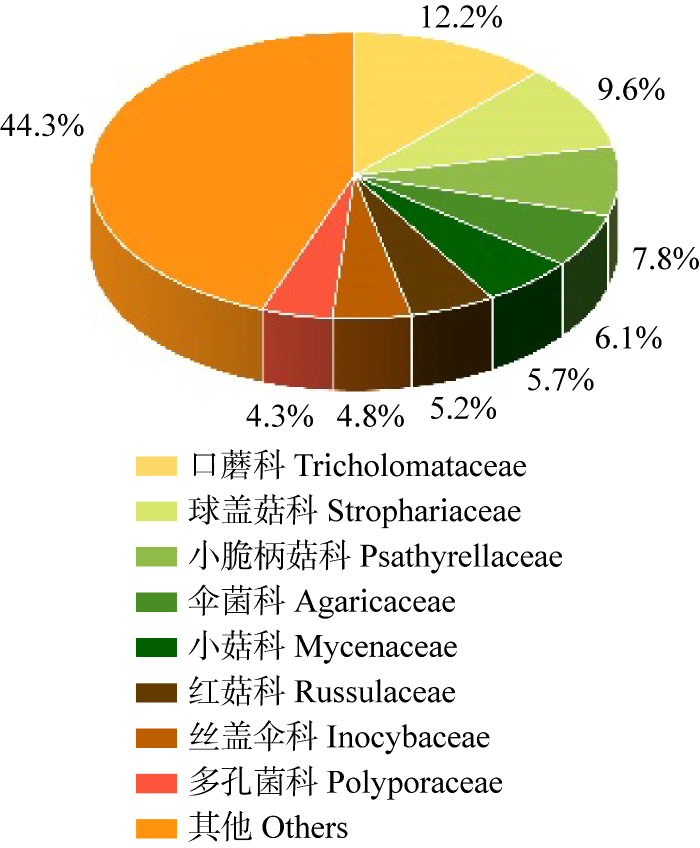
图1
六盘山国家级自然保护区大型真菌优势科(≥10种)
Fig. 1
Dominant families of macrofungi (≥10 species) in Liupanshan National Nature Reserve.
2.2.2 优势属
六盘山国家级自然保护区优势属分析结果显示,含5种以上的优势属有18个,合计118种,占总物种数的51.30%。种类最多的优势属为小菇属,包含13个种,占总物种数的5.65%;第二大属是丝盖伞属,共包含11个种,占总数的4.78%;第三大属是马鞍菌属,共包含8个种,占总数的3.48% (图2)。优势属所包含的种在该地区的大型真菌物种数中起到主导作用。
图2
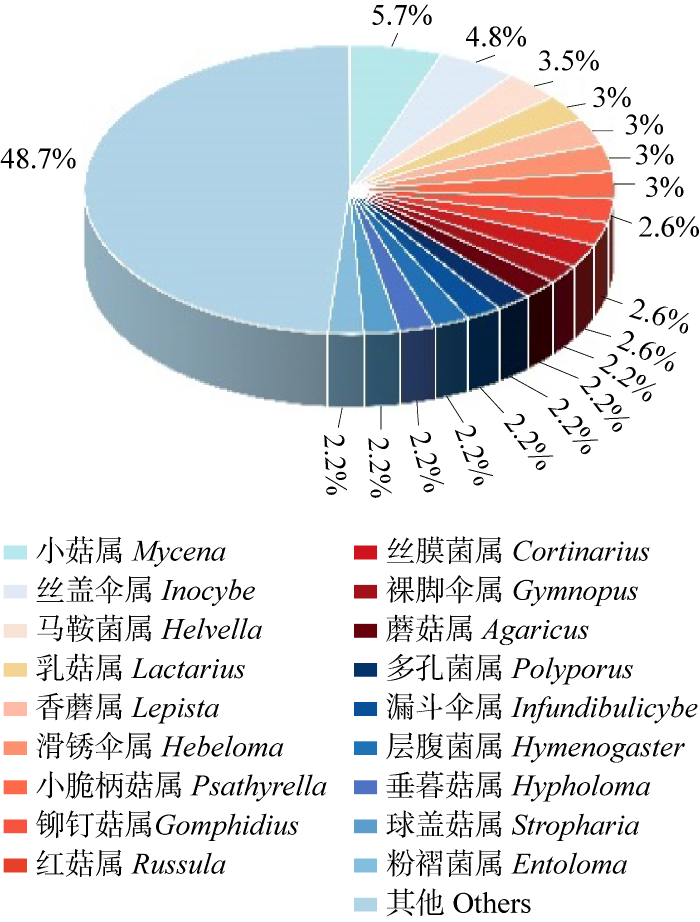
图2
六盘山国家级自然保护区大型真菌优势属(≥5种)
Fig. 2
Dominant genera of macrofungi in Liupanshan National Nature Reserve (≥5 species).
2.3 六盘山国家级自然保护区大型真菌资源评价
表2 六盘山国家级自然保护区的食用菌种类
Table 2
| 序号 No. | 学名 Scientific name | 中文名 Chinese name | 经济价值 Economic value | 生态习性 Ecological habit |
|---|---|---|---|---|
| 1 | Agaricus bisporus | 双孢蘑菇 | 食用Edible | 腐生Saprophytic |
| 2 | Calvatia gigantea | 大秃马勃 | 食用Edible | 腐生Saprophytic |
| 3 | Chroogomphus roseolus | 淡粉色钉菇 | 食用Edible | 共生Symbiotic |
| 4 | Clavariadelphus pistillaris | 棒瑚菌 | 食用Edible | 腐生Saprophytic |
| 5 | Clavulina cinerea | 灰锁瑚菌 | 食用Edible | 共生Symbiotic |
| 6 | Clavulina coralloides | 珊瑚状锁瑚菌 | 食用Edible | 共生Symbiotic |
| 7 | Clavulina rugosa | 皱锁瑚菌 | 食用Edible | 共生Symbiotic |
| 8 | Clitopaxillus dabazi | 大把子杯桩菇 | 食用Edible | 腐生Saprophytic |
| 9 | Coprinopsis atramentaria | 墨汁小鬼伞 | 食用Edible | 腐生Saprophytic |
| 10 | Coprinus comatus | 毛头鬼伞 | 食用Edible | 腐生Saprophytic |
| 11 | Cortinarius bovinus | 污褐丝膜菌 | 食用Edible | 共生Symbiotic |
| 12 | Cystoderma fallax | 金粒囊皮伞 | 食用Edible | 腐生Saprophytic |
| 13 | Gomphidius maculatus | 斑点铆钉菇 | 食用Edible | 共生Symbiotic |
| 14 | Helvella crispa | 皱马鞍菌 | 食用Edible | 腐生Saprophytic |
| 15 | Helvella elastica | 弹性马鞍菌 | 食用Edible | 腐生Saprophytic |
| 16 | Helvella ephippium | 灰褐马鞍菌 | 食用Edible | 腐生Saprophytic |
| 17 | Hygrophorus camarophyllus | 拱叶蜡伞 | 食用Edible | 共生Symbiotic |
| 18 | Lactarius deliciosus | 松乳菇 | 食用Edible | 共生Symbiotic |
| 19 | Lactarius fennoscandicus | 北欧乳菇 | 食用Edible | 共生Symbiotic |
| 20 | Lactarius pubescence | 绒边乳菇 | 食用Edible | 共生Symbiotic |
| 21 | Leccinum scabrum | 褐疣柄牛肝菌 | 食用Edible | 共生Symbiotic |
| 22 | Lepista irina | 淡色香蘑 | 食用Edible | 腐生Saprophytic |
| 23 | Lyophyllum leucophaeatum=Lyophyllum fumatofoetens | 白褐离褶伞 | 食用Edible | 共生Symbiotic |
| 24 | Marasmius oreades | 硬柄小皮伞 | 食用Edible | 腐生Saprophytic |
| 25 | Melanoleuca grammopodia | 条柄铦囊蘑 | 食用Edible | 腐生Saprophytic |
| 26 | Melanoleuca paedida | 灰褐铦囊蘑 | 食用Edible | 腐生Saprophytic |
| 27 | Psathyrella campestrtris | 草地小脆柄菇 | 食用Edible | 腐生Saprophytic |
| 28 | Ramaria apiculata | 尖顶枝瑚菌 | 食用Edible | 腐生Saprophytic |
| 29 | Ramaria abietina=Ramaria ochraceovirens | 冷杉枝瑚菌 | 食用Edible | 腐生Saprophytic |
| 30 | Ramaria distinctissima | 离生枝瑚菌 | 食用Edible | 腐生Saprophytic |
| 31 | Rhizopogon roseolus | 红根须腹菌 | 食用Edible | 共生Symbiotic |
| 32 | Russula atroaeruginea | 暗绿红菇 | 食用Edible | 共生Symbiotic |
| 33 | Russula sanguinea | 血红菇 | 食用Edible | 共生Symbiotic |
| 34 | Stropharia rugosoannulata | 大球盖菇 | 食用Edible | 腐生Saprophytic |
| 35 | Suillus grevillei | 厚环乳牛肝菌 | 食用Edible | 共生Symbiotic |
| 36 | Tremella pulvinalis | 垫状银耳 | 食用Edible | 腐生Saprophytic |
| 37 | Tricholoma argyraceum | 银盖口蘑 | 食用Edible | 共生Symbiotic |
| 38 | Tricholoma imbricatum | 鳞盖口蘑 | 食用Edible | 共生Symbiotic |
| 39 | Tricholoma terreum | 棕灰口蘑 | 食用Edible | 共生Symbiotic |
| 40 | Tuber lishanense | 历山块菌 | 食用Edible | 共生Symbiotic |
| 41 | Tuber pseudohimalayense | 假喜马拉雅块菌 | 食用Edible | 共生Symbiotic |
| 42 | Tuber umbilicatum | 脐凹块菌 | 食用Edible | 共生Symbiotic |
表3 六盘山国家级自然保护区的药用菌及食药兼用菌种类
Table 3
| 序号 No. | 学名 Scientific name | 中文名 Chinese name | 经济价值 Economic value | 生态习性 Ecological habit |
|---|---|---|---|---|
| 1 | Geastrum saccatum | 袋形地星 | 药用 Medicinal | 腐生 Saprophytic |
| 2 | Hypholoma fasciculare | 簇生垂暮菇 | 药用 Medicinal | 腐生 Saprophytic |
| 3 | Russula foetens | 臭红菇 | 药用 Medicinal | 共生 Symbiotic |
| 4 | Trametes versicolor | 云芝栓孔菌 | 药用 Medicinal | 腐生 Saprophytic |
| 5 | Agrocybe dura | 硬田头菇 | 食用/药用 Edible/Medicinal | 腐生 Saprophytic |
| 6 | Agrocybe erebia | 湿黏田头菇 | 食用/药用 Edible/Medicinal | 腐生 Saprophytic |
| 7 | Agrocybe pediades | 平田头菇 | 食用/药用 Edible/Medicinal | 腐生 Saprophytic |
| 8 | Amanita sinensis | 中华鹅膏 | 食用/药用 Edible/Medicinal | 共生 Symbiotic |
| 9 | Coprinellus micaceus | 晶粒小鬼伞 | 食用/药用 Edible/Medicinal | 共生 Symbiotic |
| 10 | Guepinia helvelloides | 焰耳 | 食用/药用 Edible/Medicinal | 腐生 Saprophytic |
| 11 | Gymnopus confluens | 绒柄裸脚伞 | 食用/药用 Edible/Medicinal | 腐生 Saprophytic |
| 12 | Lepista nuda | 紫丁香蘑 | 食用/药用 Edible/Medicinal | 腐生 Saprophytic |
| 13 | Lepista sordida | 花脸香蘑 | 食用/药用 Edible/Medicinal | 腐生 Saprophytic |
| 14 | Lycoperdon excipuliforme | 长柄马勃 | 食用/药用 Edible/Medicinal | 腐生 Saprophytic |
| 15 | Russula piperatus | 白乳菇 | 食用/药用 Edible/Medicinal | 共生 Symbiotic |
表4 六盘山国家级自然保护区的有毒真菌
Table 4
| 序号 No. | 学名 Scientific name | 中文名 Chinese name | 中毒类型 Poisoning type | 生态习性 Ecological habit |
|---|---|---|---|---|
| 1 | Agaricus xanthodermus | 黄斑蘑菇 | 胃肠炎型Gastroenteritis | 腐生Saprophytic |
| 2 | Coprinellus xanthothrix | 庭院小鬼伞 | 不明Unknown | 腐生Saprophytic |
| 3 | Galerina marginata | 纹缘盔孢伞 | 胃肠炎型、急性肝损害型 Gastroenteritis, acute liver failure | 腐生Saprophytic |
| 4 | Gymnopus dryophilus | 栎裸脚伞 | 胃肠炎型Gastroenteritis | 腐生Saprophytic |
| 5 | Hygrocybe conica | 变黑蜡伞 | 胃肠炎型、神经精神型 Gastroenteritis, psychoneurological disorder | 腐生Saprophytic |
| 6 | Hypholoma capnoides | 烟色垂暮菇 | 胃肠炎型Gastroenteritis | 腐生Saprophytic |
| 7 | Hypholoma dispersum | 单生垂暮菇 | 胃肠炎型Gastroenteritis | 腐生Saprophytic |
| 8 | Hypholoma lateritium | 砖红垂暮菇 | 胃肠炎型Gastroenteritis | 腐生Saprophytic |
| 9 | Inocybe lilacina | 淡紫丝盖伞 | 神经精神型Psychoneurological disorder | 共生Symbiotic |
| 10 | Inocybe maculata | 斑纹丝盖伞 | 神经精神型Psychoneurological disorder | 共生Symbiotic |
| 11 | Inocybe rimosa | 裂丝盖伞 | 神经精神型Psychoneurological disorder | 共生Symbiotic |
| 12 | Leotia lubrica | 润滑锤舌菌 | 不明Unknown | 腐生Saprophytic |
| 13 | Leotia cristata | 冠状环柄菇 | 不明Unknown | 腐生Saprophytic |
| 14 | Mycena pura | 洁小菇 | 胃肠炎型、神经精神型 Gastroenteritis, psychoneurological disorder | 腐生Saprophytic |
| 15 | Psathyrella candolleana | 黄盖小脆柄菇 | 神经精神型Psychoneurological disorder | 腐生Saprophytic |
| 16 | Russula emetica | 毒红菇 | 胃肠炎型、神经精神型 Gastroenteritis, psychoneurological disorder | 共生Symbiotic |
| 17 | Russula fragilis | 小毒红菇 | 胃肠炎型Gastroenteritis | 共生Symbiotic |
表5 六盘山国家级自然保护区应用价值不明的大型真菌种类
Table 5
| 序号 No. | 学名 Scientific name | 中文名 Chinese name | 生态习性 Ecological habit |
|---|---|---|---|
| 1 | Agaricus griseicephalus | 灰盖蘑菇 | 腐生Saprophytic |
| 2 | Amanita croce | 杏黄鹅膏 | 共生Symbiotic |
| 3 | Armillaria sp. | 蜜环菌 | 腐生Saprophytic |
| 4 | Calocybe psedoflammula | 假金丽蘑 | 腐生Saprophytic |
| 5 | Clitocybe nebularia | 水粉杯伞 | 腐生Saprophytic |
| 6 | Coprinopsis lagopus | 白绒拟鬼伞 | 腐生Saprophytic |
| 7 | Cordyceps sp. | 虫草 | 寄生Parasitic |
| 8 | Cortinarius bivelus | 双环丝膜菌 | 共生Symbiotic |
| 9 | Cortinarius diasemospermus | 棕黑丝膜菌 | 共生Symbiotic |
| 10 | Cortinarius imbutus | 伊氏丝膜菌 | 共生Symbiotic |
| 11 | Cortinarius subpaleaceus | 亚灰褐丝膜菌 | 共生Symbiotic |
| 12 | Crepidotus subverrucisporus | 亚疣孢靴耳 | 腐生Saprophytic |
| 13 | Cudonia confusa | 红地锤菌 | 腐生Saprophytic |
| 14 | Cystolepiota rosea | 红鳞囊小伞 | 腐生Saprophytic |
| 15 | Cystolepiota hetieri | 哈氏囊小伞 | 腐生Saprophytic |
| 16 | Daedaleopsis cf. confragosa | 裂拟迷孔菌(参照种) | 腐生Saprophytic |
| 17 | Daldinia concentrica | 黑轮层碳壳 | 腐生Saprophytic |
| 18 | Entoloma hainanense | 海南粉褶菌 | 腐生Saprophytic |
| 19 | Entoloma holmvassdalenense | 粉褶菌 | 腐生Saprophytic |
| 20 | Entoloma lepidissimum | 蓝色粉褶菌 | 腐生Saprophytic |
| 21 | Entoloma pallidocarpum | 苍白粉褶菌 | 腐生Saprophytic |
| 22 | Entoloma serrulatum | 锯齿粉褶菌 | 腐生Saprophytic |
| 23 | Fomitopsis incarnatus | 灰拟层孔菌 | 腐生Saprophytic |
| 24 | Gymnopus biformis | 湿裸脚伞 | 腐生Saprophytic |
| 25 | Gymnopus brassicolens | 芸苔裸脚伞 | 腐生Saprophytic |
| 26 | Gymnopus foetidus | 臭裸脚伞 | 腐生Saprophytic |
| 27 | Hebeloma alpinum | 高山滑锈伞 | 共生Symbiotic |
| 28 | Hebeloma dunense | 沙地滑锈伞 | 共生Symbiotic |
| 29 | Hebeloma pseudofragilipes | 脆柄滑锈伞 | 共生Symbiotic |
| 30 | Hebeloma pubescens | 绒边滑锈伞 | 共生Symbiotic |
| 31 | Hebeloma quercetorum | 酥滑锈伞 | 共生Symbiotic |
| 32 | Helvella albella | 小白马鞍菌 | 共生Symbiotic |
| 33 | Helvella costifera | 肋盖马鞍菌 | 共生Symbiotic |
| 34 | Helvella crispa | 马鞍菌 | 共生Symbiotic |
| 35 | Helvella sp. | 马鞍菌 | 共生Symbiotic |
| 36 | Heterobasidion australe | 南方异担子菌 | 腐生Saprophytic |
| 37 | Heterobasidion sp. | 异担子菌 | 腐生Saprophytic |
| 38 | Humaria hemisphaerica | 半球土盘菌 | 共生Symbiotic |
| 39 | Hydnum repandum | 白齿菌 | 共生Symbiotic |
| 40 | Hygrophorus eburneus | 白蜡伞 | 共生Symbiotic |
| 41 | Hymenogaster hessei | 赫斯层腹菌 | 共生Symbiotic |
| 42 | Hymenogaster niveus | 雪白层腹菌 | 共生Symbiotic |
| 43 | Hymenogaster rehsteineri | 腐生Saprophytic | |
| 44 | Hypholoma sp. | 垂暮菇 | 腐生Saprophytic |
| 45 | Infundibulicybe alkaliviolascens | 碱紫漏斗杯伞 | 腐生Saprophytic |
| 46 | Inocybe dulcamara | 甜苦丝盖伞 | 共生Symbiotic |
| 47 | Inocybe geophylla var. lilacina | 土味丝盖伞紫丁香色变种 | 共生Symbiotic |
| 48 | Inocybe nitidiuscula | 光帽丝盖伞 | 共生Symbiotic |
| 49 | Inocybe obsoleta | 模糊丝盖伞 | 共生Symbiotic |
| 50 | Inocybe posterula | 后腔丝盖伞 | 共生Symbiotic |
| 51 | Inocybe scolopacis | 暗丝盖伞 | 共生Symbiotic |
| 52 | Inocybe vulpinella | 狐色丝盖伞 | 共生Symbiotic |
| 53 | Leccinum griseum | 灰疣柄牛肝菌 | 共生Symbiotic |
| 54 | Leucoagaricus rubrotinctus | 红盖白环蘑 | 腐生Saprophytic |
| 55 | Leucoagaricus subcrystallifer | 近晶囊白环蘑 | 腐生Saprophytic |
| 56 | Leucoagaricus vassiljevae | 白环蘑 | 腐生Saprophytic |
| 57 | Limacella glioderma | 茶色粘伞 | 共生Symbiotic |
| 58 | Marasmius androsaceus | 安络小皮伞 | 腐生Saprophytic |
| 59 | Marasmius siccus | 琥珀小皮伞 | 腐生Saprophytic |
| 60 | Melanoleuca arcuata | 白黄铦囊蘑 | 腐生Saprophytic |
| 61 | Mycena pearsoniana | 皮尔森小菇 | 腐生Saprophytic |
| 62 | Mycena rosella | 粉红小菇 | 腐生Saprophytic |
| 63 | Mycena acicula | 红顶小菇 | 腐生Saprophytic |
| 64 | Mycena caeruleogrisea | 蓝灰小菇 | 腐生Saprophytic |
| 65 | Mycena galericulata | 盔盖小菇 | 腐生Saprophytic |
| 66 | Nigroboletus roseonigrescens | 玫红黑牛肝菌 | 共生Symbiotic |
| 67 | Otidea alutacea | 革侧盘菌 | 腐生Saprophytic |
| 68 | Otidea nannfeldtii | 侧盘菌 | 腐生Saprophytic |
| 69 | Oxyporus populinus | 杨锐孔菌 | 病原菌Pathogenic |
| 70 | Panaeolus semiovatus | 半卵圆斑褶菇 | 腐生Saprophytic |
| 71 | Parasola cf. hercules | 近地伞 | 腐生Saprophytic |
| 72 | Parasola leiocephala | 射纹近地伞 | 腐生Saprophytic |
| 73 | Pluteus brunneidiscus | 灰光柄菇 | 腐生Saprophytic |
| 74 | Pluteus brunneidiscus | 多形光柄菇 | 腐生Saprophytic |
| 75 | Pluteus multiformis | 腐生Saprophytic | |
| 76 | Polyporus ciliatus | 暗绒盖多孔菌 | 腐生Saprophytic |
| 77 | Polyporus sp. | 多孔菌 | 腐生Saprophytic |
| 78 | Polyporus mikawai | 三河多孔菌 | 腐生Saprophytic |
| 79 | Polyporus submelanopus | 亚黑柄多孔菌 | 腐生Saprophytic |
| 80 | Polyporus varius | 多孔菌 | 腐生Saprophytic |
| 81 | Postia fragilis | 脆波斯特孔菌 | 腐生Saprophytic |
| 82 | Psathyrella hydrophila | 喜湿小脆柄菇 | 腐生Saprophytic |
| 83 | Psathyrella longicauda | 长柄小脆柄菇 | 腐生Saprophytic |
| 84 | Psathyrella sterocaria | 小脆柄菇 | 腐生Saprophytic |
| 85 | Pseudoclitocybe cyathiformis | 灰假杯伞 | 腐生Saprophytic |
| 86 | Pseudoclitocybe sp. | 假杯伞 | 腐生Saprophytic |
| 87 | Pseudoclitopilus rhodoleucus | 粉褶假斜盖伞 | 腐生Saprophytic |
| 88 | Rugosomyces pseudoflammula | 假金丽蘑 | 腐生Saprophytic |
| 89 | Skeletocutis nivea | 白干皮孔菌 | 腐生Saprophytic |
| 90 | Spathularia flavida | 地勺菌 | 共生Symbiotic |
| 91 | Spodocybe bispora | 双孢灰伞 | 腐生Saprophytic |
| 92 | Stereopsis humphrey | 绒盖拟纫革菌 | 腐生Saprophytic |
| 93 | Stereum sanguinolentum | 血痕纫革菌 | 腐生Saprophytic |
| 94 | Stropharia ambigua | 可疑球盖菇 | 腐生Saprophytic |
| 95 | Suillellus luridus | 红网小乳牛肝菌 | 共生Symbiotic |
| 96 | Tephrocybe sp. | 灰盖伞 | 腐生Saprophytic |
| 97 | Tricholomopsis rutilans | 赭红拟口蘑 | 腐生Saprophytic |
| 98 | Tyromyces cf. sibiricus | 西伯利亚干酪菌参照种 | 腐生Saprophytic |
| 99 | Xerocomus chrysenteron | 红小绒盖牛肝菌 | 共生Symbiotic |
| 100 | Xylaria grammica | 条纹炭角菌 | 腐生Saprophytic |
2.4 α多样性分析
2.4.1 物种丰富度
计算样地的Margalef指数,分析不同样地物种数目的多寡,依据其大小可判断该地区的物种丰富度。研究结果表明,6个区的海拔由高到低分别为E区(2 276 m)>A区(2 172 m)=B区(2 172m)>C (2 083 m)>D区(2 026 m)=F区(2 026 m),物种丰富度由高到低依次是A区(王化南林场华北落叶松林)>D区(小南川华北落叶松林)>F区(植物园阔叶混交林)>C区(小倒沟华北落叶松林)> E区(野荷谷华北落叶松林)>B区(王化南林场油松林) (表6)。A区海拔较高,同时物种丰富度最高,C区和E区海拔差距大,但物种丰富度较接近,同海拔不同林型的样地中B区油松林物种丰富度最低。
表6 不同样地的物种丰富度和均匀度
Table 6
| 样地 Plot | 植被类型 Type of vegetation | 海拔 Altitude (m) | Margalef指数 Margalef index | Simpson指数 Simpson index | Shannon-Weaver指数 Shannon-Weaver index |
|---|---|---|---|---|---|
| A区 Area A | 华北落叶松 Larix principis-rupprechtii | 2 172 | 16.080 | 0.984 0 | 4.223 0 |
| B区 Area B | 油松林 Pinus tabulaeformis | 2 172 | 1.443 | 0.500 0 | 0.693 1 |
| C区 Area C | 华北落叶松 Larix principis-rupprechtii | 2 083 | 6.578 | 0.949 5 | 3.087 0 |
| D区 Area D | 华北落叶松 Larix principis-rupprechtii | 2 026 | 10.190 | 0.969 8 | 3.618 0 |
| E区 Area E | 华北落叶松 Larix principis-rupprechtii | 2 276 | 6.009 | 0.945 0 | 2.926 0 |
| F区 Area F | 阔叶混交林 Mixed broad-leaved forest | 2 026 | 7.938 | 0.962 2 | 3.309 0 |
2.4.2 物种均匀度
图3
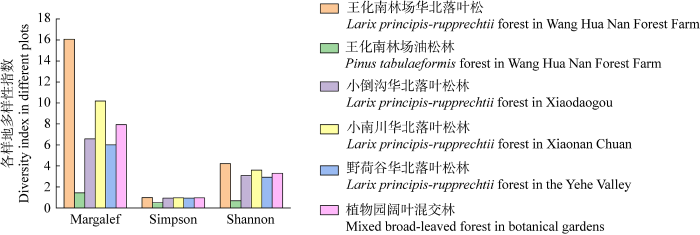
图3
不同样地间大型真菌Margalef、Simpson和Shannon-Weaver
Fig. 3
Margalef, Simpson and Shannon-Weaver of macrofungi in different plots.
2.5 大型真菌区系成分分析
2.5.1 科级区系分析
六盘山国家级自然保护区大型真菌物种数大于10种的科有8科,占总科数的20%,占总种数的比例最多(55.65%),含1个种的科有10科,占总科数的25%,但所含种数占总种数比例最少(4.35%) (图4,图5)。从科的地理分布型来看,粉褶菌科Entolomataceae、小皮伞科Marasmiaceae为热带-亚热带成分(高凡等 2019),占总科数的5%;地锤菌科Cudoniaceae、离褶伞科Lyophyllaceae、蜡伞科Hygrophoraceae、马鞍菌科Helvellaceae和红菇科Russulaceae为北温带成分(高凡等 2019),占总科数的15%;有3科的区系分布情况尚未明确;其余科均为世界分布成分(高凡等 2019;王妍等 2021;孙渤洋等 2023),占总科数的72.5%,缺少特有科的分布。
图4
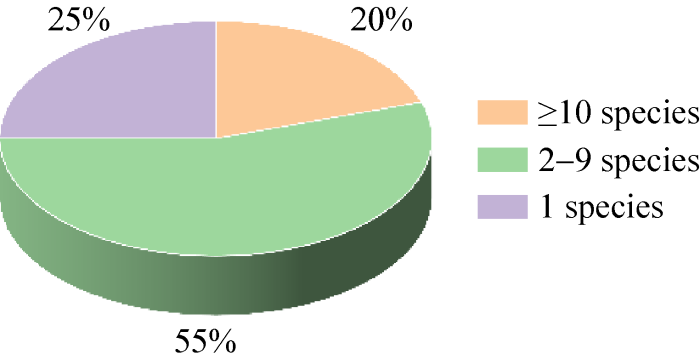
图4
六盘山国家级自然保护区含不同种大型真菌的科占总科数比例
Fig. 4
Proportion of macrofungal families with different magnitude of species to total number of families in Liupanshan National Nature Reserve.
图5
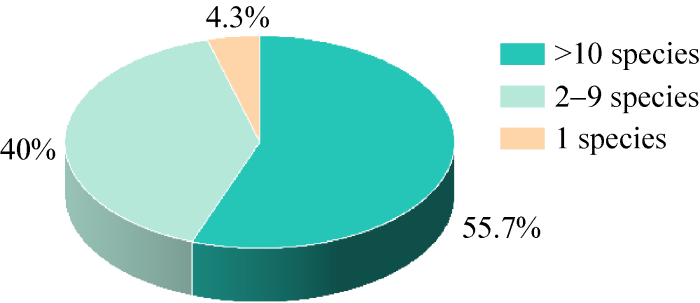
图5
六盘山国家级自然保护区各科所占物种数占总种数比例
Fig. 5
Proportion of number of species in macrofungal families with different magnitude of species to total number of species in Liupanshan National Nature Reserve.
2.5.2 属级区系分析
对大型真菌所有属的地理成分进行分析,其属级区系成分主要有4种分布类型(图6),分别为世界分布成分、北温带分布成分、泛热带成分和地中海区-西亚至中亚分布成分。
图6
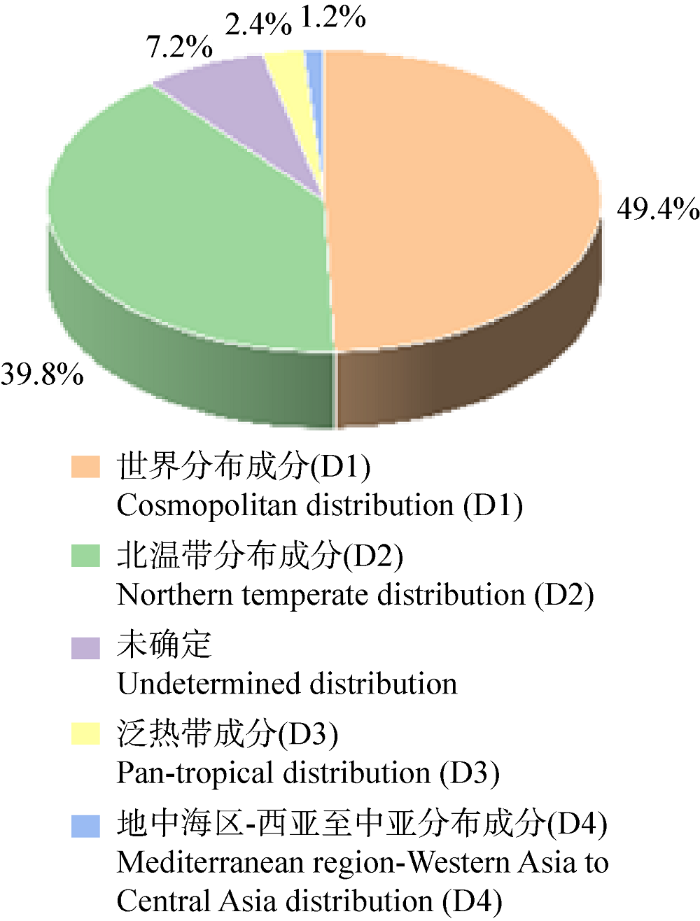
图6
六盘山国家级自然保护区大型真菌区系分布类型
Fig. 6
Distribution types of macrofungi in Liupanshan National Nature Reserve.
(1) 世界分布成分(D1)
世界分布属(图力古尔和李玉 2000;高凡等 2019;王妍等 2021;杨滢等 2022)通常指广泛分布于各大洲而没有特殊分布中心的属,该分布类型在六盘山自然保护区占比最高(41属,49.4%)。主要包括小菇属Mycena、香蘑属Lepista、小脆柄菇属Psathyrella、蘑菇属Agaricus、红菇属Russula、裸脚伞属Gymnopus、多孔菌属Polyporus、球盖菇属Stropharia、铦囊蘑属Melanoleuca、鹅膏属Amanita、杯伞属Clitocybe、光柄菇属Pluteus、拟层孔菌属Fomitopsis、环柄菇属Lepiota、拟迷孔菌属Daedaleopsis、锐孔菌属Oxyporus、蜜环菌属Armillaria、栓菌属Trametes、秃马勃属Calvatia、珊瑚菌属Clavariadelphus、虫草属Cordyceps、轮层炭壳属Daldinia、异担子菌属Heterobasidion、马勃属Lycoperdon、银耳属Tremella及炭角菌属Xylaria等。
(2) 北温带分布成分(D2)
北温带分布成分指广泛分布于北半球温带地区(亚欧大陆及北美)的属(图力古尔和李玉2000;孙丽华等2013;高凡等2019;王妍等2021),该分布类型在保护区内有33个属,占总属数的39.76%。主要包括丝盖伞属Inocybe、马鞍菌属Helvella、乳菇属Lactarius、滑锈伞属Hebeloma、铆钉菇属Gomphidius、丝膜菌属Cortinarius、口蘑属Tricholoma、田头菇属Agrocybe、琐瑚菌属Clavulina、枝瑚菌属Ramaria、乳牛肝菌属Suillellus、蜡伞属Hygrophorus、假杯伞属Pseudoclitocybe、疣柄牛肝菌属Leccinum、二丝孔菌属Diplomitoporus、杯桩菇属Clitopaxillus、地锤菌属Cudonia、丽蘑属Calocybe、地星属Geastrum、土盘菌属Humaria、斑褶菇属Anellaria、粘伞属Limacella、黑牛肝菌属Nigroboletus、根须腹菌属Rhizopogon、绒盖牛肝菌属Xerocomus和斜盖伞属Pseudoclitopilus等。
(3) 泛热带成分(D3)
泛热带成分通常指分布于东西两半球热带,延伸至亚热带至温带,但仍以热带为分布中心的属(杨滢等2022),该成分在保护区内仅分布有2属,占总属数的2.41%。分别为粉褶菌属Entoloma和小皮伞属Marasmius。
(4) 地中海区-西亚至中亚分布成分(D4)
该属主要分布于地中海周围(杨滢等2022),经西亚-西南亚-新疆-青藏高原-蒙古高原一带,这一分布成分在六盘山仅有干皮孔菌属Skeletocutis一种,占总属数的1.2%。
此外,目前还有垂暮菇属Hypholoma、波斯特孔菌属Postia、灰盖杯伞属Spodocybe、柄革菌属Stereopsis、Tephrocybe属和Rugosomyces属共6个属的分布区尚未有明确报道。
2.6 六盘山国家级自然保护区大型真菌和其他地区大型真菌区系的关系
3 讨论
通过对六盘山国家级自然保护区大型真菌资源的初步研究,发现该区大型真菌资源丰富,90.87%的种类隶属于担子菌门,其中优势科包括口蘑科、球盖菇科、小脆柄菇科、伞菌科、小菇科、红菇科、丝盖伞科和多孔菌科8科,优势属包括小菇属、丝盖伞属、马鞍菌属、乳菇属和香蘑属等18属。六盘山食用菌资源较为丰富,有毒大型真菌绝大多数属于伞菌类,种类相对较少,但近几年笔者走访调查发现,由于误食毒蘑菇而造成的中毒案例在该地区时有发生,因此在对毒蘑菇资源调查清楚的基础上,急需在该地区开展毒蘑菇相关知识的普及工作,杜绝或减少蘑菇中毒事件发生。
对六盘山不同海拔、不同林型下大型真菌的α多样性分析结果表明,当处于同一海拔时,相较于其他林型,华北落叶松林更适合大型真菌生长,可能是由于华北落叶松林自20世纪60年代引种栽培以来,经过50余年的发展,已发育成为成熟林,林冠郁闭度较大,地上草本植物覆盖度较小,枯落物厚度较高,腐木较多,乔木材积较大,这些都为大型真菌生长提供良好的生态环境(王术荣等 2016)。本研究分析的华北落叶松林分别为D (2 026 m)、C (2 083 m)、A (2 172 m)和E区(2 276 m) 4个海拔高度,随着海拔的升高,大型真菌多样性总体呈先升高后降低的趋势,物种丰富度由高到低为A区(16.080)、D区(10.190)、C区(6.578)、E区(6.009),多样性指数与丰富度指数趋势一致。Robledo & Renison (2010)研究结果表明,温度是限制大型真菌生长的重要环境因子,因此随海拔升高,温度降低,大型真菌多样性随之降低。E区比D区海拔高,大型真菌物种丰富度及多样性均小于D区,推测是由于E区为野荷谷景区,人为干扰强度大会导致大型真菌多样性减少,这与Simon et al. (2005)等得出的结论一致。
六盘山大型真菌区系分布中,世界广布成分和北温带分布成分占绝对优势,虽然其他区系成分也占有一定的比例,但总的区系分布表现出明显的北温带分布特征。六盘山自然保护区与邻近的罗山自然保护区真菌区系的相似度最高,高达42.19%。罗山保护区是以青海云杉、油松为建群种的山地针叶林森林生态系统(李小伟等 2019),其植被类型与六盘山保护区植被高度重合(何小琴等 2022)。且罗山保护区位于宁夏中部干旱带,是宁夏草原与荒漠生态系统的分界线,属于中温带干旱大陆性气候(李小伟等 2019),而六盘山在地理区划上属于温带半湿润向半干旱过渡带,具有大陆性和海洋季风边缘气候特点(曾锦源等 2022),因此两地纬度相近的气候条件和植被类型可能是真菌区系相似的主要原因。虽然六盘山隶属于祁连山山脉,但祁连山属于高寒干旱、半干旱气候,年均温度0.7 ℃,主要植被为荒漠草原和亚高山灌丛(席亚丽等 2011),因此导致六盘山与祁连山的大型真菌组成相似性系数最低。大型真菌分布虽与其伴生植物有密切关系,但又不局限于同地植物的分布范围,气候、经纬度等因素都是影响大型真菌生长的环境因子,因此很多属种的分布要比我们了解到的广泛(孙晶雪 2020)。
本研究通过连续5年的资源调查和标本采集,利用形态特征比较和分子数据分析等结合的方法分析了六盘山国家级自然保护区大型真菌物种多样性,较为客观科学地反映当地的物种多样性及区系等特征。然而,六盘山国家级自然保护区植被类型多样,树木种类繁多,地形条件复杂多样,有很多地区的大型真菌还没有进行深入调查,将来仍需进一步对六盘山国家级自然保护区大型真菌资源进行调查,补充更多的生态学资料,更加全面反映该地区大型真菌的物种多样性和群落结构。
参考文献
A revised checklist of poisonous mushrooms in China
Study on fungal flora diversity in Daqinggou Nature Reserve
Species diversity and resources of Ganoderma in China
Polypores from Zijin Mountain, Jiangsu Province
Species diversity of wood-decaying fungi in Northeast China
The forest pathogens of root and butt rot on northeast China
A revised checklist of medicinal fungi in China
Diversity and systematics of the important macrofungi in Chinese forests
Polypores from Beijing area, northern China
A revised checklist of edible fungi in China
Numbers of fungal species hitherto known in China
Distribution of Tuber in Liupan Mountain and its ecological significance
A new combination and two newly recorded species of Hygrophoraceae from China
Study on macrofungi diversity in Baihua Mountain National Nature Reserve from Beijing of China
Current status of studies on diversity of macrofungi in Jiangxi Province
Study on species diversity of forest communities in Liupanshan Nature Reserve
Response of bacterial community structure and diversity in sediment of arsenic-rich lakeside wetland to water level change
Species diversity of macrofungi in Xiaoxishan Mountain of Beijing
Atlas of bryophytes and macrofungi in Luoshan, Ningxia
Resource survey of macrofungi in Qilian Mountain National Nature Reserve
Diversity of wood-inhabiting macrofungi in Hainan Province, South China
Exploration of wild edible fungi resources in Liupanshan Nature Reserves of Ningxia
Taxonomic studies of bluish Mycena (Mycenaceae, Agaricales) with two new species from northern China
DOI:10.3897/mycokeys.90.78880
URL
[本文引用: 1]

Bluish Mycena are rare, but constitute a taxonomically complex group. A total of eight bluish species in four sections have previously been reported from North America, Europe, Oceania and Asia. Two species with a blue pileus, collected in China during our taxonomic study of Mycena s.l., are described here as new to science: Mycena caeruleogriseasp. nov. and M. caeruleomarginatasp. nov. Detailed descriptions, line drawings and a morphological comparison with closely-related species, especially herbarium specimens of M. subcaerulea from the USA, are provided. The results of Bayesian Inference and Maximum Likelihood phylogenetic analyses of a dataset of 96 nuclear rDNA ITS and 20 nLSU sequences of 43 Mycena species are also presented. The morphological data and the results of the phylogenetic analyses support the introduction of M. caeruleogrisea and M. caeruleomarginata as new species. A taxonomic key to bluish Mycena species of sections Amictae, Cyanocephalae, Sacchariferae and Viscipelles is provided.
Wood-decaying polypores in the mountains of central Argentina in relation to Polylepis forest structure and altitude
DOI:10.1016/j.funeco.2009.10.003 URL [本文引用: 1]
Isolation and identification of symbiotic fungi in roots of Picea crassifolia on Helan Mountain in Ningxia, China
Mushroom picking does not impair future harvests: results of a long-term study in Switzerland
DOI:10.1016/j.biocon.2005.10.042 URL [本文引用: 1]
Species diversity and floral characteristics of wood-inhabiting macrofungi growing on Quercus mongolica in northeast China
Study on the relationship between the diversity of macrofungi resources and forest characteristics in Huzhong Nature Reserve, Daxinganling Mts. of NE China
Ecological diversity of macrofungi in Helan Mountain
Geographical components of macrofungal flora in Helan Mountain, Ningxia
A geographical study of the flora
A study on the fungi in Ningxia, China (2)
Relationship of macrofungal diversity and vegetation and environments in alpine forests of southeastern Tibet
Studies on macrofungal diversity in Hanwula National Nature Reserve, Inner Mongolia
Species diversity and floristic composition of polypores in the southern parts of Hengduan Mountains, Southwest China
Liupan Mountains is regarded the “green jewel” of the Loess Plateau
Ecological function of wood- inhabiting fungi in forest ecosystem
Community composition and distribution character of wood-inhabiting fungi on maple in broad-leaved korean pine mixed forest plot in Changbaishan of China
Amplification and direct sequencing of fungal ribosomal RNA genes for phylogenetics. PCR protocols, a guide to methods and applications
Polypore diversity in south China
Resource diversity of Chinese macrofungi: edible, medicinal and poisonous species
DOI:10.1007/s13225-019-00432-7 [本文引用: 1]
Preliminary study on macrofungi resources in Kunyushan National Nature Reserve
Species diversity, distribution and composition of polypores occurring in botanical gardens in China
Aims: Polypores are an important group of wood-decaying fungi with important ecological functions. Previous studies on the diversity and floristic composition of polypores were mostly in natural forests. Studies on the species, distribution and floristic composition of polypores in botanical gardens were largely unknown. This study systematically investigated the species, distribution and floristic composition of polypores in 31 botanical gardens in China, aiming to clarify whether the botanical gardens can effectively protect polypores while protecting plants.
Methods: In this study, investigations on polypores in 31 botanical gardens from 31 Chinese provinces were carried out during 2010-2021. On the basis of species identification, we analyzed the species diversity, composition and distribution of polypores in botanical gardens and forest ecosystems.
Results: A total of 164 polypore species was found based on the specimens collected from these gardens, and identified to 79 genera, 23 families and 6 orders. Among the 31 gardens, the species-richest gardens are Xishuangbanna Tropical Botanical Garden of the Chinese Academy of Sciences (XTGB) in Yunnan, Danzhou Tropical Botanical Garden in Hainan and Guangxi Botanical Garden of Medicinal Plant in Guangxi, and 90, 46 and 37 polypores were found, respectively; While the most species-poorest gardens are Lanzhou Botanical Garden in Gansu Province, Xining Botanical Garden in Qinghai Province and Urumqi Botanical Garden in Xinjiang Autonomous Region, where only 4, 3 and 2 polypores were found, respectively. Among the 164 polypores, the three most common species Trametes versicolor, Irpex lacteus and Bjerkandera adusta were found in 24, 18 and 18 botanical gardens, respectively. Other 32 species, like Abundisporus mollissimus, were found in a single botanical garden only. Among the 164 polypores, the common species, occasional species and rare species are respectively 114, 40 and 10. The polypore and rare species in the investigated gardens account for 16% and 3.1% of the total Chinese polypores and the rare ones, respectively. Among the ten rare species, six were found in natural forests in XTBG, four were only found in plantations, and they account for 2.4% of total polypores found in the gardens and 1.3% of total rare Chinese polypores, respectively. Tropical, subtropical, temperate, widely distributed in North Hemisphere and boreal elements were discovered in the garden polypores, and corresponding species are 50, 45, 38, 20 and 11, and they account for 30.5%, 27.4%, 23.2%, 12.2% and 6.7% of the total garden polypores, respectively.
Conclusion: Botanical gardens have less function for conservation of polypores, particularly for rare species. The majority polypores growing in botanical garden in our investigations are the common species. Nature reserves, national park or forest parks are the most important areas for conservation of polypores, especially the rare species.
Comparison of polypore florae and diversity from temperate to subtropical forest zones in China
<p id="p00010"><strong>Background:</strong> Polypores are an important group of wood-decaying fungi and have important ecological functions and economic values. The unique geographical structure and complex vegetation types in China provide abundant substrates for the growth of polypores. Although the taxonomy of polypores has been well studied in China, few comparative studies on the diversity and flora of polypores among different climatic zones has been performed. This study is intended to compare the florae and populations of polypores in multiple forest zones with different climates and vegetations, and will provide the basis for the protection of species diversity and the development of application potential of polypores. <br><strong> Methods:</strong> In this study, we comparatively analyzed the polypore species, ecological habits and floral characteristics in the Altai Mountains, the Qinling Mountains and the Nanling Mountains which are respectively located in boreal, temperate and subtropical zones in China. <br><strong> Results:</strong> A total of 287 poroid wood-decaying fungal species belonging to 107 genera, 29 families, and 8 orders were obtained from the three mountain ranges. Of these species, 84, 132 and 160 were found in the Altai Mountains, the Qinling Mountains and the Nanling Mountains, respectively, and the community was dominated by families Polyporaceae and Hymenochaetaceae. In the generic and species levels, 25 genera and 14 species were common in the three mountain ranges. Floristic analysis found that polypores in the Altai Mountains and the Qinling Mountains were dominated by the cosmopolitan and the northern temperate elements, while polypores in the Nanling Mountains were dominated by the cosmopolitan and the pantropical taxa. In terms of host preference, polypores in the Altai Mountains preferentially grow on gymnosperms over angiosperms, while the opposite was true in the Qinling Mountains and Nanling Mountains. In the two rotting types caused by polypores, the species number of white rot polypores increased, but that of the brown rot decreased, gradually from boreal to subtropical zones. <br><strong> Conclusion:</strong> Climate and vegetation types are the major influencing factors on the flora composition of polypores, based on the analysis of species diversity, host preference and decaying type of polypores in the three mountains.</p>
Preliminary study on macrofungi resources in Qilian Mountain National Nature Reserve
Diversity and flora of macrofungi in the Fuheyuan Nature Reserve in Jiangxi Province
Development of red list assessment of macrofungi in China
Macrofungi are important with both their ecological and socioeconomic values. Due to environmental pollution, climate change, habitat loss and fragmentation, and over-exploitation of resources, the diversity of macrofungi is under serious threatened. To evaluate the threatened status of macrofungi nationwide in China, the project of “Red List Assessment of Macrofungi in China” was officially launched in 2016 by the Ministry of Ecology and Environment (formerly the Ministry of Environmental Protection) in conjunction with the Chinese Academy of Sciences. Based on extensive and comprehensive collection of literature on the occurrence and distribution of macrofungi in China, and referring to the categories and criteria of the International Union for Conservation of Nature (IUCN) Red List of Species, the evaluation methods and process of the Red List of China's macrofungi were formulated according to the biological features of macrofungi and the current understanding of macrofungi in China. Experts on macrofungi around China were mobilized and organized to assess the threatened status of 9,302 species of macrofungi reported in China. Ninety-seven species are considered under threatened (including Possibly Extinct, Critically Endangered, Endangered and Vulnerable), accounting for 1.04% of the total number of species assessed; 101 species are Near Threatened, 2,764 species are Least Concern and 6,340 species are Data Deficient, occupying 1.09%, 29.71% and 68.16%, successively, of the species assessed. The assessment, which brings together the wisdom of more than 140 experts all over the country, is the first nationwide attempt to assess the threaten status of macrofungi in China, involving the largest number of macrofungal species, the widest range of macrofungal groups, the widest coverage of distribution area and the largest number of expert participants at home and abroad. It is of great significance to the conservation and management of the diversity of macrofungi in China.
Four newly recorded species of Entoloma from China
A survey of mammal and bird diversity using camera-trapping in Liupanshan National Nature Reserve in Ningxia
Preliminary study on macrofungi diversity in Jinyun County, Zhejiang Province
Chinese polypore diversities: species, mycota and ecological functions
DOI:10.3724/SP.J.1003.2013.08074
Polypores are the group of macro-basidiomycetes with poroid hymenophore and corky basidiocarps that mainly grow on wood. China contains multiple climatic zones and geographic topographies, and thus possesses a variety of forest and vegetation types that provide rich habitats for polypores. Based on extensive collections conducted over a long period of time, a considerable knowledge of Chinese polypore species has been obtained, and this has been enriched further in recent years by using molecular technology. China possesses the highest polypore diversity in the world and 704 polypore species, belonging to 134 genera, 22 families and 11 orders, have been recorded within its borders. These 704 species are composed of cosmopolitan, boreal/temperate and tropical-subtropical elements. White-rot polypores are considered as potential industrial resources, while brown-rot polypores play an essential role in forest renewal.
The diversity and resource evaluation of macrofungi in Yuanyang County, Yunnan Province
中国森林大型真菌重要类群多样性和系统学研究
中国蜡伞科1新组合及2个新记录种
祁连山国家级自然保护区大型真菌资源调查
中国各省植物园中多孔菌种类、分布和组成
DOI:10.17520/biods.2022213
[本文引用: 1]
多孔菌是木材腐朽菌中最关键的真菌类群, 是森林生态系统的重要组成部分。为了明确植物园对植物上真菌资源的保护状况, 在2010-2021年间, 作者对全国31个省(自治区、直辖市)的31个代表性植物园中木本植物上的多孔菌进行了系统调查、标本采集和种类鉴定, 记录多孔菌164种, 隶属于担子菌门伞菌纲6目23科79属。其中, 中国科学院西双版纳热带植物园、儋州热带植物园和广西药用植物园多孔菌种类最多, 分别有90种、46种和37种; 兰州植物园、西宁植物园和乌鲁木齐植物园物种数量最少, 分别有4种、3种和2种。在植物园中, 分布最多的物种是云芝栓孔菌(Trametes versicolor)、白囊耙齿菌(Irpex lacteus)和黑管孔菌(Bjerkandera adusta), 分别生长在24、18和18个植物园中, 而软多孢孔菌(Abundisporus mollissimus)等32种多孔菌只发现于中国科学院西双版纳热带植物园中。在164种多孔菌中, 常见种、偶见种和稀有种分别有114、40和10种。生长在植物园中的多孔菌仅占全国所有森林生态系统多孔菌总数的16%, 而植物园中发现的稀有种仅占全国稀有种总数的3.1%。在10种稀有多孔菌中, 有6种发现于中国科学院西双版纳热带植物园的天然林中, 其中4种稀有多孔菌发现于植物园内的人工林中, 占植物园所有多孔菌的2.4%, 占全国稀有多孔菌的1.3%。所调查植物园多孔菌包括了热带、亚热带、温带、北半球广布和寒温带成分, 分别包括50、45、38、20和11种, 占本研究多孔菌总数的30.5%、27.4%、23.2%、12.2%和6.7%。目前中国植物园保存了我国60%的植物种类, 包括85%的珍稀濒危植物, 但对生长在植物园中的多孔菌资源保护作用有限。因此, 对稀有多孔菌的保育仍需聚焦在森林生态系统的保护上。
我国寒温带至亚热带森林多孔菌区系和多样性比较
DOI:10.17520/biods.2021094
[本文引用: 1]
多孔菌是木材腐朽菌的重要类群, 具有重要的生态功能和经济价值。本文比较分析了我国寒温带至亚热带的阿尔泰山脉、秦岭山脉和南岭山脉的多孔菌物种、生态习性和区系特征。经调查, 在三个山脉共发现多孔菌8目29科107属287种, 其中阿尔泰山、秦岭和南岭分别为84种、132种、160种, 优势科均为多孔菌科和锈革孔菌科。三个山脉的共有属和共有种分别为25个和14个。区系地理分析发现, 阿尔泰山脉和秦岭山脉以世界广布成分和北温带成分为主, 南岭山脉以世界广布和泛热带成分为主。在寄主选择性方面, 阿尔泰山脉的多孔菌偏好生长在裸子植物上, 其比例高于被子植物, 而秦岭和南岭则相反。在腐朽类型方面, 从寒温带至亚热带白腐真菌物种数量呈现逐渐上升的趋势, 而褐腐真菌数量逐渐下降。通过比较分析3个不同气候带的多孔菌物种多样性、寄主偏好性和引起的腐朽类型, 发现气候和植被类型是影响多孔菌区系组成的主要因素。
江西抚河源自然保护区大型真菌多样性与区系特征
中国大型真菌红色名录评估研究进展
DOI:10.17520/biods.2019173
[本文引用: 1]
大型真菌具有重要的生态价值和经济价值, 但由于环境污染、气候变化、生境丧失与破碎化, 以及资源过度利用等因素, 其生物多样性受到严重威胁。为了全面评估中国大型真菌的生存状况, 国家生态环境部(原环境保护部)联合中国科学院于2016年启动了《中国生物多样性红色名录——大型真菌卷》的编制工作。经广泛和全面收集文献资料, 依据IUCN物种红色名录等级与标准, 结合大型真菌特点和国内研究现状, 制定了中国大型真菌红色名录评估方法和流程, 动员和组织了全国相关研究力量, 对9,302种大型真菌的受威胁状况进行了评估。结果显示, 中国大型真菌受威胁物种(包括疑似灭绝、极危、濒危、易危)共97个, 占被评估物种总数的1.04%; 近危101种, 占总数的1.09%; 无危2,764种, 占总数的29.71%; 数据不足6,340种, 占总数的68.16%。此次评估工作汇集了全国140多位专家的智慧, 是国内外迄今为止涉及物种数量最大、类群范围最宽、覆盖地域最广、参与人员最多的一次大型真菌生存状况评估, 对我国大型真菌多样性保护与管理具有重要意义。
中国多孔菌多样性初探:物种、区系和生态功能
DOI:10.3724/SP.J.1003.2013.08074
[本文引用: 1]
多孔菌是指子实层体呈孔状且质地为革质至木质的一类大型担子菌, 主要生长在各类木材上。我国地域辽阔, 气候带和地形多样, 森林类型和植被组成丰富, 为多孔菌提供了丰富的栖息地。长期的野外资源调查和标本采集, 特别是近年来分子生物学技术的发展, 极大地丰富了对我国多孔菌种类的认识。我国是世界上多孔菌物种多样性最丰富的国家, 现在已知有多孔菌704种, 隶属于11目22科134属, 包括世界广布成分、北温带成分和热带-亚热带成分。多孔菌中的白腐菌是潜在的工业用菌, 褐腐菌在森林的更新过程中起重要作用。