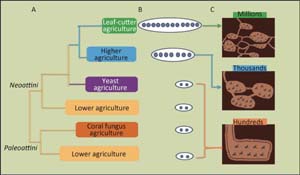
Insect fungiculture is an insect-growing system similar to human farming, including four processes of habitual planting, cultivation, harvest and nutritional dependency. Fungiculture can be maintained by advanced social insects such as leaf-cutter ants, termites, etc. and low-level non-social insects such as ambrosia beetles, leaf-rolling weevils, lizard beetles, and wood wasps that can grow and feed on fungal cultures. Many recent breakthroughs in the molecular mechanism of co-evolution of fungus-growing insects and their symbiotic fungi have been facilitated by omics and microbiome technology. Phylogenetic analysis clarifies that the origin and evolution of fungus-growing insects are highly consistent with insect symbiotic fungi. The number of symbiotic fungal nuclei also increases from dinuclear type to up to 17 nuclei while chromosomal haplotypes also increase from haploid to diploid or even polyploid. Genomics analysis also reveals a high degree of synergistic evolution in terms of arginine, carbohydrates, lignin and chitin metabolisms. This paper summarizes the phylogenetic evolution, nuclear evolution and genomic evolution of fungus-growing insects and their symbiotic fungi, and proposes the biological significance of this co-evolutionary molecular mechanism.
Termitomyces are edible mushroooms with great market value. This paper presents a review of the researches on Termitomyces, including taxonomy, symbiotic relationship with termites, chemical constituents and their functions and lignocellulose-degrading enzymes produced by the fungi. Taxonomic problems such as misidentification and invalid names appeared in previous literature are summarized. Artificial cultivation and prospective related products are predicted.
The Bank of Glomeromycota in China (BGC) was established by the Institute of Plant Nutrition and Resources, Beijing Academy of Agricultural and Forestry Sciences in 2003. Currently the BGC has preserved approximately 40 AM (arbuscular mycorrhizal) fungal species distributed among 190 isolates. BGC is an open platform providing shared services, becoming important public institution in mycorrhizal research and application in China. This review provides details of achievements in research and application of the isolates available from BGC. These informations are helpful for government policy decisions, research insititutions, scientists of mycorrhizal research, as well as fungal product manufacturers.
For lack of endosperm, tiny orchid seeds need the aid of suitable fungi during germination, and therefore the natural mycorrhizal symbiosis comes into being. Low reproduction rate and ruined habitat environment in recent years endangered orchid resource increasingly. For protection of endangered orchid resource and recovery of ecological diversity, screening symbiotic fungi with capacity for helping germination of orchid seeds is in urgent need. In this paper, investigation of orchid symbiotic fungi with different growth type including geobiontic type, epiphytic type and saprophytic type are systematically reviewed. Facts have proved that Tulasnellaceae, Ceratobasidiaceae and Sebacinales, belonging to Basidiomycota, are the main fungal groups performing symbiotic relationship with orchids. The mechanism concerning morphology, nutrition and molecular biology of orchid seed germination is discussed. Researches on mechanism of interaction between symbiotic fungi and orchid seed germination are inadequate and many problems need further exploration. This paper provide reference for applying symbiotic fungi to breeding and protecting orchid resource and exploring mechanism of symbiotic germination.
Mycorrhizal symbiosis is one of the most common reciprocal lifestyles on earth. Symbiosis diversity is also an important part of biodiversity. To date, role of mycorrhizal fungi on plant nutrient acquisition and resistance to unfavorable environment has been studied in data, whereas the study on symbiotic relationship on community scale just start out, but develop rapidly. Network analysis, an important method of ecology research, provides novel insights and approaches for exploring mycorrhizal fungal diversity and symbiosis mechanism, which is of great significance to the study of mycorrhizal fungal community structure and ecological function. This paper summarized advantages and limitations of network analysis in the study of single-point, double-point and multi-point mycorrhizal symbiotic relationship networks. Influence of null model selection and network size on network metric indices was also analyzed. This paper aimed at providing useful information and reference for the subsequent study of community scale mycorrhizal symbiosis relationship pattern.
Seventeen species of the genus Pertusaria s. lat. are transferred to the recently resurrected genus Lepra. Lepra albopunctata and L. muricata are reported as new to China. Pertusaria sanguinulenta is synonymized with Lepra submultipuncta. Pertusaria brachyspora is excluded from the lichen checklist of China because of wrong identification. Some of the wrongly identified specimens cited in literature are corrected, and a key to the 37 Lepra species known in China is provided.
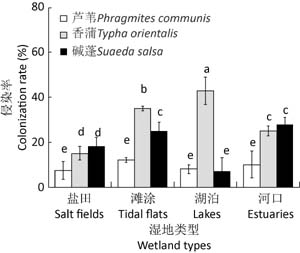
Diversity of arbuscular mycorrhizal (AM) fungi in the rhizosphere of Phragmites communis, Typha orientalis, and Suaeda glauca grown in salt fields, tidal flats, lakes and estuaries in Jiaozhou Bay of Qingdao were investigated based on spore isolation and identification. A total of 10 species of five genera of AM fungi was isolated, including two species of Funneliformis, three species of Acaulospora, two species of Claroideoglomus, one species of Glomus, and two species of Gigaspora. The frequency and relative abundance of Funneliformis and Funniliformis geosporum were the highest, which were dominant genus and species of AM fungi in the wetlands tested. The AM fungal colonization rate of plants grown in tidal flats and estuarine wetland was significantly higher than that in lake and salt fields. The highest spore density of AM fungi appeared in tidal flat wetlands (572/20mL), while the lowest in lake wetlands (220/20mL); the species richness and the Shannon-Wiener index in tidal flats were the highest, being 3.8 and 1.2 respectively. AM fungal colonization percentage increased progressively in order of T. orientalis > S. glauca > P. communis. The spore density of AM fungi was highest in rhizosphere of T. orientalis and lowest in that of P. communis, manifesting that the plant species had no significant effect on the AM fungal species richness and Shannon-Wiener index (P>0.05). Two-factor analysis of variance and analysis of variance and the typical RDA correlation analysis showed that the soil factor Ca 2+ and available phosphorus content in Jiaozhou Bay wetland were significantly negatively correlated with the AM fungal spore density, species richeness and diversity index (P<0.05), while the available potassium content, Na + and pH showed positive correlation. It is concluded that plant species mainly affect spore density of AM fungi, and the diversity of AM fungi is multiply affected by plant species and wetland types. The relative richness of species diversity of AM fungi in tidal flat wetland might be related to relatively suitable physicochemical properties of Jiaozhou Bay wetland in Qingdao.
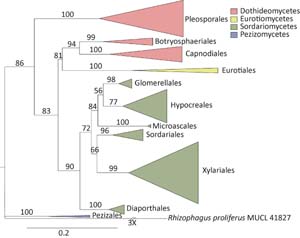
One hundred and seventy-two isolates of non-mycorrhizal endophytic fungi were isolated from epiphytic orchids, including Gastrochilus, Cleisostoma, Eria, Coelogyne and Vanda, collected in the Naban River Watershed National Nature Reserve in Xishuangbanna. Of them, 29 genera in 11 orders of 4 classes of Pezizomycotina were identified by ITS1-5.8S-ITS2 rDNA sequence analysis. The relative frequency of Xylariales, Hypocreales and Pleosporales was the highest. Xylaria, Fusarium and Phoma were the dominant genera with the relative frequency of 23.3%, 14.5% and 10.5%, respectively. These three genera displayed different tissue specificity. Xylaria could be isolated from all tissues of orchid, however, Fusarium and Phoma were only from roots. Biodiversity and community composition of endophytic fungi in different tissues varied significantly. Shannon diversity index of endophytic fungi in root, stem and leaf tissues were 2.4083, 1.0312 and 0.6557, respectively, showing that diversity of endophytic fungi in roots was significantly higher than that in stems and leaves. The dominant endophytic fungi in roots were Fusarium, Xylaria and Phoma, and in stems Xylaria, Pestalotiopsis and Colletotrichum, while in leaves Colletotrichum, Pallidocercospora, Pantospora and Phyllosticta. Shannon diversity index of endophytic fungi in Gastrochilus, Cleisostoma, Eria, Coelogyne and Vanda were 2.2689, 2.2635, 2.0115, 1.9197 and 1.7139, respectively, indicating that diversity of endophytic fungi in Gastrochilus and Cleisostoma was higher than that in other orchids.
The diversity of endophytic fungi in Selaginella tamariscina, a common fern on rock wall, from Longhu Mountain in Jiangxi Province and Danxia Mountain in Guangdong Province was explored. The fungi were isolated from 1 080 tissue segments by culture-dependent method and identified at species or genus level based on morphological characteristics and molecular analysis. Among 234 isolates, the isolation frequency of Chaetomium, Penicillium, Isaria and Aspergillus were 26.50%, 18.38%, 11.97% and 9.42%, respectively. The diversity of endophytic fungi in S. tamariscina was notably distinct in different habitats in spring. The isolation frequency from Longhu Mountain was 34.72%, but that from Danxia Mountain only 6.39%. The dominant genera also varied with different locations. The endophytic fungal diversity changed with different seasons. The investigation results in Longhu Mountain showed that the isolation frequency of the fungi in spring was 34.72%, and that in winter 23.89% and the similarity coefficient of the fungi between spring and winter was 0.39, indicating that the community composition and dominant genera of endophytic fungi markedly differed between seasons. This study provides references for further study on endophytic fungi of pteridophytes in Danxia landform.
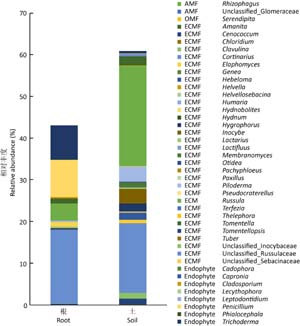
The composition of symbiotic fungi and bacterial community in the root and rhizosphere soil of Quercus mongolica pure forest in Wudalianchi, Heilongjiang Province of China, were investegated using Illumina MiSeq high-throughput sequencing platform based on ITS and 16S rRNA. Of 1 295 OTUs of fungi obtained in root, 209 OTUs were symbiotic, belonging to 36 genera, and the relative abundance was 25.46%. Of 1 513 OTUs of fungi obtained in rhizosphere soil, 285 OTUs were symbiotic, belonging to 40 genera, and the relative abundance was 59.91%. 33 genera were common in root and rhizosphere soil, and 3 genera were peculiar to root while 7 genera peculiar to rhizosphere soil. Ectomycorrhizal fungi were dominant in root and rhizosphere soil, with relative abundance of 98.82% and 99.80% respectively. A total of 5 550 OTUs of bacteria was obtanted in root, belonging to 400 genera, and 8406 OTUs in rhizosphere soil, belonging to 436 genera. The Shannon and Chao1 indexes for root bacteria were lower than those for rhizosphere soil bacteria. PICRUSt analysis showed that the abundance of signal transduction pathways and signaling molecules and interaction pathway, including CAM ligands, ECM-receptor interaction and other pathways were lower in the root than that in the soil. On the contrary, the abundace of membrane transport pathways and signaling molecules and interaction pathways, including bacterial toxins, cellular antigens and other pathways, were higher in the root than that in the soil. The results of analysis of composition difference of mycorrhizal helper bacteria in root and soil showed that with the exception of Bradyrhizobium, the relative abundance of 9 genera of mycorrhizal helper bacteria especially Pseudomonas in the root was higher than that in rhizosphere soil.
Bletilla striata, a geophytic perennial orchid, is a traditional Chinese medicinal herb. Analysis of composition and diversity of endophytic fungi associated with B. striata roots under habitats in Yunnan Province is of great significance in studying the symbiotic relationship between B. striata and endophytic fungi. The fungi were identified by morphology and ITS rDNA phylogenetic analysis. A total of 32 isolates of culturable endophytic fungi was isolated from the roots of B. striata collected from 3 sampling sites, and they were classified as 9 orders, 13 families and 16 genera. Among them, species of Trichoderma, Fusarium and Pestalotiopsis were dominant, accounting for 21.88%, 18.75% and 9.38% of the total species respectively. Species of Nemania, Neonectria, Xylaria, Purpureocillium, Colletotrichum, Nigrospora, Biscogniauxia, Humicola, Neurospora, Phomopsis, Phytopythium, Mucor, and Umbelopsis were found to be common in root tissues. The results of alpha diversity analysis showed that species diversity of endophytic fungi in the root of B. striata was the highest (D=0.799, H’=1.698) in the samples collected at headwater conservation district of Kunming and lowest (D=0.787, H’=1.580) in the samples collected at Longling County, Baoshan City. The Jaccard (0.912-0.993), Bray-Curtis (0.838-0.986) and UniFrac (Weighted 0.618-0.631, Unweighted 0.770-0.799) distances among samples were obtained by beta diversity analysis, indicating difference in species composition of endophytic fungal community in the samples collected from different sites. Soil and habitats are the main factor influencing the diversity of endophytic fungi and community composition in the roots of B. striata.
Invasion plants often cause changes in the diversity of arbuscular mycorrhizal fungi (AMF) in invaded areas, while the correlation between the changes of AMF diversity and native plant species in invaded areas is still unclear. Field homogeneity garden experiment was carried out to study the effect of the competition between invasive Ambrosia artemisiifolia and native plants on the diversity of AMF. Eight treatments designed included monoculture of Ambrosia artemisiifolia, monoculture of native Setaria viridis, monoculture of native Chenopodium album, monoculture of native Melilotus officinalis, mixed culture of A. artemisiifolia and Setaria viridis, mixed culture of A. artemisiifolia and Chenopodium album, mixed culture of A. artemisiifolia and Melilotus officinalis, and bare soil (without any plant growth) as experimental control. AMF were sampled from rhizosphere soil and plant biomass and diversity of AMF were investigated. The results showed that the biomass of monocultured A. artemisiifolia plants was higher than that of the plants in mixed culture. The competitive ability of A. artemisiifolia was the strongest in mixed culture of A. artemisiifolia and M. officinalis, but the weakest in mixed culture of A. artemisiifolia and S. viridis. The species richness and Shannon Weiner index of AMF in rhizosphere soil of mixed culture of A. artemisiifoli and respective three native plants were significantly higher than that in monoculture of A. artemisiifolia and three native plants, showing the highest in mixed culture of A. artemisiifoli and Chenopodium album, but the lowest in mixed culture of A. artemisiifoli and S. viridis. The AMF spore density in the rhizosphere soil in mixed culture of A. artemisiifolia and respective tested native plants was significantly lower than that in monoculture of native plants (except for A. artemisiifolia and M. officinalis mixture). Glomus reticulatum and Septoglomus constrictum were dominant in the soil of monocultures of A. artemisiifolia, S. viridis, C. album and the mixed culture of A. artemisiifoli and S. viridis or C. album. Glomus reticulatum, S. constrictum and Rhizophagus intraradices were dominant in the soil of monoculture of M. officinalis. Glomus reticulatum and R. intraradices were dominant in mixed culture of A. artemisiifolia and M. officinalis. Rhizoglomus manihotis, Claroideoglomus claroideum and Scutellospora calospora were dominant in the soil of monoculture of S. viridis, and mixed culture of A. artemisiifolia and S. viridis or C. album. There was a significant positive correlation between plant biomass and AMF spore density in the soil of monoculture of S. viridis, but a significant negative correlation was found between the biomass and uniformity of A. artemisiifolia in mixed culture of A. artemisiifolia and S. viridis. A significant positive correlation was found between the biomass of A. artemisiifolia and the AMF spore density in the soil of mixed culture of A. artemisiifolia and M. officinalis, significantly negative correlation occurred between the plant biomass and the Shannon Weiner index of AMF. In conclusion, the effect of competition between A. artemisiifolia and native plants on the diversity of AMF is heterogeneous, and this phenomenon is closely related to native plant species.
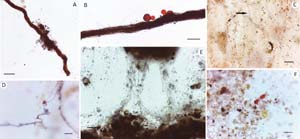
Dark septate endophytes (DSE) widely colonize invasive Ipomoea cairica in southern China. It was observed under light microscope that I. cairica roots were colonized by a large number of lipid-filled vesicles, and the most striking feature was that a great quantity of lipids were accumulated and decomposed into small lipid bodies which were transferred through hyaline or dark hyphae, demonstrating that carbon transfer between I. cairica and DSE. Lipid-filled vesicles could produce hyaline hyphae and self-duplication, indicating that vesicles had reproductive capacity. Atypical structures such as lipid-filled vesicle and hyaline hyphae without obvious wall or with transparent wall were considered to be active fungal structures. Hyaline hyphae and lipid-filled vesicles were mainly colonized in physiologically active roots. Dark septate hyphae and microsclerotia were typical structures of DSE, mainly colonized in relatively inactive roots. DSE colonizes the vascular cylinder and cortical and epidermal cells of I. cairica and extends to the soil, indicating that DSE forms a continuous and systematic fungal network between host plant and soil. The potential symbiotic relationship between DSE and I. cairica was discussed in the light of the polymorphic nature of DSE, the huge fungal network and accumulation and distribution of lipids.
The successful invasion of exotic plants is closely related to the mycorrhizal symbiosis. The colonization percentage of arbuscular mycorrhizal fungi (AMF) is an important indicator reflecting the colonization status of AMF on plants. There are many factors affecting the colonization percentage, but the impact of invasive plants interacting with native plants on the AMF colonization percentage is still unclear. In the present study, the invasive plants Flaveria bidentis, Ambrosia artemisiifolia and Bidens pilosa and native plants Setaria viridis, Melilotus officinalis and Chenopodium album were used as research objects to observe the root arbuscule, vesicule, hypha and total colonization percentage of invasive plants and native plants under different treatments. The monoculture treatment of invasive plants, the monoculture treatment of native plants, the mixed cultivation treatment of alternative invasive plant and alternative native plant and the mixed cultivation treatment of alternative invasive plant and multiple native plants are designed. The effects of alternative cultivation of native plant species on the AMF colonization percentage of invasive plants and native plant roots, and the effects of three invasive Compositae plants on the AMF colonization percentage of native plants are compared. The results showed that as compared with the monoculture treatment of invasive plants, the hypha and the total colonization percentage of Ambrosia artemisiifolia increased in mixed cultivation of Ambrosia artemisiifolia and Chenopodium album and in that of Ambrosia artemisiifolia and three native plants. There was no significant difference in total root infestation percentage of invasive plants in other cultivation treatments. As compared with the monoculture treatment of Setaria viridis and Melilotus officinalis, the AMF hyphae and total invasion rate of native plant Setaria viridis and Melilotus officinalis significantly reduced in the mixed cultivation treatment of alternative invasive plant and all experimental native plants. The hyphae and total colonization percentage of native plants were significantly inhibited with the increase of diversity of native plant species, but those of invasive plants were not influenced.
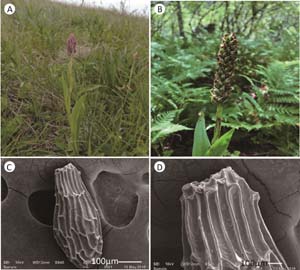
Terrestrial orchid Gymnadenia conopsea is traditionally widely used as Tibetan medicine and Mongolian medicine, having evident pharmacological activity as proved by modern pharmacology. However, G. conopsea is artificially uncultivatable and it’s market demand totally depends on wild resources. As a result, resource shortage is still the main problem to restrict development and utilization of G. conopsea. In this study, a fungus was isolated from roots of G. conopsea and identified as Ceratobasidium based on ITS sequences. The fungus strain Ceratobasidium GS2 obviously promoted seed germination and protocorm growth of G. conopsea on culture medium. The success of symbiotic germination of G. conopsea is important for germplasm conservation, artificial cultivation and ecological restoration of wild population of this orchid.
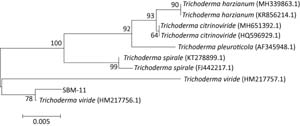
Symbiotic fungi in the roots and leaves of healthy ginger Zingiber officinale in Guangxi of southern China were isolated. The antifungal effects of the symbiotic fungi against ginger soft rot pathogen Pythium myriotylum and banana fusarium wilt pathogen Fusarium oxysporum f. sp. cubense race 4 were evaluated by using dual-culture and colony diameter assay. The taxonomic assignment of the fungi was based on morphological characters and ITS sequence analysis. Among 34 isolates, 22 were from root and 12 from leaves, and 6 were found to be effective on inhibiting ginger soft rot pathogen and banana fusarium wilt pathogen. The most effective one was SBM-11 with inhibitory rates of 93% and 82%, respectively toward ginger soft rot pathogen and banana fusarium wilt pathogen. The inhibition rate of SBM-11 fermentation broth to ginger soft rot pathogen and banana fusarium wilt pathogen was 82% and 73% respectively. The isolate SBM-11 was identified as Trichoderma viride, which had potential application value to biocontrol of plant pathogenic fungi.
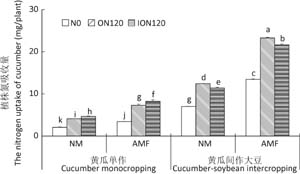
The unreasonable application and high residue of nitrogen (N) fertilizer in protected agriculture soil are the main factors that lead to excessive nitrate N accumulation in crops and agricultural non-point source pollution. The study of indigenous arbuscular mycorrhizal fungi (AMF) and intercropping system to enhance the utilization of different forms of N by vegetables, combined with the feedback effect of soil enzyme activity, may provide a basis for efficient utilization of N in protected culturing soil and reduction of soil N residue. A pot experiment with different planting ways [cucumber monoculture, and cucumber-soybean intercropping], different AMF treatments [no AMF(NM), and indigenous AMF inoculation] and different forms of N treatments [no N (N0), organic N (glutamine, 120mg/kg, ON120), and inorganic N (ammonium bicarbonate, 120mg/kg, ION120)] was conducted to reveal the effects of different forms of N, indigenous AMF and cucumber-soybean intercropping on soil enzyme activity and N utilization by cucumber under greenhouse conditions. The results showed that compared with NM treatment, inoculation of indigenous AMF increased the shoot and root biomass and N uptake of cucumber to different extent, and decreased the content of NH4 +-N and NO3 --N in rhizosphere soil. Under the same N application and AMF treatment, the cucumber root mycorrhizal colonization percentage under cucumber-soybean intercropping condition was significantly higher than that under cucumber monoculture condition. Intercropped cucumber also significantly increased shoot and root biomass and N uptake, and significantly decreased NH4 +- N content in soil. Under the condition of intercropping and indigenous AMF treatment, urease activity in cucumber rhizosphere soil treated with ON120 and ION120 was 30% and 14% higher than that in the soil with no N treatment, and the protease and nitrate reductase activities appeared the same trend. Our results indicated that cucumber-soybean intercropping combined with inoculation of indigenous AMF and application of appropriate quantity of organic N significantly promoted cucumber growth and N utilization in protected culture.
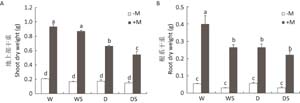
To investigate the interactive effects of arbuscular mycorrhizal fungi (AMF) and super absorbent polymers (SAP) on Medicago sativa plant growth and drought resistance, a pot experiment was conducted under greenhouse conditions. Treatment with or without Rhizophagus irregularis and addition or without addition of polyacrylamide type SAP (BJ2101) to the soil were designed under well-watered (12% water content) or drought conditions (6% water content). Results showed that the inoculation with AMF significantly increased plant dry weight under drought stress, facilitated the uptake of mineral elements, and increased the leaf chlorophyll and proline concentration. However, SAP inhibited the root colonization of R. irregularis. Compared with single inoculation of AMF, SAP combined with AMF reduced plant biomass and negatively affected the absorption of mineral elements by plants under drought stress. The combined application of SAP and AMF did not show synergistic effects, and this might be due to the defective soil moisture management. The co-application of SAP and AMF required further optimization.
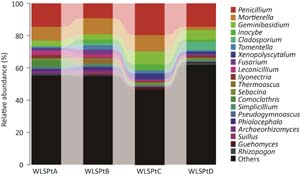
The fungal diversity and community structure in rhizosphere soil of Pinus tabulaeformis in Wula Mountain were investigated, and the fungal community structure associated with the soil physical and chemical properties was explored. The fungal community composition was studied using high-throughput sequencing technology. A total of 256 991 sequences of rhizosphere soil fungi was obtained, dividing into 1 026 OTUs belonging to 13 phyla, 37 classes, 84 orders, 145 families and 192 genera. At phylum level, Ascomycota, Basidiomycota and Mortierellomycota were dominant. At generic level, Penicillium (14.4%), Mortierella (7.6%), Geminibasidium (5.3%), Inocybe (1.8%), Cladosporium (1.6%), Tomentella (1.6%), Xenopolyscytalum (1.4%), Fusarium (1.3%), Lecanicillium (1.3%), Ilyonectria (1.1%), Thermoascus (1.0%), Sebacina (1.0%) and some unclassified genera were dominant. Analyses of alpha diversity index and NMDS showed that the fungal community structure at altitude of 1 800m was similar to that at altitude of 1 700m, but significantly different from that at altitude of 1 500m. Species diversity and abundance at altitude of 1 700-1 800m were significantly higher than those at altitude of 1 500m. RDA and correlation analysis of dominant fungi and soil physical and chemical properties showed that the community structure of soil fungi was significantly affected by soil physical and chemical properties, and nitrate nitrogen and water content were the main influencing factors.
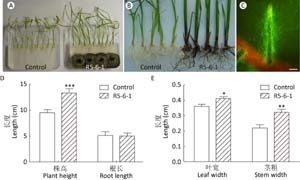
Falciphora oryzae, dark septate endophyte isolated from wild rice root, has effects of promoting growth and preventing disease of rice. The purpose of this study is to explore the mechanism underlying growth promotion. The rice seeds were co-cultured with F. oryzae plugs (4/dish) on plates. The growth indicators, nutrient element content and expression of genes related to nutrient absorption were detected. Under greenhouse cultivation condition, the rice was co-cultured with F. oryzae fertilizer in pots (60g/pot) and the agronomic characters were determined. The results showed that the plant height, leaf width and stem diameter of rice seedlings increased significantly after applying F. oryzae on plates, while the root length did not change. F. oryzae could promote the absorption of nutrient elements by rice roots, increase the content of N, P, K, S, Fe and Mg elements in shoots and roots, and induce significant upregulated expression of genes involved in nutrient element uptake, such as OsPTR9, OsAMT3;2, OsPT4, OsSULTR3;1, OsMRS2-8, OsHAK16, OsYSL15 and OsIRO2. Pot experiments showed that various agronomic characters of rice, including leaf width, stem diameter, plant fresh weight, plant dry weight, chlorophyll content and photosynthetic intensity, were significantly improved. It was concluded that root colonization of F. oryzae could induce up-regulated expression of nutrient-element absorption related genes, thereby stimulating the uptake of nutrient-element by roots, and promoting the growth of rice plants.
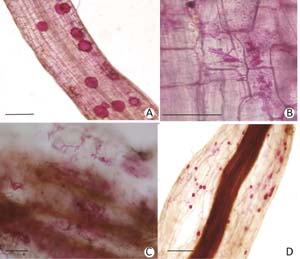
Samples of root zone soil and roots of Festuca elata grown in university campuses, Euonymus japonicus in urban parks, and Forsythia suspensa in suburb parks in Beijing, Qingdao, Jinan, Nanjing, Wuhan, and Guiyang of China were collected to determine AM fungus colonization and community structure. Typical arbuscules and vesicles were observed, and most of the arbuscules were Arum-type, while no arbuscule was observed on roots of F. elata in the campus of Renmin University of China in Beijing and on E. japonicus in Xiamafang Park, Nanjing. Total mycorrhizal colonization, arbuscule colonization, and number of vesicles per mm length of root was generally under 40%, 5% and 1, respectively, regardless of sampling sites. Total mycorrhizal colonization of F. elata in the campus of Renmin University of China was significantly lower than that in campuses of other cities. The spore density, species richness and Shannon index of AM fungi on the three plants in Qingdao were higher than those in the other cities, except for species richness on F. suspensa, and spore density on E. japonicus in Beijing, and species richness and Shannon index on F. elata in Jinan. There were few of common AM fungal species in different grass lawns, while frequency of Glomus radiatum was 100% in all the grass lawn sampled, which was also the dominant species. Compared with the other urban parks, Qingdao Zhongshan Park showed the highest spore density and species richness of AM fungi on E. japonicus. Among of suburb parks, Qianling Mountain at Guiyang had the highest spore density, species richness and Shannon index of AM fungi on F. suspensa; while Shizi Hill in Wuhan showed the lowest of species richness and Shannon index. There was a negative correlation between N deposition and vesicle density, while a positive correlation between soil compaction and the vesicle density. The present investigation showed that species richness of AM fungi was significantly positively correlated with the organic matter content in the root zone soil of E. japonicus, while Shannon index was significantly positively correlated with soil pH value. It is suggested that community structure of AM fungi in urban lands in China be quite different, and the nitrogen deposition and soil compaction degree have different effects on the number of vesicles in roots.
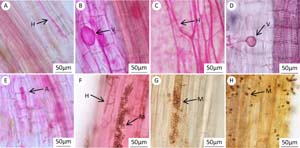
Colonization characteristics and ecological geographical distribution of Hedysarum scoparium root arbuscular mycorrhizae and dark septate endophytes, as well as the functions of mycorrhizal symbiont in plant growth and vegetation restoration were investigated. Soil and root samples of 0-30cm soil layer of different sampling sites in the desert belt of northwest China were collected for three consecutive years (2015-2017). H. scoparium was naturally infected by AM fungi and DSE in different sampling sites, forming typical AM structure with hyphae, vesicles and arbuscules, and typical DSE structure with dark septate hyphae and microsclerotia. The colonization of AM was higher than that of DSE, but DSE colonization prevailed over AM fungal colonization under extreme drought conditions. The colonization rate of AM was the highest in 2016 of observational years. In the same observational year, except for Wuhai and Shapotou sample plots, the hyphal colonization rate of AM fungi showed a decreasing tendency from east to west in different sample plots. The colonization rate of DSE was significantly higher in Wuhai in 2016 than that in 2015 and 2017. The DSE hyphal colonization rate and total colonization rate were significantly higher in the Shapotou than those in other sampling sites in 2015, while the colonization rate in Ordos sampling site was the highest in 2016 and 2017. The results of NMDS analysis showed that there were significant differences between AM and DSE colonization in different years. Correlation analysis showed that there was a significant positive correlation between colonization rate of AM and that of DSE. Soil temperature was negatively correlated with AM colonization, while organic carbon, available phosphorus, phosphatase and humidity were positively correlated with AM colonization, and DSE hyphal colonization rate and colonization intensity were solely positively correlated with acid phosphatase. This study is helpful to further understand the function of mycorrhizal symbiont in plant growth for vegetation restoration in the northwest desert.
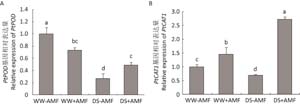
The effects of inoculation of an arbuscular mycorrhizal (AM) fungus Funneliformis mosseae on plant growth, reactive oxygen species metabolism, and expression of relevant antioxidant enzyme genes of potted trifoliate orange (Poncirus trifoliata) seedlings under well-watered and drought stress conditions were evaluated. After seven weeks of drought treatment, root mycorrhizal colonization was significantly reduced. F. mosseae inoculation significantly promoted plant biomass, root volume and leaf relative water content and reduced leaf proline concentrations under drought stress conditions. F. mosseae also markedly up-regulated the expression of arginine decarboxylase genes (PtADC1 and PtADC2), superoxide dismutase genes (PtFe-SOD and PtMn-SOD), peroxidase gene (PtPOD) and catalase 1 gene (PTCAT1) in leaves under drought stress, thereby maintaining considerably lower reactive oxygen species (e.g., hydrogen peroxide) levels. The results come to the conclusion that mycorrhizal plants possess strong antioxidant defense capacity to enhance drought tolerance.