


糖尿病是一种以高血糖为特征的慢性代谢紊乱疾病,主要分成1型、2型和妊娠型糖尿病(Cudworth & Woodrow 1997)。其中,2型糖尿病约占90%-95%(Ameirican Diadetes Association 2019)。高血糖会损伤肾脏、心脏、眼睛、血管等器官组织(Mirmiran et al. 2014)。现代药理学研究表明,相比化学合成药,来自天然产物中的降血糖活性物质普遍具有效果显著、副作用小等优点(Rautn et al. 2016)。因此,开发此类天然活性物质具有显著的社会和经济效益。
桦褐孔菌Inonotus obliquus是一种珍稀食药真菌,又名桦树茸、白桦茸、斜管纤孔菌等,主要分布于北欧、俄罗斯、日本及我国的黑龙江和吉林等寒冷地区(戴玉成和李玉 2011)。研究表明,已发现的桦褐孔菌活性成分有200多种,其中多糖为最主要活性成分(常晨和包怡红 2017)。桦褐孔菌多糖具有抗氧化、抗肿瘤、抗糖尿病以及免疫调节等生理活性(孙军恩等 2009)。其抗糖尿病活性研究最引人关注,研究证实人工栽培和野生桦褐孔菌子实体(陈艳秋等 2018)、发酵菌丝体中的多糖(Sun et al. 2008)都具有显著的降血糖功效。目前,关于桦褐孔菌多糖降血糖的机制说法不一,主要集中在改善胰岛素抵抗、提高机体对胰岛素的敏感性和调节糖代谢3个方面(吴宇锋和颜美秋 2018)。虽然桦褐孔菌子实体多糖抑制α-葡萄糖苷酶活性已有少数报道(沈心怡等2016),但其抑制类型及作用机理却鲜有探究,而且不同提取分离过程得到的多糖组成及结构各不相同。
抑制α-葡萄糖苷酶活性减少葡萄糖形成和处理HepG2细胞增加葡萄糖吸收,是两种有效的体外筛选降血糖活性物质方法(Gil-Campos et al. 2004;Tang et al. 2018)。本研究以桦褐孔菌子实体为原料经水提和分级醇沉得到粗多糖和3个多糖组分,通过α-葡萄糖苷酶筛选出效果较好的多糖组分,并进一步研究其酶动力学以及对HepG2细胞葡萄糖吸收的作用,为桦褐孔菌相关医药保健品的研发和生产提供理论参考。
1 材料与方法
1.1 供试材料
1.1.1 材料和试剂:桦褐孔菌野生子实体,采自长白山野生林区,由庆元县金源真菌多糖制品责任有限公司提供;95%食品级乙醇(杭州长青化工);α-葡萄糖苷酶(10U/mg)、PNPG(4-硝基酚-α-D-吡喃葡萄糖苷)、葡萄糖测试盒、胰岛素、盐酸二甲双胍和单糖标准品(L-鼠李糖,D-葡萄糖,D-木糖,D-岩藻糖,D-半乳糖,D-甘露糖)等标准品(美国Sigma公司);二甲基亚砜(DMSO)、噻唑蓝(MTT)、胰蛋白酶消化液(南京建成生物工程研究所);HepG2(人肝癌细胞)(中国科学院细胞库);DMEM(dulbecco’s modified eagle medium)培养基、磷酸盐缓冲液(phosphate buffered saline,PBS)、胎牛血清(fetal bovine serum,FBS)(美国Gibco公司)。
1.1.2 仪器与设备:PL602分析天平(梅特勒-托利多仪器有限公司);DJ-02小型粉碎机(上海淀久中药机械);Spectra Max i3酶标仪(美国MD公司);725型紫外分光光度计(上海光谱仪器有限公司);HH-2型恒温水浴锅(荣华仪器制造有限公司);RE-2000A旋转蒸发仪(上海亚荣生化仪器厂);311型CO2培养箱(美国Thermo Fisher Scientific公司);TDL-60B低速冷冻离型机(上海安亭科学仪器厂);ALPHA 2-4 LD真空冷冻干燥机(德国Christ公司)。
1.2 方法
1.2.1 提取时间对多糖得率的影响:桦褐孔菌子实体经50℃干燥3h后,采用小型粉碎机粉碎,过60目筛。称取100g粉末,固定料液比1:20和提取温度90℃,分别在5个不同的时间(1、1.5、2、2.5、3h)提取多糖,重复2次,合并上清液后浓缩、离心、干燥,根据公式测定得率:得率(%)=(提取物干燥后质量/原料质量)×100。
1.2.2 提取温度对多糖得率的影响:称取100g过筛后的桦褐孔菌子实体粉末,固定料液比1:20和提取时间2h,分别在5个不同的温度(80、85、90、95、100℃)提取多糖,重复2次,合并上清液后浓缩、离心、干燥,根据1.2.1公式测定得率。
1.2.3 提取料液比对多糖得率的影响:称取100g过筛后的桦褐孔菌子实体粉末,固定温度90℃和提取时间2h,分别以5个不同的料液比(1:10、1:15、1:20、1:25、1:30)提取多糖,重复2次,合并上清液后浓缩、离心、干燥,根据1.2.1公式测定得率。
1.2.4 响应面优化提取多糖条件:以单因素为前提,根据Box-Behnken中心组合实验设计原理,进行3因素3水平的响应面分析,试验因素与水平设计见表1。以多糖得率为评判标准,确定最优提取条件,并在实际条件下进行验证试验。
表1 Box-Behnken设计试验因素与水平
Table 1
| 因素 Factors | 代码 Code | 水平 Level | ||
|---|---|---|---|---|
| -1 | 0 | 1 | ||
| 时间 Time (h) | A | 1 | 2 | 3 |
| 温度 Temperature (°C) | B | 80 | 90 | 100 |
| 液料比 Liquid-solid ratio (mL/g) | C | 10 | 20 | 30 |
1.2.5 多糖的分级:将桦褐孔菌子实体粉末(500g)按照优化条件提取,重复两次。合并两次上清液,减压浓缩至一定体积,然后量取1/4体积量的浓缩液离心、冷冻干燥得到桦褐孔菌子实体粗多糖,其余3/4体积量的浓缩液加入终浓度为30%、60%、80%的乙醇分级沉淀,然后离心、冷冻干燥,分别得到IOP30、IOP60、IOP80 3种组分(张佳妍 2015),并根据1.2.1公式测定得率。
1.2.6 总糖含量的测定:采用苯酚-硫酸法(张惟杰1994),准确配置0.2mg/mL的待测样品液,向试管中加入1mL的样品液、1mL蒸馏水、5%苯酚试剂以及5mL浓硫酸,摇匀后沸水浴15min,冷却后测定490nm处的吸光值。每组3个平行,总糖含量由葡萄糖标准曲线获得。
1.2.7 还原糖含量的测定:采用3,5-二硝基水杨酸法(王健壮等 2008)。配置5.0mg/mL的待测样品溶液,取1mL加入试管,再加入3.0mL DNS试剂,摇匀后沸水浴5min,取出后冰浴冷却,加蒸馏水定容至25mL,混匀后在520nm处测吸光值。每组3个平行,还原糖含量由葡萄糖标准曲线获得。
1.2.8 多糖含量及纯度的测定:多糖含量(%)=(总糖含量-还原糖含量)×100;多糖纯度(%)=(多糖含量/多糖提取物干重)×100。
1.2.9 蛋白质、脂肪、水分含量测定:蛋白质含量测定采用考马斯亮蓝法(Baradford 1976)。将牛血清蛋白配置成0.1mg/mL的标准溶液,吸取标准液0、0.2、0.4、0.6、0.8、1.0mL于试管中,加入蒸馏水至1.0mL,后加入考马斯亮蓝溶液5.0mL,混匀静置,于595nm测吸光值,绘制标曲。按照上述操作测定样品溶液(2.0mg/mL)蛋白质含量,结果由标曲得出。
脂肪含量依照GB/T 15647-2009分析测定;水分含量依照GB/T 6435-2014分析测定。
1.2.10 α-葡萄糖苷酶活性测定:按照Dong et al.(2012)的方法,并稍作修改。分别向96孔板中加入40μL的多糖样品溶液和30μL的α-葡萄糖苷酶(0.2U/mL),混匀后在37℃下孵育10min,然后每孔加入30μL的PNPG(5mmol/L),混匀后在37℃下孵育20min,最后每孔加入100μL的Na2CO3(0.2mol/L)终止反应,阿卡波多糖作为阳性对照。每组3次平行,利用酶标仪在405nm下测吸光值,α-葡萄糖苷酶的抑制活性计算如下:
α-葡萄糖苷酶抑制率(%)=[1-(A1-A2)/A0]×100
式中,A0为空白对照吸光值;A1为样品吸光值;A2为磷酸缓冲液代替PNPG溶液的本底吸光值。所有结果的测定均以半抑制浓度(IC50)表示。
1.2.11 α-葡萄糖苷酶抑制动力学:按照Etxeberria et al.(2012)的方法,并稍作修改。PNP标准曲线的制作:依次向试管中加入0、0.2、0.4、0.6、0.8、1.0mL的PNP溶液(0.5mmol/L),再加入0.2mol/L的Na2CO3至2.31mL,以蒸馏水为空白对照,利用酶标仪在405nm处测定吸光值。以PNP的体积为横坐标,吸光值A为纵坐标,做线性回归方程。α-葡萄糖苷酶抑制类型的确定:以0.125、0.25、0.5、1、2mmol/L的PNPG溶液为底物,加入不同浓度的桦褐孔菌多糖溶液,测定体系的反应速度。以底物浓度的倒数1/[S]为横坐标,反应速率的倒数1/[V]为纵坐标作图,即Lineweaver-Burk(L-B)法作图,确定反应类型。
1.2.12 HepG2细胞培养:人肝癌细胞株HepG2细胞置于25cm2细胞培养瓶,加入5mL完全培养基(DMEM+10% FBS+1%青链霉素),在37℃、5% CO2的培养箱中培养,隔天换液,当汇合度达80%-90%以上,利用胰酶消化,传代培养(Chen et al. 2018)。
1.2.13 MTT法测定细胞存活率:参照Li et al.(2014)的方法。HepG2细胞浓度调整为 1×10⁵个/mL,每孔加入100μL细胞悬液于96孔板中,在37℃、5% CO2的培养箱中培养24h,每孔加入样品液100μL,以不加入样品液为空白对照,继续培养24h,每孔加入20μL MTT(5mg/mL)培养4h,吸去培养液,每孔再加入100μL的DMSO,振荡至紫色结晶物完全溶解,每组6个平行孔。用酶标仪在490nm处测定吸光值。
1.2.14 HepG2细胞葡萄糖消耗:HepG2细胞浓度1×10⁵个/mL,每孔加入100μL细胞悬液于96孔板中,在37℃、5% CO2的培养箱中培养24h。将试验细胞分为对照组(不加胰岛素;加入10-7mmol/L的胰岛素)、桦褐孔菌组(1.0,0.1,0.01,0.001mg/L)、阳性对照组(二甲双胍10-3mmol/L),每组6个平行孔。给药后继续孵育24h,利用试剂盒测定葡萄糖的消耗量。
1.2.15 样品衍生化处理:按照张安强等(2006)的方法处理。称取等摩尔(2.0mmol/L)的鼠李糖、阿拉伯糖、岩藻糖、木糖、甘露糖、葡萄糖、半乳糖混合标准品,用3.0mL蒸馏水溶解,加入20-30mg的NaBH4振荡3h,用冰醋酸中和过量的NaBH4,重复3次,减压浓缩除去反应产生的副产物硼酸和水,冷冻干燥后加4.0mL醋酐,100℃反应1h,冷却后加入3.0mL甲苯,减压浓缩除去醋酐。用氯仿溶解乙酰化后的产物并转移至分液漏斗,加入等量的蒸馏水振荡混匀,分层后去除水溶液,重复3次,氯仿层加入无水硫酸钠,再转移至10mL容量瓶定容,待分析。称取IOP30(2mg),加入4mL三氟乙酸(2mol/L),110℃水解2h,冷却后减压蒸发,再加入3mL甲醇,减压蒸发,重复3次,完全去除三氟乙酸。按照上述同样的方法进行还原和乙酰化。
1.2.16 气相色谱条件:HP-5毛细管柱(30m× 0.32mm×0.25μm);升温程序:120℃保持3min,以10℃/min升温至240℃,保持46.5min;气体体积流量1.0mL/min;进样口温度250℃;检测器温度250℃;柱温210℃;空气、氮气及氢气体积流量分别为350、30、35mL/min;分流比1:50;进样量2.0μL。
1.2.17 数据处理:采用每组实验重复3次,结果以平均值±标准误差表示。采用SPSS软件进行单因素方差(One-Way ANOVA)分析,来判断显著性差异,P<0.05代表有显著性差异,P<0.01代表有极显著性差异。
2 结果与分析
2.1 单因素试验
图1
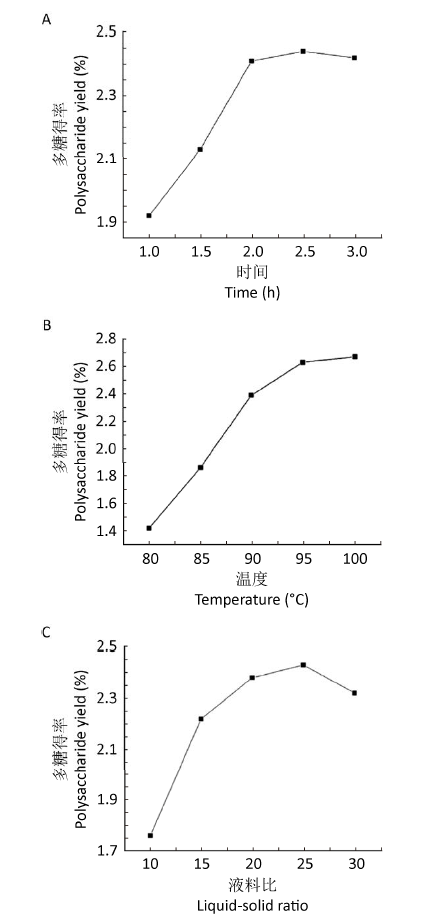
图1
提取时间(A)、温度(B)和液料比(C)对多糖提取率的影响
Fig. 1
Effects of extraction time (A), temperature (B) and liquid-solid ratio (C) on polysaccharide yield.
2.2 响应面优化试验
使用Design-Expert 8.0.5软件进行响应面设计,以得率(%)为响应值,提取时间(A)、温度(B)、液料比(C)为自变量,响应面设计和结果见表2,对其进行回归分析,得到回归方程模型为:Y=2.43+0.19A+ 0.64B+0.19C+0.028AB+0.005AC+0.13BC-0.2A2-0.32B2-0.42C2,通过方差分析检验自变量的充分性和适应度,从而验证自变量对多糖得率的影响。
表2 响应面设计方案与结果
Table 2
| 试验点 Run No. | 时间 Time (h) | 温度 Temperature (°C) | 液料比 Liquid-solid ratio (mL/g) | 得率 Yield (%) |
|---|---|---|---|---|
| 1 | 3 | 90 | 10 | 1.88 |
| 2 | 2 | 100 | 30 | 2.66 |
| 3 | 2 | 80 | 30 | 1.18 |
| 4 | 1 | 90 | 30 | 1.77 |
| 5 | 3 | 90 | 30 | 2.25 |
| 6 | 1 | 80 | 20 | 1.15 |
| 7 | 2 | 80 | 10 | 1.03 |
| 8 | 1 | 90 | 10 | 1.42 |
| 9 | 2 | 90 | 20 | 4.07 |
| 10 | 2 | 100 | 10 | 1.99 |
| 11 | 3 | 80 | 20 | 1.38 |
| 12 | 2 | 90 | 20 | 2.52 |
| 13 | 1 | 100 | 20 | 2.23 |
| 14 | 3 | 100 | 20 | 2.77 |
| 15 | 2 | 90 | 20 | 2.43 |
方差分析见表3,模型的F=86.47,P<0.0001,差异极显著;失拟项F=2.42,P=0.3054,无显著性差异,因此,该模型拟合度较高。结果显示,提取时间A和温度B以及料液比C对Y有显著意义;二次项BC对Y有显著性,AB和AC对Y均无显著性;交叉项A2、B2和C2对Y具有显著性。因此揭示响应与自变量之间的关系合适。
表3 响应面回归模型方差分析
Table 3
| 来源 Source | 平方和 Sum of squares | 自由度 Df | 均方 Mean square | F值 F value | P值 P value | 显著性 Significant level |
|---|---|---|---|---|---|---|
| 模型 | 4.96 | 9 | 0.55 | 86.47 | <0.0001 | *** |
| A | 0.29 | 1 | 0.29 | 44.75 | 0.0011 | ** |
| B | 3.26 | 1 | 3.26 | 512.54 | <0.0001 | *** |
| C | 0.30 | 1 | 0.30 | 46.55 | 0.0010 | *** |
| AB | 3.025×10⁻³ | 1 | 3.025×10⁻³ | 0.48 | 0.5214 | NS |
| AC | 1.00×10⁻⁴ | 1 | 1.00×10⁻⁴ | 0.016 | 0.9052 | NS |
| BC | 0.068 | 1 | 0.068 | 0.016 | 0.0225 | * |
| A2 | 0.15 | 1 | 0.15 | 23.87 | 0.0045 | ** |
| B2 | 0.37 | 1 | 0.37 | 58.60 | 0.0006 | *** |
| C2 | 0.65 | 1 | 0.65 | 102.48 | 0.0002 | *** |
| 残差Residual | 0.032 | 5 | 6.368×10⁻³ | |||
| 失拟项 Lack of fit | 0.025 | 3 | 8.325×10⁻³ | 2.42 | 0.3054 | NS |
| 纯误差Pure error | 6.867×10⁻³ | 2 | 3.433×10⁻³ | |||
| 总和Cor total | 4.99 | 14 |
注:NS表示无显著性;*表示0.01<P<0.1;**表示0.001<P<0.01;***表示P<0.001
Note: NS represents no significance; * represents 0.01<P<0.1; ** represents 0.001<P<0.01; *** represents P<0.001.
对于3个自变量,选取其中一个因素为固定值,其余两个因素相互交叉作用对桦褐孔菌多糖得率的影响见图2。运用Design-expert 8.0软件对回归模型进行优化分析,结果显示提取多糖的理论最佳工艺参数为:提取时间2.01h,温度99.96℃,液料比23.56mL/g,此条件下桦褐孔菌子实体多糖的理论得率为2.84%。考虑到实际操作情况,将最佳提取条件修改为:提取时间2h,温度100℃,液料比24mL/g。在此条件下,重复3次进行实验验证,桦褐孔菌子实体的多糖物提取率为(2.79±0.03)%,与预测值基本一致。
图2
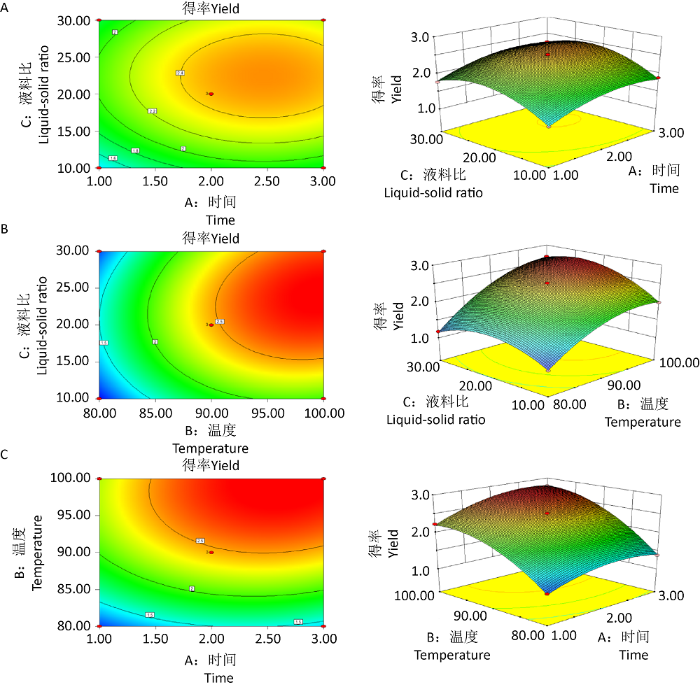
图2
两因素交互作用对多糖得率影响的响应曲面图 A:提取时间和液料比等高线图以及三维响应面图;B:温度和液料比等高线图以及三维响应面图;C:时间和温度等高线图以及三维响应面图
Fig. 2
Response surface plots of the interaction of various extraction conditions. A: Contour plots and 3D response surface plot of extraction time and liquid-solid ratio; B: Contour plots and 3D response surface plot of extraction temperature and liquid-solid ratio; C: Contour plots and 3D response surface plot of extraction time and extraction temperature.
2.3 桦褐孔菌子实体主要成分
IOP30中多糖含量最高(26.52%±0.20%);IOP60中蛋白质含量最高(18.76%±0.08%),粗多糖中脂肪含量最高(13.10%±0.30%);IOP80中水分含量最高(14.97%±0.05%)(表4)。
表4 主要成分分析
Table 4
| 成分 Components | 粗多糖 Crude polysaccharides | IOP30 | IOP60 | IOP80 |
|---|---|---|---|---|
| 总糖 Total sugar | 18.62±0.10 | 27.48±0.20 | 21.46±0.20 | 16.31±0.13 |
| 还原糖 Reducing sugar | 0.92±0.05 | 0.96±0.08 | 1.01±0.06 | 0.40±0.08 |
| 多糖 Polysaccharides | 17.70±0.10 | 26.52±0.20 | 20.45±0.20 | 9.91±0.15 |
| 蛋白质 Protein | 12.46±0.02 | 14.11±0.06 | 18.76±0.08 | 12.28±0.06 |
| 脂肪 Fat | 13.10±0.30 | 10.70±0.20 | 6.25±0.20 | 3.89±0.10 |
| 水分 Water | 11.63±0.08 | 9.50±0.07 | 11.27±0.08 | 14.97±0.05 |
2.4 桦褐孔菌多糖抑制α-葡萄糖苷酶活性
将桦褐孔菌粗多糖、IOP30、IOP60、IOP80分别首先进行α-葡萄糖苷酶抑制实验,筛选出最有效的降血糖活性多糖组分。
当多糖浓度在0-200μg/mL时,桦褐孔菌多糖的4种多糖均有一定的α-葡萄糖苷酶抑制活性,并且抑制率与多糖浓度呈正相关的量效关系(图3)。在相同的多糖浓度(100μg/mL)下,不同多糖组分对α-葡萄糖苷酶抑制率为:IOP30>IOP60>粗多糖>IOP80。其中,IOP30(IC50=38.20μg/mL)的抑制活性远远优于阳性对照阿卡波糖(IC50=3.36mg/mL)。
图3
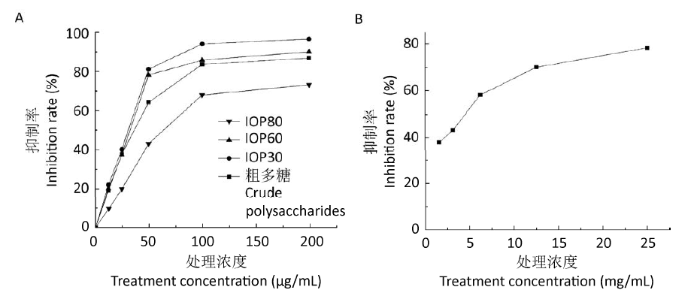
图3
(A)桦褐孔菌子实体粗多糖、IOP30、IOP60、IOP80抑制α-葡萄糖苷酶活性;(B)阿卡波多糖抑制α-葡萄糖苷酶活性
Fig. 3
(A) The α-glucosidase inhibitory activities of crude polysaccharides, IOP30, IOP60 and IOP80 from the fruiting body of Inonotus obliquus; (B) The α-glucosidase inhibitory activities of acarbose.
2.5 IOP30抑制α-葡萄糖苷酶动力学
桦褐孔菌多糖IOP30抑制α-葡萄糖苷酶的类型见图4。在酶体系反应过程中,IOP30对α-葡萄糖苷酶抑制程度与浓度正向相关,当IOP30浓度递增,动力学曲线在纵坐标上的截距变大而在横坐标相交于同一点,说明最大反应速率Vmax减小,米氏常数Km保持不变。通过上述规律可知,IOP30抑制α-葡萄糖苷酶属于典型的非竞争性抑制(Kim et al. 2006),其中米氏常数Km为1.74mmol/L。
图4
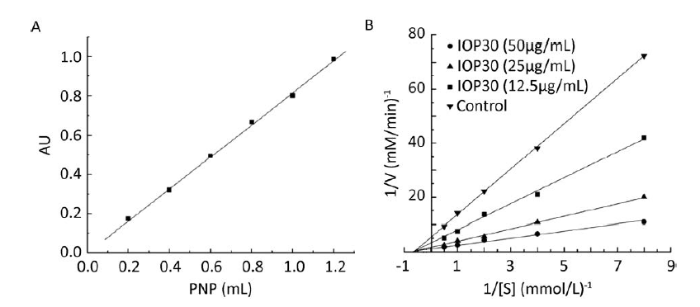
图4
(A)PNP标准曲线;(B)IOP30对α-葡萄糖苷酶抑制的双倒数动力学曲线
Fig. 4
(A) The standard curve of PNP; (B) Double reciprocal plots for IOP30 inhibition on α-glucosidase.
2.6 IOP30对HepG2细胞增殖及葡萄糖消耗的影响
经0.001-1mg/mL的IOP30处理后,HepG2细胞的吸光值与对照组无显著性差异(表5),说明在此浓度范围内IOP30对细胞无毒性作用。HepG2细胞在不添加胰岛素,只添加IOP30时,在0.001-1mg/mL的IOP30浓度下,细胞葡萄糖消耗与IOP30呈正向量效关系。HepG2细胞经0.01、0.1、1mg/mL的IOP30为处理后,细胞的葡萄糖消耗分别增加了1.62、2.46、3.34mmol/L, 与对照组相比差异极其显著(P<0.01),经0.001mg/mL的IOP30处理后,细胞的葡萄糖消耗增加了1.39mmol/L,与对照组相比差异显著(P<0.05),其中1.0mg/mL的IOP30处理效果优于阳性对照二甲双胍。
表5 IOP30对HepG2细胞的影响
Table 5
| 组别 Group | 培养条件 Culture conditions | MTT (A490) | 葡萄糖消耗 Glucose consumption (mmol/L) | |
|---|---|---|---|---|
| IOP30 (mg/L) | 胰岛素Insulin (mmol/L) | |||
| 对照组 Control | — | — | 0.38±0.01 | 1.65±0.21 |
| 桦褐孔菌组 Treatment of Inonotus obliquus | — | 10-7 | 0.38±0.06 | 2.47±0.32 |
| 1.0 | — | 0.38±0.07 | 4.99±0.21** | |
| 1.0 | 10-7 | 0.37±0.10 | 5.24±0.39## | |
| 0.1 | — | 0.38±0.08 | 4.11±0.27** | |
| 0.1 | 10-7 | 0.38±0.03 | 4.65±0.13## | |
| 0.01 | — | 0.37±0.07 | 3.27±0.33** | |
| 0.01 | 10-7 | 0.37±0.10 | 3.50±0.23# | |
| 0.001 | — | 0.37±0.08 | 3.04±0.18* | |
| 0.001 | 10-7 | 0.38±0.11 | 3.12±0.20# | |
| 二甲双胍 Metformin | 0.38±0.02 | 4.29±0.36** | ||
注:与对照组(不加胰岛素)相比,*P<0.05,**P<0.01;与对照组(添加胰岛素)相比,#P<0.05,##P<0.01
Note: Compared with the control group (without insulin), *P<0.05, **P<0.01; Compared with the control group (insulin added), #P<0.05, ##P<0.01.
此外,在HepG2细胞同时添加胰岛素(10-7mmol/L)和IOP30时,细胞的葡萄糖消耗增加更显著,表明加入的胰岛素对HepG2细胞的葡萄糖消耗起到了协同效应,而且在0.1、1mg/mL的IOP30处理HepG2细胞后,与对照组相比差异极其显著(P<0.01),HepG2细胞经0.001、0.01mg/mL的IOP30处理后,与对照组相比差异显著(P<0.05),在该条件下,其中0.1mg/mL的IOP30处理效果优于阳性对照二甲双胍。
2.7 桦褐孔菌多糖IOP30的单糖组成分析
图5
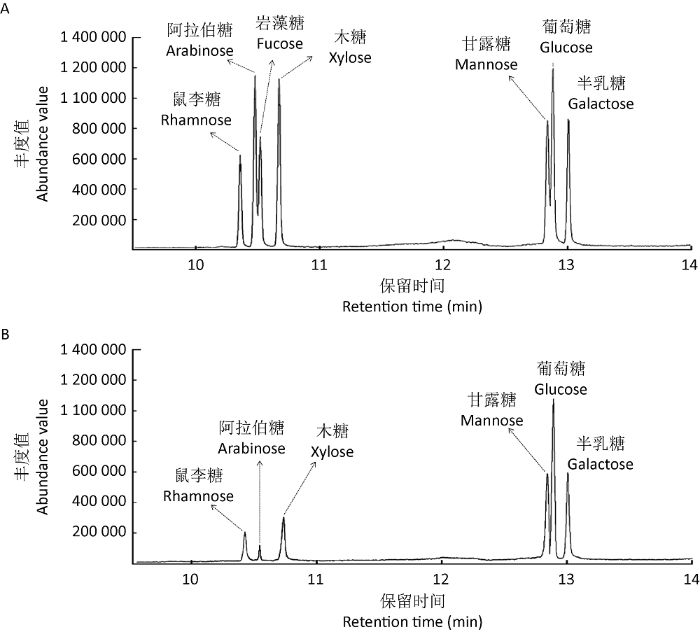
图5
(A)标准单糖GC-MS图;(B)IOP30的GC-MS图
Fig. 5
(A) GC-MS of the monosaccharides in standard sample; (B) GC-MS of the IOP30.
3 讨论
以单因素为前提,结合响应面优化得到桦褐孔菌子实体多糖的实际最佳提取条件:提取时间2h,温度100℃,液料比24mL/g下多糖提取率为(2.79±0.03)%,与模型预测的结果基本一致。
经乙醇分级沉淀,得到了桦褐孔菌粗多糖和IOP30、IOP60、IOP80 4个组分,其中IOP30多糖含量最高,达到了(26.52±0.20)%。而方妤露等(2017)从桦褐孔菌子实体中提取的粗多糖(14.88%)和许泓瑜等(2008)从桦褐孔菌粉中提取的多糖(24.58%)都要低于IOP30。α-葡萄糖苷酶抑制剂用于治疗糖尿病在临床医学已取得成功,它的作用机制是减少进入肠胃中葡萄糖的释放,从而达到降低餐后血糖(Stefano et al. 2018)。结果表明,粗多糖、IOP30、IOP60、IOP80都具有较好地抑制α-葡萄糖苷酶活性,其中桦褐孔菌IOP30效果最佳(IC50=38.20μg/mL),其半抑制浓度仅为阳性对照阿卡波糖(IC50= 3.36mg/mL)的1.14%。沈心怡等(2016)报道了桦褐孔菌子实体粗多糖抑制α-葡萄糖苷酶IC50为150μg/mL,其抑制效果低于本文的IOP30;IOP30与王梦雅等(2020)从桦褐孔菌发酵液分离纯化得到的EIOP1抑制α-葡萄糖苷酶活性相似(IC50=39.18μg/mL)。经查阅文献,本研究首次经酶动力学分析提出了IOP30抑制α-葡萄糖苷酶属于非竞争性抑制,为后续相关酶抑制剂靶向活性制剂的研发和生产提供了理论参考。
HepG2细胞是一种肝癌细胞,而肝脏是葡萄糖代谢的主要器官(Xu et al. 2003)。因此,HepG2细胞是一种体外研究葡萄糖消耗模拟体内的理想细胞。采用HepG2细胞模型对IOP30进一步降血糖研究,结果显示,0.01-1.0mg/mL的IOP30能够极显著(P<0.01)增加HepG2细胞的葡萄糖消耗量,在1.0mg/mL时的效果优于二甲双胍。龙凯等(2017)发现相对分子量为1×104-3×104的桦褐孔菌多糖(0.1mg/mL)改善HepG2细胞的葡萄糖消耗[(3.08±0.35)mmol/L]效果最佳,而本研究证实IOP30(0.1mg/mL)具有更好的改善HepG2细胞的葡萄糖消耗能力(4.65±0.13)mmol/L。MTT实验可知,0.001- 1mg/mL的IOP30对HepG2细胞增殖无显著影响,说明桦褐孔菌多糖IOP30各浓度组的葡萄糖消耗量的增加以及其协同胰岛素的作用并不是由于HepG2细胞数目的增加而导致,潜在的原因可能是桦褐孔菌多糖通过促进细胞周围组织对葡萄糖的代谢,及加强肝细胞对胰岛素的敏感性而起作用。
对照单糖标品及相对峰面积,IOP30主要由鼠李糖(7.93%)、阿拉伯糖(3.12%)、木糖(11.15%)、甘露糖(19.08%)、葡萄糖(39.17%)、半乳糖(19.15%)6种单糖组成。这与Wang et al.(2018)和方妤露等(2017)的研究组成单糖成分相同,但是由于制备方法的差异,各种单糖的含量存在差异。
综合来看,桦褐孔菌IOP30降血糖可通过抑制α-葡萄糖苷酶活性减少餐后血糖的形成,促进细胞周围组织对葡萄糖的代谢,加强肝细胞对胰岛素的敏感性而起作用。本研究成果可为桦褐孔菌这一珍稀药食真菌资源的开发和利用奠定相关理论基础。
参考文献
Classification and diagnosis of diabetes: standards of medical care in diabetes-2019
A rapid and sensitive method for the quantitation of microgram quantities of proteins utilizing the principle of protein-dye binding
Research progress of Inonotus obliquus polysaccharides
Tetrahydrocurcumin ameliorates free fatty acid-induced hepatic steatosis and improves insulin resistance in HepG2 cells
A comparative study on the hypoglycemic effect of Inonotus obliquus from artificial culture mycelium, sclerotia and wild sclerotia of Inonotus obliquus
Notes on the nomenclature of six important medicinal fungi in China
Inhibitory potential of trilobatin from Lithocarpus polystachyus Rehd. against α-glucosidase and α-amylase linked to type 2 diabetes
Antidiabetic effects of natural plant extracts via inhibition of carbohydrate hydrolysis enzymes with emphasis on pancreatic alpha amylase
Nutrient component and monosaccharide composition of water extracts from Inonotus
Adiponectin, the missing link in insulin resistance and obesity
DOI:10.1016/j.clnu.2004.04.010
URL
PMID:15380884
[本文引用: 1]

Obesity and insulin resistance have been recognised as leading causes of major health issues, particularly diabetes type 2 and metabolic syndrome. Although obesity, defined as excess body fat, is frequently accompanied by insulin resistance, diabetes, metabolic syndrome and cardiovascular diseases, the molecular basis for the link between obesity and those diseases has not yet been clarified. Adipose tissue expresses various secretory proteins, including leptin, tumour necrosis factor-alpha and adiponectin, which may be involved in the regulation of energy expenditure, lipid metabolism and insulin resistance. The aim of this study is to provide an overview of the metabolic alterations occurring in insulin resistance as well as to review the biological roles of adiponectin, particularly in the regulation of fatty acid oxidation and insulin action. Adiponectin is the most abundant gene product in adipose tissue and accounts for 0.01% of total plasma protein. Plasma adiponectin level is decreased in obesity, both in children and adults, and it is negatively associated to plasma insulin and positively associated to plasma triglycerides. Low levels of adiponectin decreases fatty acid oxidation in muscle. Recent data have demonstrated that adiponectin effects are mediated by the interaction with muscle and hepatic receptors through activation of AMP kinase, the cellular
Glycosidase inhibitory flavonoids form Sophora flavescens
Sensitisation of ovarian cancer cells to cisplatin by flavonoids from Scutellaria barbata
Improvement on insulin resistance in HepG2 cells by polysaccharide from solid-state cultured Inonotus obliquus
Functional foods-based diet as a novel dietary approach for management of type 2 diabetes and its complications: a review
Selected bioactive natural products for diabetes mellitus
Research on Inonotus obliquus extracts in α-glucosidase activity
Functional significance and structure-activity relationship of food-derived α-glucosidase inhibitors
DOI:10.1016/j.cofs.2018.02.008 URL [本文引用: 1]
Antihyperglycemic and antilipidperoxidative effects of dry matter of culture broth of Inonotus obliquus in submerged culture on normal and alloxan-diabetes mice
DOI:10.1016/j.jep.2008.02.030
URL
PMID:18434051
[本文引用: 1]
AIM OF THE STUDY: The antihyperglycemic and antilipidperoxidative effects of the dry matter of culture broth (DMCB) of Inonotus obliquus were investigated. MATERIALS AND METHODS: The normal, glucose-induced hyperglycemic and alloxan-induced diabetic mice were used to evaluate the antihyperglycemic and antilipidperoxidative effects of the DMCB of Inonotus obliquus. RESULTS: Treatment with the DMCB (500 and 1000 mg/kg body weight) exhibited a mild hypoglycemic effect in normal mice, and failed to reduce the peak glucose levels after glucose administration. However, euglycemia was achieved in the DMCB of Inonotus obliquus (1000 mg/kg) and glibenclamide-treated mice after 120 min of glucose loading. In alloxan-induced diabetic mice, the DMCB (500 and 1000 mg/kg body weight for 21 days) showed a significant decrease in blood glucose level, the percentages reduction on the 7th day were 11.90 and 15.79%, respectively. However, feeding of this drug for 3 weeks produced reduction was 30.07 and 31.30%. Furthermore, the DMCB treatment significantly decreased serum contents of free fatty acid (FFA), total cholesterol (TC), triglyceride (TG) and low density lipoprotein-cholesterol (LDL-C), whereas effectively increased high density lipoprotein-cholesterol (HDL-C), insulin level and hepatic glycogen contents in liver on diabetic mice. Besides, the DMCB treatment significantly increased catalase (CAT), superoxide dismutase (SOD) and glutathione peroxidase (GPx) activities except for decreasing maleic dialdehyde (MDA) level in diabetic mice. Histological morphology examination showed that the DMCB restored the damage of pancreas tissues in mice with diabetes mellitus. CONCLUSIONS: The results showed that the DMCB of Inonotus obliquus possesses significant antihyperglycemic, antilipidperoxidative and antioxidant effects in alloxan-induced diabetic mice.
Hypoglycemic effect of dry matter of culture broth of Inonotus obliquus and Tricholoma matsutake in submerged culture
Exploring the interaction between Salvia miltiorrhiza and α-glucosidase: insights from computational analysis and experimental studies
Effects of simulated gastrointestinal digestion in vitro on the chemical properties, antioxidant activity, α-amylase and α-glucosidase inhibitory activity of polysaccharides from Inonotus obliquus
DOI:10.1016/j.foodres.2017.10.058
URL
PMID:29389616
[本文引用: 1]
This study was aimed to investigate the impacts of gastrointestinal digestion in vitro on the physicochemical properties and the biological activities of polysaccharides from Inonotus obliquus (UIOPS-1). Results showed that the monosaccharides composition, structure and conformation of polysaccharides were remarkably altered, and the molecular weight (Mw) of UIOPS-1 was steadily decreased from 105.02kDa to 88.97kDa and 36.74kDa after simulated digestion. The reducing ends were increased and the free monosaccharides including d-glucose, d-galactose and d-xylose were released suggested that the degradation of UIOPS-1 was caused by disrupting the aggregates and glycosidic bonds. The antioxidant activities of UIOPS-1 were significantly increased after gastric digestion (P<0.05), however, they were decreased after intestinal digestion. The alpha-amylase and alpha-glucosidase inhibitory activities of UIOPS-1 were significantly increased after digestion indicating a good control of postprandial hyperglycemia (P<0.001). The results indicated that UIOPS-1 still exhibited antioxidant and antihyperglycemic potential after gastrointestinal digestion, which could be considered as a promising candidate for functional foods.
Methodological study on the determination of plant polysaccharides content
Hypoglycemic activity of purified polysaccharides from Inonotus obliquus in vitro
Progress in hypoglycemic effect and mechanism of Inonotus obliquu
Optimization of extraction technique of polysaccharides from fermentation powder of Inonotus obliquus
Characterisation of some cytotoxic endpoints using rat liver and HepG2 spheroids as in vitro models and their application in hepatotoxicity studies. I. Glucose metabolism and enzyme release as cytotoxic markers
DOI:10.1016/s0041-008x(03)00089-9
URL
PMID:12781628
[本文引用: 1]
Cytotoxicity endpoints, spontaneous glucose secretion/consumption and LDH and gamma-GT release, were characterised in rat liver and HepG2 spheroids as in vitro models for toxicology studies. Preprepared rat liver spheroids and HepG2 spheroids cultured in a six-well plate format were exposed to varying concentrations of galactosamine, propranolol, diclofenac, and paracetamol. All four model toxins significantly affected glucose secretion, which agreed well with LDH and/or gamma-GT release in rat liver spheroids. These toxins also significantly increased LDH and/or gamma-GT release in HepG2 spheroids. Whereas glucose consumption in HepG2 spheroids did not show conclusive results, LDH activities in both types of spheroids were similar and their levels were relatively high. Accordingly, the level of LDH leakage in both types of spheroids was much higher than gamma-GT after exposure to the toxins. In contrast, gamma-GT activity in HepG2 spheroids was sixfold higher than that in rat liver spheroids. This study revealed that galactosamine interfered with the gamma-GT assay and paracetamol interfered with the LDH assay. It demonstrated, for the first time, that glucose secretion by liver spheroids can be used as a functional indicator of cytotoxicity. Test compounds may interfere with enzymatic assays as indicated by LDH and gamma-GT release in this study. Combining functional parameters together with two or more indicators of enzyme releases can provide a reliable cytotoxicity evaluation. Liver and HepG2 spheroids as in vitro models showed good predictions in chemical-induced hepatic cytotoxicity.
Identification of 3-O-methyl methylpentose in polysaccharides from Hericium erinaceus Pers
Study on hypoglycemic activity of aqueous extract from Inonotus obliquues