



芳香杯伞Clitocybe fragrans属于真菌界、担子菌门、伞菌纲、伞菌目、白蘑科。主要分布在我国的高原地区,在黑龙江、吉林、河北、山西、云南等多地均有分布(魏铁铮和姚一建2015)。我国对野生蕈菌驯化已有近千年的历史,是世界上最早对食用菌进行栽培研究的国家之一,曾经首先对香菇、木耳、银耳等野生蕈菌驯化栽培成功(王建瑞和图力古尔2006;王刚等2006)。近几年,冷杉侧耳Pleurotus abieticola R.H. Petersen & K.W. Hughes、絮缘蘑菇 Agaricus subfloccosus (J.E. Lange) Hlaváček、脆木耳 Auricularia fibrillifera Kobayasi等先后被驯化成功(张晓宇等2019;梁倩倩等2020;罗智檜等2020)。芳香杯伞属于白蘑科,但是目前对于白蘑科的驯化栽培报道较少(香永田等1987;李晓华等2004),白蘑科里菌种的驯化栽培一直是业界难点。杯伞属仅有大杯伞Clitocybe maxima和漏斗形杯伞Clitocybe infundibuliformis有驯化成功报告(曾金凤1985,1991;颜振兰2001),而芳香杯伞作为白蘑科的一个野生菌种,至今未见驯化栽培的研究报道。
本研究以野生芳香杯伞子实体组织分离获得的菌种为材料,对其进行了形态学和ITS鉴定(刘红霞2014),随后,对其菌丝生长的生物学特性和驯化栽培进行了系统研究,筛选出适宜的母种、原种、栽培种培养基,明确了其生长条件及驯化栽培技术。研究结果对河北省野生蘑菇资源的保护利用、丰富我国食用菌栽培品种具有重要意义。
1 材料与方法
1.1 供试菌株
供试菌株采自于河北省平泉市,组织分离培养后获得菌种,经形态学及ITS鉴定为芳香杯伞Clitocybe fragrans,现保存于河北师范大学应用真菌学实验室。
1.2 菌丝体营养特性研究
1.2.1 不同碳源对菌丝体生长的影响
固定基础培养基中的碳素含量,碳源更换为与葡萄糖等量碳素的10种不同碳源。基础培养基配方为:葡萄糖20 g,蛋白胨3 g,磷酸二氢钾3 g,无水硫酸镁1.5 g,琼脂20 g,加水定容至1 L。以无碳培养基作为对照,在平板上进行培养,用直径6 mm的打孔器打孔,取菌丝接种至平板,每种碳源进行5个重复处理,25 ℃培养箱恒温暗培养。十字划线法在相同时间段内测量菌丝体直径,当有一个菌丝即将满板时,结束培养。
菌丝生长速度(mm/d)=菌落半径(mm)/生长天数(d)
1.2.2 不同氮源对菌丝体生长的影响
固定基础培养基中的氮素含量,氮源更换为与蛋白胨等量氮素的10种氮源,以无氮培养基作为对照。其他步骤同碳源影响实验。
1.2.3 不同C/N对菌丝体生长的影响
固定基础培养基中葡萄糖的含量,改变蛋白胨的含量,配制成C/N比不同的9种培养基。其他步骤同碳源影响实验。
1.2.4 不同无机盐对菌丝体生长的影响
以基础培养基作为对照,将无机盐硫酸镁更换为等质量浓度的9种不同的无机盐。其他步骤同碳源影响实验。
1.2.5 正交试验
以筛选出的菌丝体碳源、氮源、C/N、无机盐为4个单因素,分别挑选出最佳的3个水平,进行L9(34)正交试验,共9组。
1.3 菌丝体生长环境条件研究
1.3.1 不同温度对菌丝体生长的影响
根据最适正交配方制作固体培养基用于温度筛选。在19-43 ℃间以3 ℃为一个梯度设定不同的温度梯度。
1.3.2 初始pH值对菌丝体生长的影响
在pH 4.5-8.5间以0.5为一个梯度设定不同初始pH梯度。
1.3.3 不同光照条件对菌丝体生长的影响
分别设定24 h连续黑暗、12 h光照+12 h黑暗、24 h连续光照,3个不同光照处理方案。
1.4 芳香杯伞菌种培养基研究
1.4.1 母种培养基
根据相关参考文献及菌丝体营养特性,设计以下11种母种培养基配方(初始pH自然):A:PDA+木屑煮汁培养基:CPDA培养基+木屑100 g (取煮汁);B:大豆饼粉培养基:CPDA培养基中马铃薯替换为大豆饼粉20 g;C:马铃薯蔗糖培养基:CPDA培养基中葡萄糖替换为蔗糖;D:CPDA培养基:马铃薯200 g (去皮切片煮汁),葡萄糖20 g,磷酸二氢钾3 g,蛋白胨3 g,无水硫酸镁1.5 g,琼脂20 g,水1 L;E:玉米粉培养基:CPDA培养基中马铃薯替换为玉米粉20 g;F:牛粪煮汁培养基:CPDA培养基中葡萄糖替换为牛粪100 g (取煮汁);G:麦粒煮汁培养基:CPDA培养基中马铃薯和葡萄糖替换为小麦粒200 g (取煮汁);H:粪草培养料培养基:CPDA培养基中葡萄糖替换为发酵后粪草料100 g (取煮汁);I:PDA+麸皮煮汁培养基:CPDA培养基+麸皮100 g (取煮汁);J:PDA培养基:马铃薯200 g (去皮切片煮汁),葡萄糖20 g,琼脂20 g,水1 L;K:正交配方(见2.1)。
1.4.2 原种培养基
根据相关参考文献及菌丝体营养特性,设计以下5种原种培养基配方,配方如下:高粱粒培养基:高粱98%,石膏1%,糖1%;玉米粒培养基:玉米粒98%,石膏1%,糖1%;荞麦培养基:荞麦98%,石膏1%,糖1%;麦粒培养基:小麦98%,石膏1%,糖1%;小米培养基:小米98%,石膏1%,糖1%。
将高粱粒用冷水浸泡12 h后,加热蒸煮至八分熟时,按比例加入石膏粉及葡萄糖,搅拌均匀后装入单头大试管(3 cm×20 cm),121 ℃高压灭菌1 h。待试管温度降至室温,接入直径为12 mm的菌丝块。22 ℃培养箱培养,当菌丝长满试管时可作为原种。
栽培料配方为粪草培养料98%,石膏1%、糖1%。使用前需对其进行人工二次发酵处理,处理方法为,将粪草培养料进行预湿,含水量保持在60%-65%,按比例加入石膏和糖,搅拌均匀后于55-60 ℃烘箱中进行二次发酵3-5 d,期间每天早晚进行翻料处理,待发酵臭味消失后,即发酵完成。将长好的原种接至发酵好的栽培料菌袋中(菌袋规格140 mm×280 mm×0.045 mm),于22 ℃、湿度60%的发菌培养室,在黑暗条件下进行发菌处理。将发菌完成的菌袋进行覆土出菇,出菇温度为20-25 ℃,湿度为80%-90%,并给予一定的散射光;昼夜温差10 ℃左右刺激原基发生,保持1 d两次通风;当原基形成后,加大通风,直至子实体发育成熟。
2 结果与分析
2.1 芳香杯伞菌丝体生物学特性
表1 不同营养物质对芳香杯伞菌丝生长的影响
Table 1
| 培养条件 Conditions | 不同因素 Different nutritional factors | 菌丝长势 Mycelial growth vigor | 生长速度 Mycelial growth rate (mm/d) | 显著性差异 Significance levels | |
|---|---|---|---|---|---|
| 0.05 | 0.01 | ||||
| 碳源 Carbon source | 乳糖Lactose | + | 0.39±0.02 | g | G |
| 果糖Fructose | + | 0.79±0.02 | f | E | |
| 葡萄糖Glucose | ++ | 1.32±0.03 | e | D | |
| 木糖Xylose | + | 0.77±0.03 | F | E | |
| 半乳糖Galactose | + | 0.20±0.02 | h | G | |
| 山梨糖醇Sorbitol | ++ | 2.09±0.03 | a | A | |
| 蔗糖Sucrose | +++ | 1.86±0.03 | b | B | |
| 甘露醇Mannitol | +++ | 1.80±0.05 | b | B | |
| 麦芽糖Maltose | ++ | 1.50±0.03 | d | C | |
| 可溶性淀粉Starch | ++ | 1.62±0.05 | c | C | |
| 空白CK | +++ | 1.70±0.09 | c | C | |
| 氮源 Nitrogen source | 钼酸铵Ammonium molybdate | ++ | 1.33±0.06 | d | DEF |
| 氯化铵Ammonium chloride | ++ | 1.39±0.09 | d | D | |
| 硝酸铵Ammonium nitrate | +++ | 1.86±0.07 | a | AB | |
| 尿素Urea | + | 1.08±0.12 | e | F | |
| 亮氨酸Leucine | +++ | 1.56±0.03 | bc | CD | |
| 蛋白胨Peptone | +++ | 1.42±0.12 | cd | CDE | |
| 牛肉膏Beef extract | +++ | 1.64±0.03 | b | BC | |
| 硫酸铵Ammonium sulfate | +++ | 1.64±0.07 | b | BC | |
| 空白CK | + | 1.28±0.09 | d | EF | |
| 酵母浸粉Yeast extract powder | +++ | 2.03±0.07 | a | A | |
| 碳氮比 | 酵母膏Yeast extract paste | + | 0.72±0.0 | f | G |
| C/N | 10:1 | + | 1.03±0.03 | d | C |
| 15:1 | + | 1.17±0.06 | bc | BC | |
| 20:1 | ++ | 1.17±0.06 | bc | BC | |
| 25:1 | ++ | 1.19±0.03 | b | BC | |
| 30:1 | ++ | 1.25±0.06 | b | AB | |
| 35:1 | ++ | 1.42±0.06 | a | A | |
| 40:1 | ++ | 1.14±0.07 | bcd | BC | |
| 45:1 | ++ | 1.06±0.03 | cd | C | |
| 50:1 | ++ | 1.03±0.03 | d | C | |
| 无机盐 Mineral salt | 氯化钾Potassium chloride | ++ | 0.98±0.02 | b | BC |
| 氯化镁Magnesium chloride | ++ | 0.65±0.02 | d | D | |
| 硫酸镁Magnesium sulfate | ++ | 1.15±0.10 | a | AB | |
| 碳酸钠Sodium carbonate | + | 0.39±0.03 | e | E | |
| 硫酸钠Sodium sulphate | +++ | 1.27±0.11 | a | A | |
| 硫酸钾Potassium sulphate | ++ | 0.80±0.06 | cd | CD | |
| 空白CK | ++ | 0.93±0.06 | bc | BC | |
| 硫酸锰Manganese sulphate | - | - | |||
| 硫酸铜Cupric sulfate | - | - | |||
| 硫酸锌Zinc sulphate | - | - | |||
| 硝酸钠Sodium nitrate | - | - | |||
注:“+++”表示菌丝生长势较强,“++”表示菌丝生长势一般,“+”表示菌丝生长势弱,下同
Note: “+++” indicates vigorous growth, “++” indicates moderate growth, “+” indicates weak growth. The same below.
图1
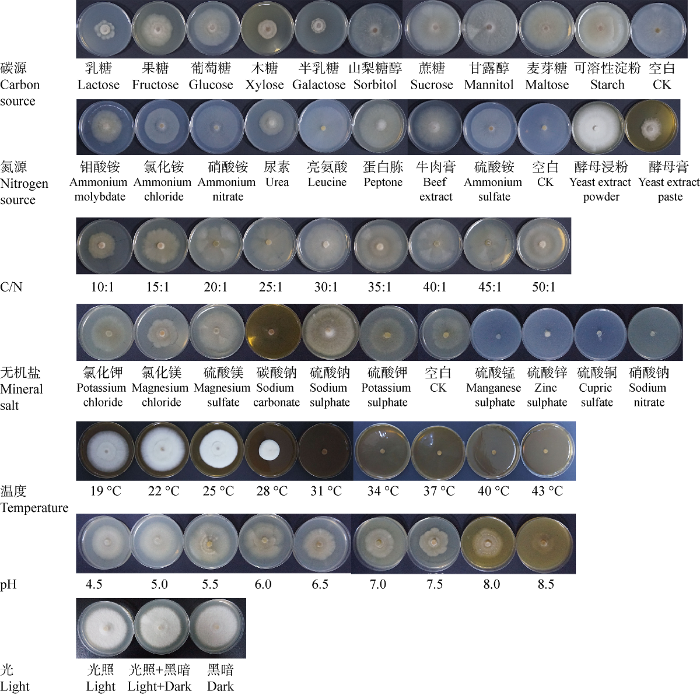
图1
不同培养条件对芳香杯伞菌丝生长的影响
Fig. 1
Effects of different culture condition on mycelial growth of Clitocybe fragrans.
以筛选的适宜芳香杯伞菌丝生长的碳源、氮源、C/N、无机盐为单因素,进行4因素3水平L9(34)正交试验(表2和表3)。不同正交配方对芳香杯伞菌丝菌落形态以及生长速度、菌丝干重影响差异较大,从极差R与r看出,菌丝生长速度各因素的影响顺序为D<C<A<B,菌丝生物量各因素的影响顺序为C<D<B<A (表3)。综合分析,适宜菌丝生长的最佳组合为A3B1C3D2,即7号培养基,在此配方下,芳香杯伞菌丝生长速度与菌丝体干重均极显著(P<0.01)高于其他组。据此分析适宜芳香杯伞的碳源为蔗糖、氮源为酵母浸粉、C/N为40:1、无机盐为硫酸镁。正交配方为:蔗糖17.3 g,酵母浸粉1.8 g,磷酸二氢钾3 g,无水硫酸镁1.5 g,琼脂20 g,水1 L。
表2 芳香杯伞培养基配方优化正交试验因素水平表
Table 2
| 水平 Level | 因素 Factor | |||
|---|---|---|---|---|
| 碳源 Carbon source | 氮源 Nitrogen source | C/N | 无机盐 Mineral salt | |
| 1 | 山梨糖醇Sorbitol | 酵母浸粉Yeast extract powder | 35:1 | 硫酸钠Sodium sulphate |
| 2 | 甘露醇Mannitol | 牛肉膏Beef extract | 30:1 | 硫酸镁Magnesium sulfate |
| 3 | 蔗糖Sucrose | 蛋白胨Peptone | 40:1 | 氯化钾Potassium chloride |
表3 芳香杯伞培养基配方优化正交试验结果
Table 3
| 试验号 Text number | A:碳源 Carbon source | B:氮源 Nitrogen source | C:C/N | D:无机盐 Mineral salt | 菌丝生长速度 Mycelial growth rate (mm/d) | 菌丝干重 Mycelial dry weight (g/d) |
|---|---|---|---|---|---|---|
| 1 | 1 | 1 | 1 | 1 | 0.96±0.03cd | 17.10±1.39c |
| 2 | 1 | 2 | 2 | 2 | 0.86±0.08cd | 12.93±0.39de |
| 3 | 1 | 3 | 3 | 3 | 0.55±0.02d | 9.50±0.21f |
| 4 | 2 | 1 | 2 | 3 | 0.9±0.04cd | 16.57±2.16c |
| 5 | 2 | 2 | 3 | 1 | 1.12±0.07bc | 11.50±0.35ef |
| 6 | 2 | 3 | 1 | 2 | 0.95±0.06cd | 10.90±0.32ef |
| 7 | 3 | 1 | 3 | 2 | 1.56±0.04a | 28.90±1.85a |
| 8 | 3 | 2 | 1 | 3 | 1.24±0.04b | 25.00±0.42b |
| 9 | 3 | 3 | 2 | 1 | 0.73±0.26d | 14.93±0.66cd |
| K1 | 0.790 | 1.140 | 1.050 | 0.937 | ||
| K2 | 0.990 | 1.073 | 0.830 | 1.123 | ||
| K3 | 1.177 | 0.743 | 1.077 | 0.897 | ||
| R | 0.387 | 0.397 | 0.247 | 0.226 | ||
| k1 | 13.177 | 20.857 | 17.667 | 14.510 | ||
| k2 | 12.990 | 16.477 | 14.810 | 17.577 | ||
| k3 | 22.943 | 11.777 | 16.633 | 17.023 | ||
| r | 9.953 | 9.080 | 2.857 | 3.067 |
注:数据为6次的平均值和标准差;Kn和kn分别代表n水平的菌丝平均生长速度和菌丝平均干重;R和r为该因素的极差
Note: The data were average value of six replicates; Kn and kn indicate the average of mycelial growth rate and mycelial dry weight respectively at n level. R and r are ranges.
2.2 芳香杯伞菌丝体生长环境条件
图2
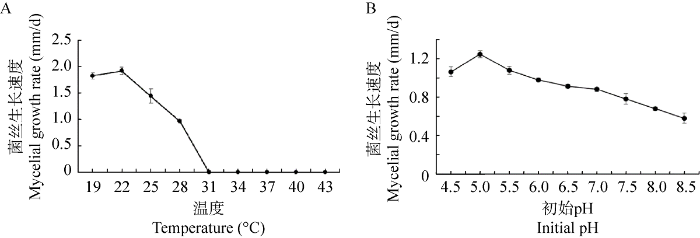
图2
不同温度和初始pH对芳香杯伞菌丝生长的影响
A:温度;B:初始pH
Fig. 2
Effects of different temperature and initial pH on the mycelial growth of Clitocybe fragrans.
A: Temperature; B: Initial pH.
不同光照条件处理下,菌丝体生长速度差异不大。但在黑暗处理下,菌丝生长速度及菌落形态略优于其他处理条件(图1)。
2.3 芳香杯伞菌种培养基
2.3.1 母种培养基
表4 不同培养基对芳香杯伞菌丝生长的影响
Table 4
| 培养基 Medium | 培养基名称 Medium name | 菌丝长势 Mycelial growth vigor | 生长速度 Mycelial growth rate (mm/d) | 显著性差异 Significance levels | |
|---|---|---|---|---|---|
| 0.05 | 0.01 | ||||
| 母种培养基 Stock culture media | A:PDA+木屑煮汁Boiled sawdust juice | +++ | 1.24±0.04 | de | CD |
| B:大豆饼粉培养基Soybean meal medium | +++ | 1.49±0.05 | c | B | |
| C:马铃薯蔗糖培养基Potato sucrose medium | +++ | 1.02±0.01 | f | EF | |
| D:CPDA | +++ | 1.26±0.10 | de | CD | |
| E:玉米粉培养基Corn flour medium | +++ | 1.79±0.07 | b | A | |
| F:牛粪煮汁培养基Boiled cow dung juice medium | ++ | 1.32±0.07 | d | BCD | |
| G:麦粒煮汁培养基Boiled wheat juice medium | ++ | 1.17±0.05 | e | DE | |
| H:粪草培养料培养基Compost substrate medium | ++ | 1.96±0.04 | a | A | |
| I:PDA+麸皮煮汁Boiled bran juice | ++ | 1.78±0.04 | b | A | |
| J:PDA | ++ | 1.38±0.04 | cd | BC | |
| K:正交配方Orthogonal formula | ++ | 0.97±0.05 | f | F | |
| 原种培养基 Mother spawn media | 高粱Sorghum | +++ | 2.44±0.02 | a | A |
| 玉米粒Corn | ++ | 1.34±0.07 | b | B | |
| 荞麦Buckwheat | + | 0.4±0.02 | d | D | |
| 小麦Wheat | ++ | 1.07±0.04 | c | C | |
| 小米Millet | ++ | 1.32±0.04 | b | B | |
图3
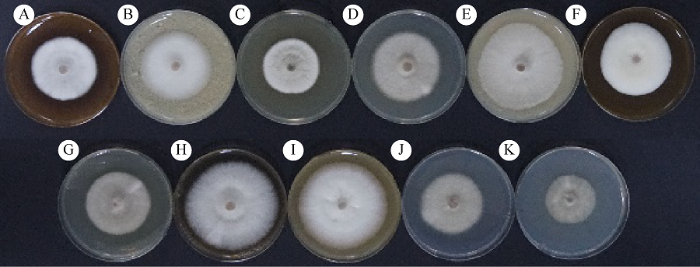
图3
不同培养基对芳香杯伞菌丝生长和菌落形态的影响
A-K:不同母种培养基
Fig. 3
Effects of different culture medium on the mycelial growth and colonial morphology of Clitocybe fragrans.
A-K: Different stock culture medium.
2.3.2 原种培养基
菌丝体在5种原种培养基上均可以正常生长,但是不同培养基上菌丝长势差异较大,在荞麦培养基上菌丝生长速度较慢,在小米粒培养基上菌丝较纤弱,浓密度较差(表4)。综合分析,选择菌丝洁白浓密,长势较好,且生长速度最快的高粱粒培养基作为芳香杯伞适宜原种培养基。
2.4 驯化栽培
原种接种后22 ℃暗培养,发菌时间为30-35 d。栽培袋接菌后,35-40 d满袋,后移入出菇房,芳香杯伞的原基发生时间较短,为8-10 d,经过7-8 d原基分化成子实体,子实体成熟时菌盖厚度0.25-0.41 cm,菌盖直径1.87-2.93 cm,菌盖向上翻折生长,呈倒伞状;菌盖边缘呈波浪形或圆形;菌盖颜色为白色;菌柄长度3.61-4.08 cm,菌柄中空,扁平;单菇重量范围为1.75-2.51 g,单个子实体重量较轻,菇质较软且易碎,子实体香味浓郁(图4)。
图4

图4
芳香杯伞驯化栽培
A:菌袋出菇;B:单个子实体形态
Fig. 4
The fruit bodies of Clitocybe fragrans obtained by domestic cultivation.
A: Fruiting in sack cultivation; B: Separate fruit body morphology.
3 讨论
芳香杯伞属于白蘑科,白蘑科中的杯伞属、口蘑属、香蘑属等很多野生种类均为优良野生蕈菌,但其人工驯化栽培一直是业界公认难题。而且杯伞属仅有大杯伞Clitocybe maxima和杯蕈Clitocybe infundibuliformis驯化成功,对于芳香杯伞国内外至今未见驯化栽培研究报道。
本研究对野生芳香杯伞菌种分离后,发现其菌丝生长缓慢、纤弱、长势较差,因此对其菌丝生长所需的营养条件进行了研究。芳香杯伞适宜的碳源为蔗糖、山梨糖醇和甘露醇。这与大杯伞的最适碳源是蔗糖相同,与白霜杯伞Clitocybe dealbata的最适碳源是葡萄糖不同。芳香杯伞适宜的氮源为酵母浸粉、牛肉膏和蛋白胨,均为有机氮源,该真菌更偏好有机氮源,可能是有机氮源更有利于菌丝的利用吸收。这与大杯伞最适氮源是尿素不同。不同蘑菇的营养需求不同,如白霜杯伞在无氮的情况下生长最好(冀瑞卿等2005;牛长满等2007)。菌丝体对不同无机盐利用差异较大,培养基中添加硫酸锰、硫酸锌、硫酸铜、硝酸钠菌丝均不生长,不生长的原因是无机盐的浓度不合适还是这4种无机盐的加入抑制了菌丝生长,有待设计试验验证。正交试验结果表明,硫酸镁为菌丝生长最适无机盐,其最适浓度有待进一步筛选确定。
芳香杯伞最适的母种培养基为粪草培养料培养基,可能因为芳香杯伞属于草腐菌,粪草培养料含有的营养物质更有利于菌丝吸收,因此粪草培养料培养基最适宜芳香杯伞菌丝生长;而在正交配方上菌丝生长较弱,可能因为正交配方的营养物质过于单一,而其他配方都添加了天然基质,所含营养丰富。
参考文献
A revised checklist of poisonous mushrooms in China
A revised checklist of medicinal fungi in China
A revised checklist of edible fungi in China
Taxonomy of Tricholoma and Clitocybe and related genera in Northeast of China
Cultural and physiological characters of 8 strains of toxic mushroom
Preliminary report on artificial domestication and cultivation techniques of Lepista sordida (Fr.) Sing
Biological characteristics and domestic cultivation of Agaricus subfloccosus
Studies on characteristics of Flammulina velutipes varieties and cultivation with different media
Studies on identification of macrofungi by ITS technique and domestication of 8 species of wild fungi
Biological characteristics and cultivation conditions of Pleurotus abieticola from Qilian Mountain, northwestern China
Major clades of Agaricales: a multilocus phylogenetic overview
DOI:10.1080/15572536.2006.11832627 URL [本文引用: 1]
Phylogenetic relationships of agaric fungi based on nuclear large subunit ribosomal DNA sequences

Phylogenetic relationships of mushrooms and their relatives within the order Agaricales were addressed by using nuclear large subunit ribosomal DNA sequences. Approximately 900 bases of the 5' end of the nucleus-encoded large subunit RNA gene were sequenced for 154 selected taxa representing most families within the Agaricales. Several phylogenetic methods were used, including weighted and equally weighted parsimony (MP), maximum likelihood (ML), and distance methods (NJ). The starting tree for branch swapping in the ML analyses was the tree with the highest ML score among previously produced MP and NJ trees. A high degree of consensus was observed between phylogenetic estimates obtained through MP and ML. NJ trees differed according to the distance model that was used; however, all NJ trees still supported most of the same terminal groupings as the MP and ML trees did. NJ trees were always significantly suboptimal when evaluated against the best MP and ML trees, by both parsimony and likelihood tests. Our analyses suggest that weighted MP and ML provide the best estimates of Agaricales phylogeny. Similar support was observed between bootstrapping and jackknifing methods for evaluation of tree robustness. Phylogenetic analyses revealed many groups of agaricoid fungi that are supported by moderate to high bootstrap or jackknife values or are consistent with morphology-based classification schemes. Analyses also support separate placement of the boletes and russules, which are basal to the main core group of gilled mushrooms (the Agaricineae of Singer). Examples of monophyletic groups include the families Amanitaceae, Coprinaceae (excluding Coprinus comatus and subfamily Panaeolideae), Agaricaceae (excluding the Cystodermateae), and Strophariaceae pro parte (Stropharia, Pholiota, and Hypholoma); the mycorrhizal species of Tricholoma (including Leucopaxillus, also mycorrhizal); Mycena and Resinomycena; Termitomyces, Podabrella, and Lyophyllum; and Pleurotus with Hohenbuehelia. Several groups revealed by these data to be nonmonophyletic include the families Tricholomataceae, Cortinariaceae, and Hygrophoraceae and the genera Clitocybe, Omphalina, and Marasmius. This study provides a framework for future systematics studies in the Agaricales and suggestions for analyzing large molecular data sets.
One hundred and seventeen clades of euagarics
Study on nutrient formula of mother culture medium of Clitocybe maxima
Chinese edible fungi species of domestication and introduction
Survey on introduction and domestication of Chinese wild edible fungi in recent 20 years
A checklist of Clitocybe s.l. in China
Domestication of Clitocybe gigantea
Key points of cultivation techniques of Clitocybe maxima
Casing soil cultivation of Clitocybe maxima in bag
Domestic cultivation of Clitocybe infundibuliformis
Effects of cultivation temperature on Auricularia auricula-judae mycelial growth and fruit body development
Biological characteristics and cultivation of Auricularia fibrillifera